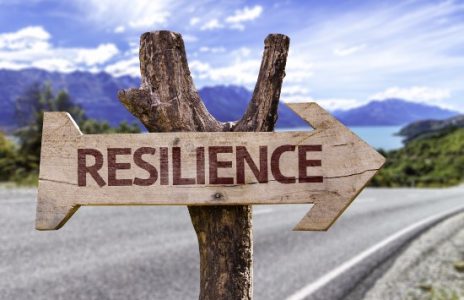
Five Pillars of Community Resilience

Optimism is a strategy for making a better future. Because unless you believe that the future can be better, you are unlikely to step up and take responsibility for making it so.

Noam Chomsky

The other week, Claire Rubin sent me a link to an article from Beaumont resilience training – Here’s How to Use Resilience to Move out of Your Comfort Zone. The author – Laura Ponting – focuses on the personal growth of the individual, but her “five pillars” seem to fit well with my own conception of community resilience as a springboard for growth – development or strengthening – of a community, i.e., for making a community more Future-fit.

I apologize to Ms Ponting – I’m reorganizing her order to suit my [sometimes – often?] warped logic. I’ve also taken some of her words out of context, to help make my points. I’m also couching this in terms of systems; after all, communities are first and foremost complex adaptive systems (CASs). I’ll also use the Seven Community Capitals as a way to clarify some of my points.

First Pillar: Purpose. Future-fitness – growing in strength and capability – requires not just action, but purposeful action. Action — to strengthen the individual or the community. Since a community is only successful if it provides the quality of life its members want, the purpose of becoming more resilient is to safeguard that quality of life, and to improve it if possible. This is often called a vision; the community’s conception of what that stronger community will be. The community as a whole has to buy into that vision, or else it is likely that it won’t be realized.

In particular, this requires cultural capital. A common language to describe and understand that future state. A common self-confidence that breeds optimism. As Chomsky implies, without that confidence and the optimism it engenders, the community won’t work together to achieve it.

Second Pillar: Self-awareness. “Know Thyself” is not just an inscription on a Greek temple; it is the zero-th step for any community plan. For the community as a system, self-awareness means knowing who its members are. It means knowing how they are connected – or not. It means knowing the “balances” in each of its capital accounts, and the constraints or limits on the use of each capital. Most importantly, it means that the community’s leaders know how to make decisions and take action (human and institutional capital).

Third Pillar: Mindfulness. “Mindfulness” for a community equates to situational awareness. Communities as systems are in dynamic environments, with trajectories conditioned by both internal and external forces. “Mindful” communities recognize not only where they’re headed, but the forces that are driving them. The fine people at ResOrgs in NZ consider situational awareness one of the four enablers of effective crisis strategic planning.

Situational awareness rests on the community’s social capital. It requires “ears to the ground” within the community to gauge the community’s mood and its ability to move. Situational awareness also requires linchpins keenly tuned in to sources of information outside the community. They can warn the community about new sources of stress and alert the community to unexpected opportunities.

Fourth Pillar: Self-care. As individuals, we know we have to take care of ourselves. We exercise (well, some of us do). We have physicals to tell us whether we’re overweight, have high blood pressure, are pre-diabetic or any of the other warning signs the doctor looks for. And if we’re wise, we take action to avoid further damage to our vitality.

The same holds true for our communities. We know that if we fail to maintain our homes or our physical and natural infrastructure, they may be damaged in a severe storm, or even collapse from neglect. But the same holds true for our “softer” infrastructures.
• our community’s culture that, at its best, brings us together and gives us the confidence to act;
• our community’s social networks that enable us to communicate with each other, and – in times of crisis – tell us where resources are needed;
• our community’s economy that provides us with the financial capital to take action.

And just as we as individuals have physicals to point out where action is indicated to strengthen us, so too should we in our communities be aware of those signs that point out that action is needed. More frequent maintenance of physical systems, rising crime, a fraying social fabric, or growing poverty each are indicative of the need for “self-care” for our communities.

Fifth Pillar: Positive relationships. Ms Ponting couches this in terms of finding people to support us, esp. as we strive to better ourselves. The same holds true – in spades – for communities. It is simply a reflection of the economy of scale. The more resources we can bring together, the more we can do. If we work smartly (after all, two heads are better than one) we can make our communities more functional and better places to live for all of us.

But there are also traps for the unwary in this. First, “working smartly.” If we let ideology overrule reality, in other words if we don’t couple Purpose and Mindfulness/Situational Awareness, then we may actually harm our community. The debacles that so many of our big cities have become – crime, filth in the streets, the ugliness of the hopeless homeless – are monuments to failed ideologies not rooted in reality.

The second trap seems to be endemic in our age of “engagement.” Even the best of ideas can die the death of a thousand cuts in a committee. When egos are engaged, everyone wants to see a little of themselves in what’s done. That leads to inefficiencies and sometimes even alters the idea so much that it no longer supports the Purpose.

A third trap is the difficulty in overcoming the distrust and mistrust that seems to be endemic in our not-so-civil civil life. It sometimes seems that no one has the authority to act but everyone has veto power over any action. Relationships ultimately are grounded in trust. In our age, however, Trust has become a rare commodity. Thus, building positive relationships particularly in our polarized polity is not for the faint of heart.

Five Pillars for strengthening us as individuals; Five Pillars to move our communities toward a better and more secure future. That should be our Purpose. Achieving the Purpose has to be grounded in self- and situational-awareness, so we can set a realistic path from today to that better tomorrow. As we advance upon that path we must maintain those strengths we rely on to move forward – self-care. And if we can find willing partners to support us, these positive relationships can help us to advance more rapidly.

Our Declaration of Independence

We hold these truths to be self-evident, that all men are created equal, that they are endowed by their Creator with certain unalienable Rights, that among these are Life, Liberty and the pursuit of Happiness. –

Declaration of Independence

This week the US celebrates its founding. The date chosen commemorates the signing of our Declaration of Independence from Great Britain. This document is arguably the most important written in the English language in the last 250 years. Its ringing words sparked our own and the French revolutions. It voiced the aspirations of the voiceless around the world yearning for a better life.

And let there be no mistake – it is truly an aspirational document. It articulates a vision of what our nation should be. Our Founding Fathers were all too aware that government formed by Man cannot be perfect; our Constitution with its checks and balances is their attempt to protect our “inalienable rights.” I believe all of them recognized their society’s failings; Slavery – America’s original sin – chief among them. Three quarters of a million died as part of our national penance to expiate and exterminate this sin. The Declaration and the Constitution established an aspirational culture in our country that continues to be a magnet attracting those from other countries who want to have a piece of the American Dream.

However, we now live in a world in which many Americans are questioning those aspirations and would have us deem the American Dream a nightmare. Some want to subvert our aspirational culture and deny the importance of the rights so many have sought and so many have fought to ensure.

This battle of conflicting visions of our future is being fought at the national level, in our state capitals, and in our communities. It has profound implications for our resilience at each of these levels. And while Jefferson, Franklin, Adams, Livingston and Sherman didn’t use that term, I think it’s important to examine the impact of the Declaration on our resilience.

First and foremost, the Declaration is about “Rights.” In our highly polarized politics at the national level, both sides claim to be for “Freedom,” although they seem to be worlds apart in what they think Freedom is. To me, our Bill of Rights – inspired by the Declaration – lays out an excellent definition of our Rights, especially in the First Amendment. We must be free to believe as we wish and to express those beliefs. We must be free to peaceably assemble. In the Constitution, these are couched in terms of prohibiting the federal government from denying these rights. But it is just as important that we recognize that no individual or group has the right to abridge those freedoms either. “Cancel culture” does not exist in a society that values freedom.

But – in more subtle ways – the Declaration also speaks to Freedom’s homely twin – Responsibility. In the Declaration, the Founding Fathers talk about the duty of the people to “take arms against a sea of troubles, and by opposing end them” (to wax Shakespearean). The Declaration also states that the colonists have reached out to their fellow citizens in Great Britain, implying a responsibility of citizens to support each other.

This theme is also hidden in the famous phrase “Life, liberty and the pursuit of happiness.” This was originally the more prosaic “Life, liberty and property” borrowed from John Locke. Jefferson changed this based on another of Locke’s essays in which the pursuit of happiness is seen as the antithesis of today’s “don’t think twice, it’s all right” culture. Rather, in Locke’s (and apparently Jefferson’s) view, the pursuit of happiness was not chasing whatever “feels good now,” but rather thinking in terms of what is best overall. In other words, seeking the timeless rather than the timely. In the Federalist papers, both Madison and Hamilton referred to this as social happiness.

Today, many question the Declaration and its worth. They assert that the Founding Fathers’ conceptions were necessarily corrupted by their owning of slaves. They assert that so much has happened – so much more has been learned since then that these simple principles should be effectively abandoned. But what they fail to realize is that the Declaration is indeed timeless; that the flawed men who wrote it were all too aware of their own flaws. Those who would modify the Rights the Declaration so powerfully asserts ignore the role that these words played in bringing an end to slavery. The role that they played in the French Revolution. The role they more recently played in the UN’s Charter. The role these words continue to play in drawing immigrants to America so that they can pursue their dreams, so that they can create and pursue their own happiness. Calvin Coolidge said it well:

If all men are created equal, that is final. If they are endowed with inalienable rights, that is final. If governments derive their just powers from the consent of the governed, that is final. No advance, no progress can be made beyond these propositions. If anyone wishes to deny their truth or their soundness, the only direction in which he can proceed historically is not forward, but backward … Those who wish to proceed in that direction can not lay claim to progress. They are reactionary. Their ideas are not more modern, but more ancient, than those of the Revolutionary fathers.

Only free men and women can take purposeful action to better themselves and their families, whether in adversity or in good times. Only free men and women can truly be resilient. Our Declaration is the fundamental statement of both the Rights and Responsibilities of that freedom. It is thus the basis – the foundation – of our resilience.

Memorial Day 2023

we take increased devotion to that cause for which they gave the last full measure of devotion

Abraham Lincoln

This past weekend we remembered those who died in service to our country. For them, Duty, Honor, Country was more than a phrase, it became the visceral reality they lived and died for. They understood the concepts of Duty to guard the ideal of Freedom, of Honor in doing that duty, and of devotion to Country. 

After Viet Nam, we as a country decided that we would move from a military based on the draft to an all-volunteer service. This resulted in an Army that was able to transform itself into a much more capable fighting force after the debacle that was Viet Nam. However, it meant that our youth no longer had to serve, but rather only if they chose to do so.

I don’t think it’s a coincidence that since then we have drifted toward a “me-centric” society. This “multi-culture” requires no Duty, has no concept of Honor and is at best indifferent to its Country. In my youth (as best I can remember it!), the idea of a Trump or a Biden as our President would have been unthinkable. In our media we had men and women who had actually lived on the frontlines, seen soldiers die, who knew what Duty, Honor, Country actually meant. We had leaders who had served, and whose leadership had been literally honed under fire. These honorable men and women stood above party to do the right things for their country.

Those who haven’t served have no conception of service to something greater than themselves. Those who have never seen the great good that our country has striven for here and abroad cannot truly appreciate our country until they contrast it against foreign societies (Brittany Griner’s epiphany is a good case in point). We cannot “get our Country back” until we – all of us – rediscover the importance of that cause that so many have died for.

One might think that these are idealistic concepts, of no practical importance. But they are, even – perhaps especially – at the community level. We see rising crime, a widening partisan divide – a chasm!, leaders who are pushed forward by their “followers,” citizens lacking trust in their governments because they sense that their governments don’t trust them, and decreasing life expectancies especially among those who have lost all hope. 

And yet … And yet, even in the kaleidoscope of our current dysfunction, I see glimmers of hope. I see parents starting to speak up for their kids’ education and taking back responsibility for their upbringing. I see business owners starting to pressure their city councils to take back their downtowns from the thugs and the druggies. I see people voting with their pocketbooks against businesses that seem to have forgotten who their customers are. 

Yes, these growing pains can be messy; yes, they sometimes are downright ugly. But ultimately, my hope is that this reawakening of responsibility will lead to greater civic engagement. That we will all eventually realize the importance of community, of serving something greater than ourselves. And in doing that, we will have rediscovered Duty, Honor Country. And if we can, we will pay the greatest possible tribute to those who “gave the last full measure of devotion.”

Embracing Complexity

… actually a complex, adaptive system (CAS) which is constantly evolving, never in equilibrium.

Wiliam White


William White has been called the “Central Banker for Central Bankers.” I first became aware of him when I read the transcript of a speech he gave in Philadelphia. His understanding of practical macroeconomics is probably second to none.

Many of his writings in the last few years have been focused on the global economy as a complex adaptive system (CAS). However, his insights apply just as well to communities as economies. As some of you know, I’m hip deep in a book-writing project on systems thinking for community professionals. One of its themes is that communities are CASs, and have to be understood as such. What distinguishes “complex” from the merely (!) complicated is that the system’s behavior can’t be predicted from that of its parts. CASs web of interdependencies and their open-ness mean that their behavior can be spectacularly non-linear. CASs – as their name implies – also have the ability to adapt. They can change their structure and thus their behavior in response to stress.

In the following, I’ve provided excerpts from White’s “Simple Lessons for Macro Policymakers from Embracing Complexity,” and suggested what they mean for community leaders.

Policymakers’ multiple objectives make trade-offs inevitable. Ultimately, the job of a community leader is to provide their community’s residents with the quality of life they want. Without infinite resources community leaders must make choices – balancing priorities.


Policymakers can affect structure, and structure matters. As I’ve posted previously, “Form Follows Function.” But the converse is true, as well. Changing “form” – how the community is wired – leads to changes in what the community can do. When some new problem arises, one of the knee-jerk reactions of community leaders is to add a new organization to deal specifically with the problem. Unfortunately, that makes the community as a CAS more complex, and even less predictable. Whether recognized or not, this creates new interdependencies and a high likelihood of unintended consequences. This is what I see when I look at a city like New Orleans where it seems that no one is responsible anything but everyone has veto power over everything.


Policymakers should minimax not maximize. When we want to introduce new policies (e.g., “Defund the Police”) we need to think in terms of the Hippocratic Oath: First, do no harm. We can’t predict how a system may adapt to a change, but we can foresee negative ways it may do so. Community leaders need to find ways to protect against them.


Policymakers should act more symmetrically. Simply put, avoid both the high highs and the low lows. Build up rainy day funds in good times to tide the community over in bad times.


Policymakers should expect the unexpected. Stress can come from the darndest places. And its impacts can resonate throughout the community’s web of interdependencies.


Policymakers should focus on systemic risks more than triggers. Quite simply, “follow the trend lines not the headlines.” Rather than trying to guard the community against every possible stressor, focus on inoculating the community against changes in its environment, loss of community capital, changes in demand for its common functions, new constraints imposed by state or federal governments, and, of course, against entropy – the ravages of time.


Policymakers should be guided by multiple indicators. Communities adapt by a “Learn-Plan-Do” process. An important part of learning is gathering information about potential stresses. Since there are many sources of stress, community leaders need several ways to look for them.


Policymakers can’t forecast. Community leaders are as unlikely to accurately predict the future as economists. What they can do, however, is to use trends to develop scenarios of what the future might be, and then shape their communities to be Future Fit.


Policymakers should be prepared for breakdowns. Crises are built into the DNA of a CAS and a community. Communities in which leaders work through various scenarios to minimize pain and eliminate suffering are the ones which are truly resilient. It’s not so much that they develop specific plans to deal with each scenario but that they build the collective experience of working together for the community. This is cultural capital of the highest order!


No policymaker is an island. In the modern world, every community is connected to others. Every community is embedded in a state or province, and that in a nation. Every community is made up of neighborhoods and other community systems, many of which are also complex. Ultimately, each of these is a group of people bound together for a common purpose. Thus, when community leaders take action in their community – hopefully to improve it! – the impacts may be felt in their residents’ homes, in neighboring communities, and up to the halls of government. Thus, evaluation should be part of action, especially looking for unintended consequences.


A community’s resilience resides in its ability to adapt – both to the stresses inherent in its connections to the rest of the world and to the Wild Things it faces – those extreme events that can permanently alter a community’s quality of life. White’s “Lessons” make the point that communities as CASs may be unpredictable, but that policymakers – community leaders – can devise means to see where the community is going, and to influence the outcome. Ultimately White’s most important lesson is for community leaders to embrace the complexity of their communities. His “Lessons” provide community leaders with a practical playbook they can use to build their communities’ adaptive capacity and to make their communities more resilient.

Trend lines

Follow the trend lines, not the headlines.

Bill Clinton

Advice as applicable to communities as to Presidents. Following the headlines tells us of disasters that have happened; following a trend – a trajectory – can alert us to disasters – and opportunities – to come.

Almost every community has some sort of plan for its future. Too often, those plans are predicated on a hoped-for future, and formulated without following the trend lines. It is far better to start with “What will our world look like in X or Y years?” Far better to acknowledge the trends, to consider a variety of scenarios reflecting their interplay, and then to aim for a future that mitigates the downside and maximizes the chances to thrive.

Almost exactly three years ago, I wrote a piece about our current decade – the Roaring Twenties. I highlighted trends that I thought would profoundly impact the evolution of communities this decade (and a bit beyond).
• The continuing culture clash;
• The dwindling influence of the Baby Boomers;
• Low interest rates punishing savers (esp. the elderly) and exacerbating the rich-poor divide;
• Business consolidation;
• Youth unemployment; and
• The accelerating pace of change itself.

The pandemic was a disaster most of us lived through. It was a shock wave that reinforced almost all of the trends I cited. The culture clash between individualists and collectivists has gotten worse. Baby Boomers have left the workforce in increasing numbers. While interest rates have risen, they are still less than the rate of inflation – the value of savings continues to fall and it is still more difficult for the poor to accumulate wealth. Youth unemployment has not been solved (and, as I discuss below, there are other trends affecting our kids). And the pace of change continues its dizzying acceleration.

However, the pandemic shock wave – the compound of the pandemic itself and our responses to it – has also brought to the fore other trends that will shape our communities’ futures. An especially concerning trend is the increasing social isolation across society. According to a recent Pew Foundation study, on average the time we spend with friends dropped by about half a day compared with 2012, as did the time we spend with acquaintances. On average we spend the equivalent of a day more a week alone. Who will we turn to in times of crisis?

There have been several articles pointing out how few of us have sufficient savings to meet a crisis. It is just as true for social as financial capital – other people are crucial resources in times of trouble. Fewer resources imply slower [or no] recovery. And less resilient people mean less resilient communities relying on resources they may not have.

And whether alone or even when out with friends and family, too many of us have our noses buried in our phones. We tune into the echo chambers fostered by social media, telling us that the Reds [or the Blues, depending on the hue of our personal echo chambers] are evil degenerates beneath contempt. This reinforces a lack of trust in our institutions and ourselves.

Sadly, too many of our community leaders seem bewildered by parents who want to have a say in what’s being taught their kids. Bewildered by parents who believe that parents must have a say in life-altering “transitions” of their kids. Bewildered by a public who believe that denying opportunities to Asians is really racism. Bewildered by a public who bemoan the growth of a “culture” that seems to have turned its back on accountability. Bewildered by a public that believes crimes should be punished, and that the police are all that stands between them and the barbarism of the mean streets.

Many of our youth are the unfortunate victims of these trends. Over the last ten years, emergency room visits for acts of self-harm by young women have gone up almost a factor of five; the rate for young men has almost doubled. Kids with “Progressive” parents – esp. young women – have fared even worse. Our kids are living in our houses longer and marrying later than in previous decades. There really aren’t any jobs in our inner cities for kids who can’t read or write.

And we know that our poor response to the pandemic only made things worse. Too many kids in public schools not only lost learning time, but some, I fear, will have to learn how to learn again. We know that the masking of young kids slowed the development of their social skills. While we have poured money into our inner city schools, we also find that in Chicago, for example, not one student – not one – in 55 schools (about 10% of the total) can read or do arithmetic at grade level. In Baltimore, Philadelphia and DC less than one in four students can read or do math at grade level. And way too many are functionally illiterate.

And it’s not only the mega-cities like Chicago, Baltimore, Philadelphia or DC. In Schenectady, NY, only 4% of black students passed the state’s math test this year. Overwhelmingly this hits boys – esp. African-American boys – the hardest. Much more than girls, they fall by the wayside on their way through school. As a result, young men make up only 40% of incoming college classes (with disproportionately fewer blacks), and even fewer make it through to a degree. Too many of our kids are the real losers of the political games being played around our schools. Our often dysfunctional education system’s recovery from this loss of learning will be a true measure of its resilience. I fear that communities will be dealing with the aftershocks of this for decades.

The restructuring of the global economy is another trend accelerated by the pandemic. Companies are edging away form indiscriminate off-shoring; they’re looking to locate facilities in more stable environments and to shorten supply chains. There is a much greater emphasis on resilience over efficiency. More future-fit communities will find ways take advantage of this and seize the opportunities inherent in this restructuring.

The pandemic also led to a wave of early retirements which revealed another facet of this restructuring. Prior to the pandemic, there were five people unemployed for every job opening. Last year, there were two job openings for every person unemployed. This opens the door to greater automation and to the use of AI techniques to augment the workforce.

For most of my life, the economy could be characterized as goods looking for buyers, i.e., excess supply. We’re now in a position of buyers looking for goods, i.e., excess demand. This drives inflation. We also have excessive spending and a political tug of war that is likely to lead to recession and significant economic volatility. Really hard on those with fixed incomes!

Finally, we are at the leading edge of an energy crisis in many parts of our country, caused by our ill-considered rush to renewables and unreasoneing refusal to use fossil fuels. This crisis has already hit Europe in the form of “energy poverty,” where many can’t afford the electricity we take for granted. Or, some of us take for granted. As is true for so many trends, California is at the “forefront,” with brownouts and rolling blackouts periodically occurring.

Don’t get me wrong – I’m not against renewables. But our governments’ approach to integrating them into our power systems is something like

  1. Mandate a date when all our electricity comes from renewables (ignoring the coupling of these mandates to economics, power system reliability, …);
  2. Shut down other sources of electric power – nuclear, and fossil fuels;
  3. Further mandate that we won’t build any more cars fueled by petroleum, thus increasing our demand for electricity (ignoring the need to develop a charging infrastructure); and then,
  4. Expect three miracles to occur:
    (1) We will somehow find the materials necessary for all of the electric vehicles and wind turbines and photovoltaic systems;
    (2) We will somehow find the engineers and scientists to make this transition work; and
    (3) Our power engineers will find ways to reliably provide electricity from all of these inherently intermittent energy sources.

Good intentions are not a plan. If we are going to shift to renewables we need to lay out a realistic path toward that aim. One that recognizes that we need stable baseload power. If that means batteries to store power from solar and wind, then we shouldn’t shut down our nuclear plants nor our fossil plants until affordable storage systems are available (as California has done). We must also recognize that we likely will need to install something like 20,000% more battery storage than we currently have. Just in California!

Elon Musk installed a single 100MW/128MWh battery for $100,000,000. The city of San Francisco would require seven of those to provide power for a week. Where would that money come from?

In developing that path, we also need to consider the destination. Renewables require large amounts of metals. The world’s known reserves of copper are only 20% of what’s needed to make renewables work. The known reserves of lithium and nickel (e.g., for batteries) are only 10% of what’s needed. The known reserves of cobalt and vanadium are only about 3.5% of what’s needed. Where are the minerals and the mines for all of these metals? Is it even realistic to think we can completely “go electric?”

Future-fit communities will carefully plan this transition, while keeping a sharp eye on the evolution of technology. Right now, the capital cost of battery storage for New York City is 200X greater than the cost of a comparable diesel system. I fully expect that to change, but no one can predict when. It is foolish to expect that the relative cost will decline enough to satisfy some politically-motivated mandate.

Sadly, many communities will be swamped by these trends, but future-fit communities will take purposeful action to transcend their tyranny. They will carefully set reachable goals, and develop practical plans to reach them. They will maintain keen situational awareness, so that they can alter those plans as the future unfolds. They will follow the trend lines, not the headlines, to a better Future.

+++++++++++

I blundered across this essay over the weekend. It effectively identifies an important destination; but purposeful action is needed to get there.
https://blog.joelonsdale.com/p/to-save-america-restore-our-frontier

Form Follows Function, Except …

Whether it be the sweeping eagle in his flight, or the open apple-blossom, the toiling work-horse, the blithe swan, the branching oak, the winding stream at its base, the drifting clouds, over all the coursing sun, form ever follows function, and this is the law.

Louis Sullivan

We’ve all heard the old rubric, “Form follows function,” apparently first coined by Sullivan discussing the design of large buildings.  But it is just as true of our bureaucracies.  As I’ve ranted discussed in a previous post (see Bureaucracy and Community Resilience), “bureaucracies exist to carry out routine functions efficiently and in a consistent manner.”

What I didn’t say (and probably should have!) is that bureaucracies usually are tuned to be efficient under normal conditions.  Thus, the bureaucracy’s structure – its form – reflects business as usual.  The bureaucracy works because its structure is consistent with the tasks it must perform.

Sullivan goes on to say, “Where function does not change, form does not change.”  But what happens when a bureaucracy is faced with a significant change in its working environment – during a crisis, for example – that forces changes in how it functions?

The short answer, of course, is that it tries to handle the unusual in its usual manner.  Its organizational structure – the bureaucracy’s form, hopefully well-tuned to normal conditions – now governs its functioning.  If the organization’s form does not change, then its ability to function efficiently and consistently may well suffer.  On the other hand, if the bureaucracy adapts quickly to the new set of conditions, it may find an opportunity in change to reach a higher level of performance.

Let me look at some very disparate examples to illustrate this.  Hurricane Katrina had a major impact on the forest enterprise in the impacted regions (esp. in lower Mississippi).  In the most affected areas, 40% of the forests were damaged.  According to the Forest Service, the downed or damaged timber could have produced 800,000 single family homes and 25 million tons of paper products.  The EPA and Mississippi’s Department of Environmental Quality had no plans for dealing with this massive amount of solid debris.  It took several months before the owners of downed timber could gain permits for wet storage areas to preserve their timber, primarily because the regulators involved did not change their bureaucratic structures (and thus not their processes) to deal with this unusual situation.  While the permit process was expedited, this was accomplished by simply adding more people, not through restructuring to better handle the problem.  As a result, over half of the timber was lost with major repercussions on the entire forest products enterprise.  In addition, the downed timber led to a situation in which there was literally a new forest fire in Mississippi every day during the spring, summer and fall of the following year.  In short, regulatory functions were dictated by organizational structures tuned to “normal” circumstances; i.e., form dictated function, and resulted in poor performance.  Unfortunately, the regulators have not really learned anything from this – in the face of another Katrina, it would still take months before storage sites for downed timber would obtain permits.

Waffle House provides a very different example.  It plans for surprises, and is organized so that it can function under almost any set of circumstances.  It clearly has learned from past experience and has adapted itself so that restaurants impacted by disasters can open with restricted menus.  If workers can’t get to a Waffle House location (as happened to my community in January, 2014, because of an ice storm), workers can be temporarily brought in from other locations to minimize service interruptions.

WalMart provides an excellent example of finding opportunity in change.  In the ‘90’s, virtually every corporation in America spent huge amounts on information technology.  For most companies, the gains in productivity (i.e., the return on investment) were modest.  However, WalMart used this technological change to reorganize its supply chains so that it quickly gained a tremendous competitive advantage.  In other words, it altered its form to improve functioning.

Form follows function, except when changing circumstances demand changes in how an organization functions.  In the earlier blog on bureaucracies, I pointed out the factors that determine how rapidly an organization can change:  its history, its age, its ability to collaborate, its ability to innovate, and, most importantly, its leadership.  The resilience of an organization, or a community, is manifested in how rapidly it adapts – how quickly it changes its form – so that it can function effectively in a new environment.

Bureaucracy and Community Resilience

The purpose of bureaucracy is to compensate for incompetence and lack of vision.

Jim Collins

Bureaucracies are inherently anti-democratic. Bureaucrats derive their power from their position in the structure, not from their relations with the people they are supposed to serve. The people are not masters of the bureaucracy, but its clients.

Alan Keyes

I’ve had way too much experience with bureaucracies in my almost fifty years working with the federal government.  In the next couple of blogs, I’ll be looking at bureaucracy through the lens of community resilience.

First, a word of disclaimer.  My view of bureaucracy is well summarized in some of Moore’s laws of bureaucracy:

  • Bureaucracies have no heart.
  • Bureaucracies are perverse.
  • Bureaucracies will thrash about, causing much cost, pain and destruction.

If I (and so many others) feel this way, why do we still have bureaucracies?  There are two reasons for this that more or less mirror the quotes above.

  1. Most importantly, bureaucracies exist to carry out routine functions efficiently and in a consistent manner – bureaucracies are the wheels that keep organizations (governments, businesses…) running more or less smoothly.  But this also implies a more fundamental role for bureaucracies.  Their rules, regulations, and procedures encapsulate the organization’s corporate memory of what works, at least within a bureaucracy’s domain.  However, the more rigid this procedural structure, the more resistant the bureaucracy is to change.
  2. Bureaucracies tend to be self-perpetuating.  As formulated in Jerry Pournelle’s Iron Law of Bureaucracy:  In any bureaucracy, the people devoted to the benefit of the bureaucracy itself always get in control and those dedicated to the goals the bureaucracy is supposed to accomplish have less and less influence, and sometimes are eliminated entirely.  In other words, in any bureaucratic organization there will be two kinds of people: those who work to further the actual goals of the organization, and those who work for the organization itself. Examples in education would be teachers who work and sacrifice to teach children, vs. union representatives who work to protect any teacher including the most incompetent. The Iron Law states that in all cases, the second type of person will always gain control of the organization, and will always write the rules under which the organization functions.

Larger organizations – and communities – tend to be more bureaucratic because they tend to do more things on a routine basis. All too often, however, their bureaucracies are rigid and resistant to change. But resilience is all about managing and adapting to change.  Achieving resilience thus means tearing down the walls between balkanized bureaucracies that are busily making their silos into fortresses.  This leads to a paradox:  if a community is working to become more resilient, it will try to take action through its tried and proven bureaucratic channels, the ones least prone to change.  Further, since adapting to major disruptions (e.g., pandemics, recessions) generally does not neatly fit into a single bureaucracy’s purview, it forces bureaucracies to interact with one another in non-routine ways.  If the community’s bureaucracies are flexible, the community is likely to be more resilient; if not, any efforts to enhance the community’s resilience become much more difficult. 

Of course, these are general thoughts.  However, they lead to some specific things to consider in determining whether a community’s bureaucracies will help or hinder efforts to become more resilient.

  • History.  If a bureaucracy is a sort of corporate memory container, then look at the challenges the community, esp. the bureaucracy, has faced.  Were they varied?  Were some of them relatively recent?  Were they successfully met?  “No” answers may indicate that the bureaucracy is too rigid.
  • The age of the bureaucracy.  Just like people, a bureaucracy can get “hardening of the arteries” with age.  It can accrete documentation requirements, for example, that continue on long after the need for a document has disappeared.  In a crisis, these will sow frustration in both the public and the bureaucracy and slow down recovery.
  • Collaboration.  Has the bureaucracy worked with others outside their domain to solve crosscutting problems?  City governments such as San Diego and Baltimore that are managed in a fashion that forces bureaucracies to work together toward common crosscutting goals are likely to be more resilient than ones that are managed in a more stovepiped manner.
  • Leadership.  Is the leadership of the bureaucracy open to new ideas?  Does the leadership have experience working outside the bureaucracy?  Has any of the leadership come from outside the bureaucracy?  Again, “No” answers raise red flags.
  • Innovation.  Has the bureaucracy periodically changed how it does business?  Is continuous improvement a part of its culture?
  • Number.  More bureaucracies imply more organizations that must be aligned to actually make something happen.
  • Accountability. Do community leaders hold their bureaucrats accountable for how they have served the people?

Bureaucracy can be a boon or a bane to community resilience. It’s up to the community – through its leaders – to determine which it is to be.

Community culture and community resilience

Culture outperforms strategy every time; culture with strategy is unbeatable.

Quint Studer

A community’s culture is one of the most overlooked – and misunderstood – contributors to its future fitness. A community’s culture is primarily its history – not the one in books but the one embedded in its mind, its heart and its soul. A community’s culture shapes its shared values, and how its residents expect each other to behave. It thus conditions how a community approaches its problems, and whether the community can even recognize its problems.

A community’s culture is related to but different from its social capital. A community’s social capital resides in its connections – how the community is wired, and how effectively those wires enable the community to share information. A community’s culture conditions which connections are made, how messages are framed and even which information is shared. Thus, a community’s culture is a sort of skeleton supporting its social connection and directing where they form.

One of the ways that a community’s culture is manifested is in whether or not the community has a “can-do” attitude. Some time ago, I read an interview of the CEO of Fluor, focusing on his move of the giant construction company from California to Texas.

[When the 2006 move became known] “California made no attempt to keep us… things started to happen quickly [in Texas], without us initiating them. The Irving Chamber of Commerce did orientation sessions for employees and spouses, even helping with new-house searches. Or ‘little things:’ Irving on its own renamed a street Fluor Drive, which in California or the Northeast would be laughable.

This sort of attitude implies a community self-confidence that results in decisive action.

A community’s culture also reveals itself in how – whether – it recognizes its problems. When working with the Navajos, one of the striking features of their culture is the implicit prohibition against talking about bad things that might happen. This was based on the fear that talking about them would lead to them occurring. This sort of “whistling in the dark” makes it very difficult to prepare for or mitigate against disaster.

So how do I know whether my community has a culture that makes it future fit, that makes it resilient? There are several signposts.

First and foremost, the trajectory of the community. If the community’s quality of life is improving, that’s a sign of a proactive culture, indicating a self-confident community. If the community’s quality of life is deteriorating, the community is going to become less confident and less able to tackle its problems. Its future fitness is questionable.

Next, the unity of purpose within the community. As Paolo Freire has said: One cannot expect positive results from an educational or political action program which fails to respect the particular view of the world held by the people. Thus, if a community’s leaders are pushing programs that negatively impact a large swath of the community – that, in fact, are counter to their cultural values – the community has a culture that is in conflict with itself. It cannot confidently attack its problems. In fact, it may not even address them until they balloon into a crisis.

Then consider how tolerant the community’s culture is. As Joel Salatin says: The stronger a culture, the less it fears the radical fringe. The more paranoid and precarious a culture, the less tolerance it offers. If one part of a community refuses to let other – different – voices be heard, then the community effectively is limiting its approach to solving its problems to only those “approved” by the intolerant. Effectively, it’s like a general stubbornly concentrating on taking the hills in front of him while refusing to look at the mountains behind. Whether it’s banning books or refusing to listen to parents’ concerns, this kind of community culture will impair a community’s fitness to face the future.

Finally – and closely allied to its tolerance – look at the community’s open-ness, its willingness to accept new people and new ideas. The quote from Fluor’s CEO about Irving, TX, indicates a culture that knows how to adapt to new people and to accept new ideas. In solving their problems, “open” communities will be open to innovations, whatever their source. “Open” communities will also be the most likely to see and seize opportunities brought on by changing circumstances.

Most importantly, “open” communities are the ones most likely to have some sort of strategic vision for their community. They know what they want to become. They may even have mapped out a plan for their future. These communities – their actions compounded from culture and strategy – will be the ones best able to cope with change and to seize the opportunities inherent in change. They will be the most future fit, the most resilient.

Cognitive bias and community resilience

Beliefs are not like clothing: comfort, utility and attractiveness cannot be one’s conscious criteria for acquiring them.

It is true that people often believe things for bad reasons – self-deception, wishful thinking and a wide variety of other cognitive biases really do cloud our thinking.

Sam Harris

Have you ever tried to convince your boss, your spouse, or someone else about something?  And found your blood pressure rising as you thought to yourself “Why can’t he / she keep an open mind?”  You may have been a victim of the other person’s cognitive biases (of course there’s always the possibility that you were wrong!).

When we receive new information, we try to fit it into our existing mental models – the patterns that we have formed to help us organize information.  These patterns are important and useful because they help us rapidly respond to threats.  However, sometimes our existing mental models act as barriers to incoming information, especially if the new information doesn’t fit into an existing pattern very well.  This is known as cognitive bias.

Community leaders are human.  They are just as subject to cognitive bias as anyone else.  But that means that they may under- or overestimate risks facing the community, or ignore potential solutions to the community’s problems, or accept “solutions” that simply won’t work.  Thus, cognitive bias can have profound impacts on a community’s resilience.  In this post, I want to explore some common kinds of cognitive bias in a community context.

Perhaps the most important kinds of cognitive bias are what I call “delusions of competence.”  These appear in many different guises.  Sometimes we ignore new information because we don’t trust the source.  The messenger may be our political opponents (For example, a recent paper found that most Republicans who didn’t believe in climate change cited the fact that it’s being touted by liberal politicians as a primary cause of their disbelief.  The state of denial by progressive politicians [now there’s an oxymoron!] of the truth of recent revelations of Iranian nuclear misdeeds may have a similar cause.).  We may think we’re smarter than the messenger.  Or better at making decisions, or at predicting the future.  However it appears, this type of cognitive bias usually causes us to discount or ignore new information.  It introduces blind spots in our thinking.

Another type of cognitive bias arises because humans are social animals.  Most of us want to be part of “the group” (whatever that is).  If (noboby/everybody) thinks X then we should think the same.  Or we let our instincts be overridden by trying to be politically correct, or polite.  Or we respond to the confidence exhibited by a squeaky wheel.  This type of cognitive bias often ends up in a sort of community groupthink and misdirected actions.

A third type of cognitive bias is “the Tyranny of the Status Quo.”  Often, we tend to value what we have so much that we will do almost anything to avoid change.  This kind of bias can be summed up in something my friend Jim Kelley once said to me:  “People will only change when the pain of not changing becomes too great.”  This type of cognitive bias can also show up in more subtle ways.  We may tend to downplay some new information because it either conflicts with or pushes aside what we are concerned with now.  Or, rather than recognizing a new pattern, we may try to force fit new information into an old mould. 

Confirmation bias is closely related.  In this case, we pay attention to new information only if it buttresses previously held opinions.  This is particularly pernicious because we are flooded with so much information and so many studies that come to contradictory conclusions that it is way too easy to fall into this trap.  It seems that Climate Change Zealots on both sides are especially prone to this.

Every one of us as humans will fall prey to cognitive bias at some point – pattern making and matching are important evolutionary advantages.  But the leadership of our communities is made up of more than one person.  Inherent in the types of cognitive biases described above are ways that community leadership can avoid their negative impacts.

  • Diversity.  The best way to counter groupthink is to have people with diverse mental models each grappling with new information.
  • Respect.  If people respect one another, then they are highly unlikely to overweight their capabilities against someone else’s.  They are also more likely to listen to each other.
  • Good governance structures.  Diversity can lead to conflict; respect can lead to a desire to placate everyone.  Both can lead to inaction.  Good governance structures can achieve an appropriate balance as well as adding other checks and balances to avoid cognitive biases.

Our communities need information to gauge the risks they face and to find ways to either adapt to or mitigate those risks.  They need information to find ways to grow healthier and to recognize and seize the opportunities around them.  They need information to strike a good balance among their myriad needs and competing priorities.  Cognitive biases disturb and distort the flow of information.  If our communities are to become more resilient, they must find ways to combat cognitive bias.

Insights from Scale, by Geoffrey West

To sustain open-ended growth in light of resource limitation requires continuous cycles of paradigm-shifting innovations.

Geoffrey West

I recently finished reading this book (official title is Scale: the universal laws of growth, innovation, sustainability, and the pace of life in organisms, cities, economies, and companies, whew!) published in 2017. Somehow, I missed it when it first came out; I found a reference to it in something else I was reading. West is a former President of the Santa Fe Institute and a distinguished nuclear physicist – in spite of that his book is relatively easy reading.

The general basis of the book is that there are properties of cities that scale in certain ways with population. In general, infrastructure scales sublinearly with population. As an example, if we graphed miles of roads vs population of cities from around the world we’d get a line that would curve down from a straight line. In other words, the larger the city the fewer miles of road per person (Mathematically, road miles scales with population raised to the ~0.85 power, 1 being linear).

However, some properties do scale linearly with population. For example, “the total number of establishments in each city regardless of what business they conduct turns out to be linearly proportional to its population size. Double the size of a city and on average you’ll find twice as many businesses. The proportionality constant is 21.6, meaning that there is approximately one establishment for about every 22 people in a city, regardless of the city size. Similarly, the data also show that the total number of employees working in these establishments also scales approximately linearly with population size: on average, there are only about 8 employees for every establishment, again regardless of the size of the city.

On the other hand, socioeconomic properties scale superlinearly (curve up from a straight line, with exponent ~1.15). “The larger the city, the higher the wages, the greater the GDP, the more crime, the more cases of AIDS and flu [and covid, as we saw during the pandemic], the more restaurants, the more patents produced, and so on, all following the “15 percent rule” on a per capita basis in urban systems across the globe.” Both what’s good and what’s bad about cities, in one mathematical relation!

This seems to imply that population growth leads to socio-economic growth indefinitely. But, as West points out, growth can’t go on indefinitely. Similar to Moore’s Law for computer chips (doubling in power every two years), eventually you come up against some physical limitation that slows down growth. Unlimited growth inevitably leads to collapse…unless…

And that leads to what I see as the most important reason to read the book: West’s insights on growth, innovation and change. Innovation leading to positive change can enable continued growth. Thus, West posits a sort of symbiotic relationship among the three.

Change and, by implication, innovation, must occur in order to continue growing and avoid collapse. Growth and the continual need to be adapting to the challenges of new or changing environments, often in the form of “improvement” or increasing efficiency, are major drivers of innovation.

He also has a valuable insight about the rate of transformation. He points out that communities trying to fundamentally change and rise above their peers must temper their desire with the knowledge that positive transformation can be a very slow process. “Perhaps the most salient feature is how relatively slowly fundamental change actually occurs. Cities that were overperforming in the 1960s, such as Bridgeport and San Jose, tend to remain rich and innovative today, whereas cities that were underperforming in the 1960s, such as Brownsville, are still near the bottom of the rankings. So even as the population has increased and the overall GDP and standard of living have risen across the entire urban system, relative individual performance hasn’t changed very much. Roughly speaking, all cities rise and fall together, or to put it bluntly: if a city was doing well in 1960 it’s likely to be doing well now, and if it was crappy then, it’s likely to be crappy still.” This is an interesting sort of echo of the Law of Conservation of Community Momentum.

In the book, West concentrates on the overall trends. However, the real opportunities for fruitful investigation by the rest of us are the outliers to the trends.

What communities have leapfrogged their peers? How have they done it? New Orleans after Katrina seemed to have done this in several areas, e.g., education. But now NOLA seems to be backsliding – reverting to the mean or even worse, especially in violent crime. I think this book is essential reading for those interested in our communities – both for the hidden relationships it reveals and for the food for thought it provides.


I read this appreciation of George Orwell this morning. Well worth your time.
https://www.spiked-online.com/2022/09/17/why-orwell-matters/