Featured

Muddling Through

Life was a damned muddle – a football game with everyone offside and the referee gotten rid of – everyone claiming the referee would have been on his side. ~ F. Scott Fitzgerald

In this series, I am presenting scenarios that represent possible Futures. In the last – The Empire Strikes Back – I laid out a “low resilience” scenario. In that scenario, the Democrats triumph in the 2024 election, and essentially take control of the government. Freedom’s light dims, and communities have little say in their own Futures. I personally don’t expect either of these to be the path we follow. Instead I expect us to “muddle through;” to use John Mauldin’s apt phrase, our country will be a bug looking for a windshield.

This scenario starts with a bang – neither Trump nor Biden win the election in the Electoral College. Kennedy wins enough states so that neither Trump nor Biden have the requisite 270 electoral votes. The election is thrown to the House of Representatives. The incoming House has a slightly larger Republican majority, but it is still close – 27 states for Trump, 23 for Biden.

The new Congress starts similarly as in 2016, rescinding many of the regulations put in place by the previous administration. However, with only a slim majority little else is accomplished. The Sestercentenial in 2026 is rather muted; lost in the uproar over Trump’s decision to forcibly expel illegal aliens from the country. Although the vast majority of the country is initially in favor of the policy, the videos of the use of force and the heart-rending separation of families turns the tide of opinion against it.

In 2028, Governor Newsom narrowly defeats Governor DeSantis after DeSantis pauses his campaign due to the recurrence of his wife’s cancer. In 2032, DeSantis wins a large personal victory, but, again, the GOP has only a slight majority in Congress. As a result, compromises that “save” Medicare and Social Security are little more than kicking the can down the road. While there is much furor over individual initiatives each side takes, our policies lurch from Left to Right and back again, with no net accomplishments by either side.

In foreign policy, China’s threat to take Taiwan by force slowly recedes as China’s leaders try to stop “peak people.” Its population (already less than that of India in 2024) may decrease by as much as 1% per year. This same niggling problem impacts the entire developed world over the next two decades.

For communities, it is “The Good, the Bad and the Ugly.” To the good, communities are able to plot their own course; ever-changing policies mean that local politicians are only responsible to their voters for what they do. The Bad – polarization leading to migration. Communities in Blue states such as California and New York struggle to deal with a shrinking tax base and blight. They face the same problems unsuccessfully faced by the Rust Belt decades before. Red state communities must strain to provide services to a welter of new arrivals. And the Ugly confrontations between angry populists and arrogant technocrats proceed apace.

Under these conditions, communities that forge lasting coalitions between local government, local business, NGOs and higher education are likely to be the most resilient. Because of their extensive connections outside the community, they are most likely to take advantage of any opportunities and be able to leverage state resources. These coalitions are also likely to be flexible – they can “stop on a dime and give you nine cents change.” They are likely to recognize that positive change is incremental, and have the patience to accept incremental progress.

* This roughly mirrors the current makeup of the House. However, the outcome could easily be different depending on the votes for House members. The Republican will probably firmly control the delegations of 26 states; they currently have control of the North Carolina delegation by only one vote. I’ve assumed that the GOP will gain hold serve there to nail this down. Conversely, the Dems firmly control the delegations of 20 states, with very slim control (one vote) of Michigan, Nevada, Pennsylvania and Virginia.

==========

Some of you may be interested in a new paper I have written that is now available online (abstract below). Published in the Journal of Critical Infrastructure Policy, it’s entitled “Making Policy for Complex Adaptive Systems.” Liesel Ritchie made the connection between myself and the journal’s editor, Rich Little; I’m most grateful to her!

Abstract:

We have come to rely on a variety of systems – social, economic, environmental – in our modern world. All of these systems are made up of people, working together, to carry out an important function. All of these systems are complex and adaptive. In the face of change, they each may react in different ways, often unpredictably. If they are unable to react to the stress caused by change rapidly enough, they may fail – no longer providing the product or service we’ve come to rely on.

Unfortunately, many policies are being enacted that do not recognize the nature of these systems. Though often well-intended, policies made that do not consider the systems that they impact can lead to failure of those systems. We use the rolling blackouts that began to afflict California’s electricity consumers in 2020 as an example of this type of failure. We conclude with lessons learned to help policy makers “embrace the complexity” of these systems.

Featured

The Empire Strikes Back, or, Revenge of the Woke

This country is never going to move forward unless we end Republican rule in the House and Senate. ~ Bernie Sanders

In this series, I am presenting scenarios that represent possible Futures. In the last post of this series – the Triumph of the Trads – I laid out a “high resilience” scenario. This scenario was based on a resurgence of more traditional American values, and the muting of “woke-ness.” This post is thus the inverse of the previous ones.

In this scenario, President Biden and Vice President Harris are re-elected in 2024. Shortly after the election, a highly embarrassing on-screen moment leads the Cabinet to invoke the 25th Amendment. President Biden then resigns, admitting that his downward spiral is irreversible; within months he dies.

Harris becomes President at a difficult time. While the Democrats have won the White House and the House of Representatives, the Republicans have won the Senate, making it difficult to ram through legislation. The Russian-Ukraine war is dragging on. China has stepped up its provocations against Taiwan. While Hamas has been destroyed, Iran has found other ways to ratchet up its proxy war against Israel. And the border crisis rolls on.

The Sestercentennial celebrations in 2026 are marred by protests (many violent) and a variety of demands that all have some form of “social justice” in common. More disturbingly, in 2027, the BRIC counties band together to knock the US dollar off its perch as the global reserve currency. As a result, the cost of imports skyrockets, resulting in stagflation – high inflation and a jump in unemployment – in 2029.

The President counters all of this by

  • Colluding with the media to hide or obfuscate all of the potential bad news;
  • By Executive Order, directing federal departments to establish Offices of Information Management to “counter the flow of mis- or disinformation;”
  • Setting up a new office in the Department of Justice to aggressively pursue those who “knowingly spread mis- or disinformation.”

As a result, American free speech becomes something like that in Scotland under its Hate Crime Act. You can say anything you want, but it is likely that you’ll be prosecuted if someone is offended, especially if that someone is a federal bureaucrat.

In 2028, things take a turn for the worse – in a lightning raid, China seizes Taiwan before we can even mobilize our naval forces. This is barely mentioned by the mainstream media, but it is a rude awakening for our allies. NATO effectively splinters; Ukraine falls; in spite of US opposition, Israel bombs the Iranian nuclear sites touching off a major war in the Mid-east.

The 2028 Presidential election finds Governor Newsom of California against Governor DeSantis of Florida. In October, DeSantis suddenly withdraws because his wife’s cancer recurs. This means that the Republicans are not on the ballot in several states and Newsom wins. As a result, he begins to implement what had been done in California in the rest of the country.

Ballot harvesting becomes the Law of the Land. Illegal immigrants are given the right to vote in federal elections. In the 2030 elections, the Democrats win control of both houses of Congress. In 2032, Newsom is reelected, and the Democrats win supermajorities in both the Senate and the House, realizing Bernie Sanders’ Dream. As in California, only “woke” opinions are allowed – Congress passes and Newsom signs a law that makes it illegal to say anything that offends anyone of any protected class.

After being reelected, Newsom is faced with the potential insolvency of Medicare and Social Security. He solves the former by replacing Medicare with a new National Health System. He replaces Social Security with a Universal Guaranteed Income. He pays for the latter by seizing the bank accounts of everyone worth $400,000 or more.

This scenario is perhaps the worst for communities. They are under extreme stress. Those economies that have relied on exports find that their products are no longer cost-competitive. Under this scenario, any brakes on the federal bureaucracies are effectively eliminated. The federal government effectively decides what communities can and cannot do in the face of Wild Things. Instead of a Culture of Accomplishment, communities take on a Zero Sum mentality (like the South after the Civil War) – no one can gain anything unless everyone does. The quality of life in our communities tanks!

This is the “Low Resilience” scenario. Communities have few resources, much less say in how they can be used, and a polity best characterized as cynical and full of resentment.

My personal view? Our country now stands at a crossroads looking at signposts toward the Future. One signpost points to the Triumph of the Trads: a reaffirmation of the American Dream – a government and a society that functions as if people – you, I, our kids, all of us – matter. It points to a country that provides plenty of opportunities to achieve our dreams, and in return asks only that we respect each other’s aspirations.

Another signpost is toward a land of supposed equity – the Revenge of the Woke. No one can advance unless all do. A country willing to be mired in mediocrity that not only disrespects our aspirations but actually seems to fear those who dare to Dream.

There is another road leading off from the crossroads into a dark forest that has no signpost, one that finds us muddling through without a coherent direction. In the next in this series, we’ll look at a “Muddling Through” scenario.

Featured

An Age of Corruption

People who live in an age of corruption are witty and slanderous; they know that there are other kinds of murder than by dagger or assault; they also know that whatever is well said is believed. – Friedrich Nietzsche

As some of you may know, my daily routine starts with a 4-5 mile walk every weekday. This is my time to cogitate and try to make sense of what I know, have read, or have inferred about the world around me. Few distractions (almost no cars on the road at 615) in the darkness.

The other morning I was thinking about what the age we’re living in should be called – Anthropocene, Ignoramuscene … the Age of Stupid? Nietzsche’s quote, however, seems an all-too-accurate description of our modern world. We’re witnessing the attempted murder of Responsibility. Our culture has become a caricature of what it once so vibrantly was, corrupted by a lack of accountability.

When parents turn raising their kids over to the educational system or social media or …, the kids go from being Johnny, Mary, Lakeisha, and Juan to White male 53, White female 27, Black female 31, Hispanic male 22, i.e., they become identitarian statistics. No one is ever held accountable for mistreating or not educating statistics.

Our history has either been forgotten or so badly distorted by Hannah-Jones’ bastardization of Howard Zinn’s communist re-imaginings to be unrecognizable. Our “leaders?” A demented dolt and a braggadocious narcissist. Our “humorists” – whether Colbert on the Left or Gutfeld on the Right – are indeed witty but simply aren’t funny. Their mean-spirited sarcasm is more aimed at de-platforming – a form of social and economic murder – than of satire. Our supine press publishes the verbal scraps handed them by Government without questioning or probing their veracity. Even our Science is perverted by partisan politics.

We know that many of our educational institutions at all levels are failing too many kids. The disadvantaged have probably been hurt the worst. When the majority of kids in schools in our largest cities get social passes but “graduate” without being able to figure or read – or think! – something’s wrong. When over one-sixth of our young women contemplate suicide or have other mental health issues – something’s wrong. When our health establishment pushes “gender affirming care” as the answer to our kids’ mental health crises – something’s wrong. When the pill pushers pump our young men full of Ritalin or Adderall to tame their “toxic masculinity” – something’s wrong.

Perhaps the most atrocious indicator that we are living in an Age of Corruption is how seemingly blasé we have become to Corruption itself. In my youth, a muck-raking journalist exposed that the Chief of Staff to our President had received gifts of $1,000 in paid travel and a vicuna coat; Congressional pressure forced him to resign. Today, we have the sad spectacle of Congressional sophists ignoring millions of dollars of bribes to our President’s son by hostile foreign governments, and billions of dollars to be “managed” by a President’s son-in-law from a shaky ally. And the press seems unable to muster the muckrakers to uncover what these foreign governments have received or hope to receive.

A dark portrait of our Age, but one we can brighten. First, we must rebuild trust in our institutions. This starts by electing real leaders – intelligent people who are worthy of our trust; who care about our communities, our nation, and all of our people; who have the courage to make the tough choices; who hold themselves and those they work with accountable regardless of party.

But at the same time, we as parents have to take responsibility for raising our kids. That starts with recognizing that we – and no one else – are responsible for their passage from child to adult. Yes, the schools should play a role – teaching the kids to read, write and think critically. But if their schools aren’t doing that, or if the schools are indoctrinating them rather than teaching them, then we have both a moral and legal obligation to ensure the kids’ education in some other way.

One of the things that we as parents can do is make sure that the schools set standards and hold our kids accountable for reaching them. I recently read a nice piece in the Free Press about the Classical Education Movement. It is sort of “Back to the Future;” its foundations in the classical trivium and its focus on enabling critical thinking as preparation for training in a vocation. People on both the Left (Cornel West) and the Right (Ron DeSantis) have seen what this could mean for our future generations.

Our institutions need firm standards firmly enforced as well. For example, we need to nail shut the revolving door between regulators and regulated, lawgivers and those bound by the laws.

Most importantly, we need a resurgence of wisdom:

  • Understanding what is known, and recognizing what is uncertain;
  • Assessing conditions based on facts as we know them, not someone else’s idea of what the facts are, no matter how well said;
  • Using reason and logic – not emotion – to make decisions; and,
  • Holding ourselves to a high ethical standard.

If we can start on these, we can eventually pass out of the Age of Corruption.

==========

On a related note: several weeks ago, I was notified that Transparency International had published their new Corruption Perceptions Index (CPI). The CPI reflects perceived corruption in the public sector of 180 countries around the world.  I had seen previous versions (the first was in 1995) but hadn’t looked into the making of the Index. It’s really an interesting piece of work.

Transparency International uses 13 different sources of data relating to corrupt behavior (e.g., diversion of public funds), or mechanisms to prevent corruption (e.g., legal protection of whistleblowers). TI vets its sources based on their reputation, methodological reliability, focus on corruption, quantitative scalability, cross-country comparisons, and repetition over time. TI then standardizes the data to a 0-100 scale, where “0” indicates the high level of perceived corruption and “100” the lowest (I know; this does seem a little bass-ackwards!). In this year’s compilation, Denmark was the least corrupt (CPI = 90), and Somalia the most (CPI = 11).

We all “know” that corruption is an enemy of freedom and free enterprise. But we really haven’t paid attention to what that means in the real world. One way to do that is to plot the CPI against the GDP per capita of the 180 countries (GDP, adjusted for price parity, available from the CIA World Fact Book).

The blue line indicates that a country’s economy (as measured by its GDP) apparently is constrained by its public corruption. Although I haven’t found any comparable data for communities, the plot at least suggests that economic developers should pay attention to community corruption. Certainly there are other constraints – the wide range of GDP’s for countries with a CPI ~ 75 attests to that. However, eliminating corruption may be crucial, esp. for those with poorly developed economies.

Featured

Triumph of the Trads

The vision recurs; the eastern sun has a second rise; history repeats her tale unconsciously, and goes off into a mystic rhyme; ages are prototypes of other ages, and the winding course of time brings us round to the same spot again.

— A N Mouravieff

In this series, I am presenting scenarios that represent possible Futures. Each Future is not intended to be an end state. Instead, each is a possible way station in our country’s evolution about a decade from now. My goal is not to write a history of each Future but rather to point to plausible paths that could lead us to that Future – looking for its “mystic rhymes” in our history. Unfortunately, politics will impinge on each scenario, but I will try to be as non-partisan as possible.

I call this first way station the “Triumph of the Trads,” signaling a resurgence of more traditional American values: family, community, civility and hope. The voice of “woke-ness” is muted, not silenced. As in the late ‘50s and early ‘60s there is dissent, but it is now more couched in aspirational terms, echoing Dr King: calling on our better angels to surpass what we have been, calling for evolution not revolution.

Oddly enough, this scenario starts with the election of Trump to the Presidency (His braggadocio and bluster are perhaps a better reflection of our current state than we’d like to admit.). His 2024 Presidential campaign captures an unparalleled number of minority and blue collar voters, overcoming Biden’s advantage among college-educated voters. Trump immediately begins a concerted effort to trim our bloated bureaucracies. He proceeds with his now-customary chaotic fits and starts, punctuated by the media’s predictions of dire consequences. But there is a definite shift toward a leaner, more competent, federal government.

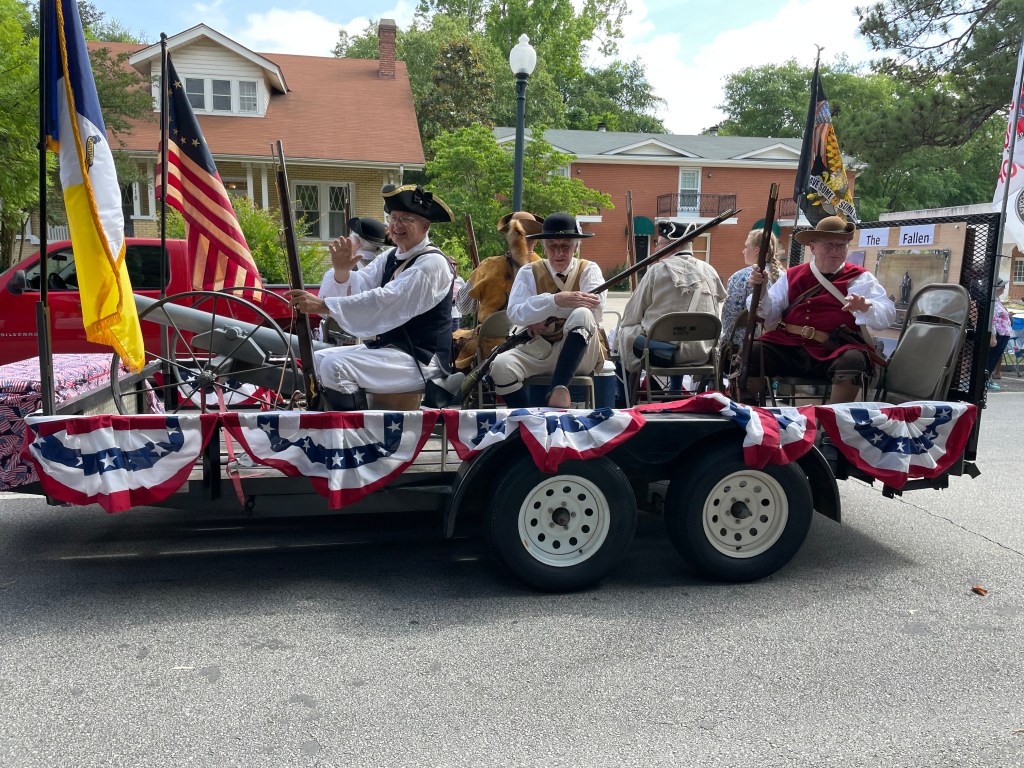
In 2026, we celebrate the 250th anniversary of our independence. Planning has gone on for over a decade for celebrations across the country. There is a veritable orgy of patriotic fervor, and a renewed dedication on the part of many to the principles enunciated so well in the Declaration of Independence. Although there are protests, the anniversary celebrations are wildly successful. This is in part due to a surge in religious feeling and churchgoer attendance. Overall, a feeling of something like hope starts to bloom across most of the country.

However, barely after the confetti has been swept up, ill health forces Trump to hand the reins to his Veep. His selection as Vice-President is very significant in this Future. Trump has chosen a younger person of color with an inspiring family story, emphasizing personal effort and grit. The now-President is almost an embodiment of the American Dream.

Seldom have the Man and the Moment been so well-met. The new President builds on the bursts of patriotism to begin to rebuild bipartisanship in Congress. Both parties follow his lead in consciously turning down the rhetorical heat. This stands him in good stead in his second term when he gets Congress to pass dramatic reforms to both Medicare and Social Security, assuring their solvency.

During his first term, non-college-educated workers regain the upward income trajectory they enjoyed prior to the pandemic. Inflation is tamed. His second election campaign signals the completion of the realignment of the political parties. The working class coalition that was so important in getting Democrats elected in the 20th Century is no longer a voting bloc the Dems can rely on. In fact, joining with small business owners, they tend to vote cultural issues rather their pocket books, reject “woke-ism,” and vote Republican especially in the 2028 and 2032 elections. The Democratic party is now led by Big Business (esp. Big Tech), academia, the cultural elites and those living in big cities (but whose populations continue to decrease).

The President also uses the Bully Pulpit as well as the Department of Education to advance policies aimed at encouraging diversity of viewpoints. The University of Chicago’s principles serve as the basis. Incidents of viewpoint discrimination are much less frequent, though there are pockets of resistance.

When the President leaves office on January 20, 2037, his successor rightly characterizes him as “everyone’s friend, but nobody’s fool.” Economically, the country is the strongest it’s been in the last quarter century. This is helped by demographics: as the Baby Boomers pass, less of our budget has to go toward their entitlements and pensions. In foreign affairs, the President has steered a careful course. His State Department has extended the Abraham Accords to include Saudi Arabia. China has continued to claim Taiwan, but his Cabinet has greatly decreased the nation’s dependence on China for precious metals and electronics. The standoff in Ukraine has been resolved.

Perhaps his greatest legacy, however, is a turn toward civility in the country. He is not a very flamboyant person, but after the Sturm und Drang of Trump-Biden people find that they kind of like “boring.” The positive economy and the downturn in the volume of political rhetoric also have important implications for communities.

In this scenario, communities find what is probably their most positive Future. The financial stress due to pensions is largely relieved. The economic gains of their members translate into increased business activity and tax revenues. The trimmed federal government empowers them to do more for themselves. The rebirth of civility in civic affairs means that they can actually accomplish more – compromise is easier when everyone can get something they want. For many communities this leads to an enhanced “Culture of Accomplishment” – a confidence that the people living there can make good things happen. As a result, the quality of life in a majority of communities is improved, though some still stumble (There’s no cure for bad governance!).

In short, this scenario is actually the “High Resilience” scenario – more resilient families and individuals living in more resilient communities. In a sense, this is sort of an outlier – probably a low probability of occurrence from where we are now. Many things need to break right for it to happen. But that’s one of the benefits of working through scenarios – we can take conscious action to go after those we deem more positive, and try to mitigate the more negative.

In my next post, I’m going to interrupt this series to look at some interesting data relating to corruption. Following that, I’ll resume this series with “The Empire Strikes Back.”

Featured

The Coming Crisis: A New Age Now Begins

What rough beast, its hour come round at last,
Slouches towards Bethlehem to be born?

William Butler yeats

In my previous “Coming Crisis” post, I presented evidence from a variety of sources that we are approaching a tipping point that will profoundly impact our lives and our communities. In this and the next few posts, I’ll provide a sort of answer to Yeats’ question: what the crisis (the rough beast) will be; what its aftermath will be.

Why do I say a “sort of answer?” Because I will lay out what they might be, rather than what they will be. Our communities and, indeed, our societies are complex adaptive systems. One of the great paradoxes of these systems is that while we can explain their past, we cannot predict their future very well. In general, the path a community takes is deterministic – if we know the cause, we can predict its effect and vice versa. However, a community’s interdependencies and path dependence prevent us from accurately predicting how a community may evolve in a time of turbulence – too many causes pulling in competing directions. And in this case, we cannot even predict the nature of the coming crisis very well. There are too many trends and counter-trends swirling around so that our crystal balls are permanently clouded!

What we can do, however, is develop scenarios representing possible futures and then gauge how our communities will be impacted. While there is an infinite variety of scenarios, there are some simple rules to follow in developing one. First and foremost, it has to be plausible: there has to be a clear path of cause and effect – “and then a miracle occurs” is not allowed. It also should be consistent with current trends; it may accentuate one or more, but needs to explain why the Conservation of Momentum has been disrupted. This implies that a useful scenario is based on (and acknowledges) a set of plausible assumptions about its starting point and the relative strength of existing trends.

In this series of posts, I’m going to create four scenarios and look at their impact on our communities. As a foretaste:

  • The Triumph of the Trads. The current social war is eventually resolved in a return to more traditional values.
  • The Empire Strikes Back. The “Empire,” i.e., the Establishment, take away whatever victories the Trads have won, and the US becomes even more like Canada under Trudeau. The CCP succeeds in brainwashing our kids and the US becomes hyper-isolationist. The Common Man and Woman are faced with head-spinning changes depending on who’s being paid by whom. Our kids aren’t reading – but are living – 1984.
  • Muddling Through. We stay poised on a knife’s edge, “a bug looking for a windshield” (HT John Mauldin) but never finding it. No one really wins.
  • The Age of Scarcity. We’re way too close for comfort to this. Our depleted arsenals, our Woke military, and flabby (both physically and mentally) youth mean that a military loss (e.g., to China) would be too likely. Our unpayable debt will continue to eat up an increasing portion of our tax revenue. And the American Dream becomes something of a nightmare. Our kids get to relive the Depression like their Great Grandparents did. Social Justice Warriors starve along with the rest of us.

To set the stage for the following posts, I want to highlight the trends that will help to shape my scenarios (and potentially our future).

  • Millennials displacing Gen X-ers (and Baby Boomers), or in Neil Howe’s terms, Heroes displacing Nomads. The coming crisis is likely to have social, economic and political aspects. The Heroes will have to resolve them.
  • Underlying this transfer of power is a potentially more important trend – the passing of the Baby Boomers. The largest generation in history is slowly “shuffling off this mortal coil.” Our outsized impacts on everything from culture to the welfare state will live on. However, our outsized portion of the federal budget impacting Medicare and Social Security’s solvency will slowly disappear.
  • Our current “government by experts” is revealing just how inept its experts are. It is being assailed across the spectrum from the Far Left to the Far Right. Too many blinkered Hedgehogs, too few far-seeing Foxes. Adding to our political instability is the over-production of potential elites, each competing for power, leading to omni-directional distrust.
  • An underlying trend that is receiving far too little attention is the search for meaning. A result of each of the great crises of our past is some form of a spiritual revival, whether religious (after the Civil War and the Spanish Flu Pandemic) or cultural (the “Age of Aquarius” after Viet Nam). The unreasoning dogmatism of the climate cultists and of the Far Woke is similar to the Inquisition’s rigidity in their mindsets. I often think that Savonarola and Kendi would be kindred spirits.
  • Finally, I think it is important to recognize the similarities between the 1920’s and the 2020’s. The Spanish Flu pandemic of 1918-19 had profound impacts on the “Roaring Twenties” just as Covid had had on our own ’20’s.

Some of these will seem silly to some of you; they may all be unlikely (although Muddling Through seems quite possible). The important thing is that developing scenarios such as these can prepare us for the Future’s uncertainties; can point us toward safer paths; and can lead us, and our communities, to greater resilience.

Featured

The Dog Ate My Homework

When I was in sixth grade, we had to make a project for ancient civilization, and it was a Sumerian brick. I made it, and I left it on the radiator overnight. I came downstairs in the morning, and it had disappeared. And my dog – my Labrador was looking very guilty… So it must have been like, what she dreamed of because it was the size of a loaf of bread, and there was nothing left.

Unknown

I have been an indifferent correspondent this quarter. After my last post on “The Coming Crisis,” I had intended laying out a few possible futures, starting with one I call “Triumph of the Trads.” Three things intervened.

  • October 7. A Minsky Moment of the first magnitude! And something that I believe may have a profound impact on the Coming Crisis’ outcome. The testimonies of the “three sisters” – I mean the Presidents of Penn, Harvard and MIT – were as appalling as the response to them was surprising. In fact, I’m still processing what the impact of 10/7 and beyond on those futures might be. I’ll come back to this next month.
  • Medicare Open Enrollment. As some of you know, for the last decade I have helped hundreds of seniors optimize their choices, esp. for their drug plans. I’ve helped them save almost a half million dollars. As you might expect, it takes a lot of time.
  • Over the last few weeks, Bill Hooke and I have had a running dialog over whether and how the First World should help the Third World deal with the “Climate Crisis.” My responses are in the comments to his posts here and here. Our views are, ahem, a bit divergent, but as he posted, “Readers are treated to another view, and then are better positioned to sort out their own thinking on the subject of the day.” His posts and my comments (well, his posts and maybe my comments) are worth reading.

I am one of Bill’s biggest fans. He is – as I try to be – an intellectual provocateur. He forces me to more clearly think through my own positions and to correct them as necessary. If I can characterize our starting points, his is that as a rich nation the US should help poorer countries when they have climatic damage because we have benefited so much from what has caused that damage. In that sense, he is a “gentle collectivist.”

My starting point is quite different. I’m not sure what harm has been done that can be attributed to a changing climate (Feel free to object in a comment). Further, while our forebears certainly left us much better off than many others, we should not forget how much they and we have done for the rest of the world, with our money, our time and even our blood. And I would much prefer donating my money, time and talents myself to those that I believe can truly benefit from them rather than have the government make the judgment of who is worthy. All of this makes me a sceptical individualist.

But please read the exchange – the issues we bring forth are important. Perhaps equally so, we can disagree while respecting each other.

In a sense “climate reparations” is [are?] a moot point, since John Kerry and company have already established such a fund at COP28. But in a sense it’s not: Congress still must authorize the release of funds for our contribution.

So these are the dogs that ate my homework. Seriously, I’ll try to do better! Maybe next year…

=========

Finally, we are rapidly approaching Christmas and a new year. It is a time for giving and sharing. Please remember those less fortunate. Help them not out of guilt for what you have, but out of the responsibility inherent in our common humanity. Above all, treat the less fortunate as human beings, as individuals, not faceless avatars of some group identity. And, maybe, we can do the same for those with whom we disagree.

I hope we all find that 2024 ends better than 2023 has. Peace!

Featured

The Coming Crisis

History does not repeat itself, but it sometimes rhymes.

Attributed to Mark Twain

Eighty years ago, our nation’s armies and the world were being savaged by World War II’s dogs of war. Eighty years before that, the country was in the midst of our Civil War. Eighty years before that – almost exactly 240 years ago – the Treaty of Paris ending our Revolutionary War was signed. Do you see a disturbing pattern here?

Mark Twain’s “rhymes” are the patterns that prophets use to foretell the future. Over the last few months, John Mauldin has collated predictions based on historical patterns that indicate that the next ten years may well be more tumultuous than any of us have seen before in our lives. These come from three very different perspectives: one demographic, one geopolitical and the other historical. Independently, William White has observed that we are passing from an Age of Plenty to an Age of Scarcity. A crisis is coming, with potentially profound impacts on our communities. In this post, I’ll look at the patterns that point to crisis. In the next, I’ll offer two different possible futures that the coming crisis might lead to. I’ll also offer some thoughts on how the coming crisis might impact our communities.

Neil Howe focuses on generations and their characteristics. He sees a cycle of 80 years, roughly corresponding to the human life span. A generation of Nomads is followed by Heroes, then Artists and Prophets. Each generation is born during a 20-year period; each dominates affairs in their later middle age (40-60), and then begins yielding to the next generation. This change from one generation to the next is called a Turning.

Heroes must deal with the great crises of their times. They are the ones who fought and won our Nation’s independence from Great Britain. They are the ones who preserved the Union and ended slavery. They are the Greatest Generation who won World War II. Artists watched their Hero-parents struggle through crisis, but are powerless to act. As a result, they are risk-averse conformists. Their times tend to be relatively calm and crisis-free. Prophets reap the advantages – and the disadvantages – of never knowing a real crisis. They tend to be focused on cultural and moral issues (e.g., the ‘60s), and – most importantly – set the stage for the next crisis. They are followed by the Nomads, pragmatists who are suspicious of bureaucracies of any form. Because they have few connections and trust only themselves, crises brought on by the Prophets tend to fester when Nomads are in power. It is up to the next generation of Heroes to resolve them.

According to Howe, we are now in the Fourth Turning – Gen X (Nomads) giving way to the Millenials (Heroes). It started with the Great Recession, and should reach its culmination around 2030. Going back to the 15th century, Fourth Turnings have been times of crisis and upheaval. They were often violent, but more importantly, have each resulted in social upheaval. To quote Mauldin, “This major upheaval doesn’t have to include war, or at least the calamitous shooting wars of past cycles. Hopefully. But anyone who thinks the current cultural antagonisms, rabid partisanship, unrealistic expectations, geopolitical turmoil, and the staggering accumulation of debt will end with a whimper isn’t paying attention.

George Friedman, one of the preeminent observers of the geopolitical scene, has observed an 80-year institutional cycle and a 50-year socioeconomic cycle in our nation’s history, starting in 1783. A crisis occurred at the peak of each cycle; for the first time, those peaks coincide. That implies the coming crisis will be both an institutional and a socio-economic one. Again, to quote Mauldin, “it seems likely we will face social crisis, economic breakdown, and structural political change—all at the same time.

Friedman sees our increased longevity and reduced reproduction as fueling the crisis. We have an increasing number of elderly consumers, spending their own savings (and pensions – in some cases) as well as their Social Security benefits, and Medicare for health care. In principle, Social Security and Medicare are supported by taxes on workers, but fewer births means that the number of workers supporting each older American has almost halved – falling from 6 in 1980 to slightly more than 3 now. And the ratio is continuing to decrease – this is not sustainable!

Friedman points out that the last institutional crisis – dealing with the post-World War II world – was solved by transitioning to “government by experts.” In the post-war world, our experts were truly heroes. George Marshall shepherding Europe’s economic recovery. Lewis Strauss forming the “Atoms for Peace” program. Eisenhower championing the Interstate Highway System, and many others.

However, we currently are awash in “experts” seemingly more adept at bureaucratic gamesmanship than solving our problems. As I’ve previously noted, the economists at the Federal Reserve are largely responsible for the widening gulf between rich and poor. It is clear that the masking and lockdown “guidance” from the “experts” at the Centers for Disease Control and Prevention was, at the least, misguided. And the remote learning foisted upon us by the “experts” in the educational establishment will continue to wreak havoc on the futures of our disadvantaged youth, perhaps for generations.

Peter Turchin is a Ph.D. zoologist, who founded the field of cliodynamics. He and his colleagues have focused on the study of state formation and collapse, compiling a database that spans virtually all of recorded history. Using mathematical models to test trends, he concluded that

when a state, such as the United States, has stagnating or declining real wages (wages in inflation-adjusted dollars), a growing gap between rich and poor, overproduction of young graduates with advanced degrees, declining public trust, and exploding public debt, these seemingly disparate social indicators are actually related to each other dynamically. Historically, such developments have served as leading indicators of looming political instability. In the United States, all of these factors started to take an ominous turn in the 1970s. The data pointed to the years around 2020 when the confluence of these trends was expected to trigger a spike in political instability.

Turchin has noted that as societies age, they naturally evolve into a state of inequality. An elite forms, based on wealth and education, which directs the actions of the commoners. Turchin sees this as a power imbalance. Over time, the gap between the two widens leading to the commoners becoming what Turchin calls “immiserated,” no longer able to work to achieve the advantages of being in the elite. As an aside, before the pandemic, data indicated that social mobility – the rate of socio-economic “churn” – had significantly slowed, consistent with Turchin’s slowly building crisis. The decreasing life expectancy of lower middle class white men is also in line with Turchin’s view of immiseration.

According to Turchin, over time the elites over-produce – a group of educated potential elites, who are without power, and in danger of slipping into immiseration. It is at this point that the crisis arises as there is a competition between the elites and these counter-elites. As Turchin points out, the crisis often turns violent and rarely turns out well for the society as a whole.

One more negative pointer – William White sees the global economy moving from an Age of Plenty” to an “Age of Scarcity.” He believes that its systemic instability (high public and private debt, geopolitical turbulence, declining workforce worldwide, restricted energy supplies due to fears of climate change, …) are leading to political instability, that is being exacerbated by the distrust in established institutions.

To add my personal viewpoint, this omni-directional distrust seems to be the one “belief” that currently unites Americans of all political persuasions. A Turchin might point to the CDC’s botched handling of the pandemic. A Friedman might point to Biden’s timid attempts to prevent the Russo-Ukrainian War. A White might point to the Fed’s fiddling with the economy that has exacerbated the wealth gap between rich and poor. But universal distrust in our institutions has become the hallmark of our age.

None of us can predict how all of this will play out. we can only postulate a range of futures. It may be my own personal idealism, but I believe that our future path will depend on how we resolve this lack of trust in our institutions and ourselves. In the next post, I’ll spin out two scenarios of how these crises might be resolved, and their impacts on our communities.

Featured

Five Pillars of Community Resilience

Optimism is a strategy for making a better future. Because unless you believe that the future can be better, you are unlikely to step up and take responsibility for making it so.

Noam Chomsky

The other week, Claire Rubin sent me a link to an article from Beaumont resilience training – Here’s How to Use Resilience to Move out of Your Comfort Zone. The author – Laura Ponting – focuses on the personal growth of the individual, but her “five pillars” seem to fit well with my own conception of community resilience as a springboard for growth – development or strengthening – of a community, i.e., for making a community more Future-fit.

I apologize to Ms Ponting – I’m reorganizing her order to suit my [sometimes – often?] warped logic. I’ve also taken some of her words out of context, to help make my points. I’m also couching this in terms of systems; after all, communities are first and foremost complex adaptive systems (CASs). I’ll also use the Seven Community Capitals as a way to clarify some of my points.

First Pillar: Purpose. Future-fitness – growing in strength and capability – requires not just action, but purposeful action. Action — to strengthen the individual or the community. Since a community is only successful if it provides the quality of life its members want, the purpose of becoming more resilient is to safeguard that quality of life, and to improve it if possible. This is often called a vision; the community’s conception of what that stronger community will be. The community as a whole has to buy into that vision, or else it is likely that it won’t be realized.

In particular, this requires cultural capital. A common language to describe and understand that future state. A common self-confidence that breeds optimism. As Chomsky implies, without that confidence and the optimism it engenders, the community won’t work together to achieve it.

Second Pillar: Self-awareness. “Know Thyself” is not just an inscription on a Greek temple; it is the zero-th step for any community plan. For the community as a system, self-awareness means knowing who its members are. It means knowing how they are connected – or not. It means knowing the “balances” in each of its capital accounts, and the constraints or limits on the use of each capital. Most importantly, it means that the community’s leaders know how to make decisions and take action (human and institutional capital).

Third Pillar: Mindfulness. “Mindfulness” for a community equates to situational awareness. Communities as systems are in dynamic environments, with trajectories conditioned by both internal and external forces. “Mindful” communities recognize not only where they’re headed, but the forces that are driving them. The fine people at ResOrgs in NZ consider situational awareness one of the four enablers of effective crisis strategic planning.

Situational awareness rests on the community’s social capital. It requires “ears to the ground” within the community to gauge the community’s mood and its ability to move. Situational awareness also requires linchpins keenly tuned in to sources of information outside the community. They can warn the community about new sources of stress and alert the community to unexpected opportunities.

Fourth Pillar: Self-care. As individuals, we know we have to take care of ourselves. We exercise (well, some of us do). We have physicals to tell us whether we’re overweight, have high blood pressure, are pre-diabetic or any of the other warning signs the doctor looks for. And if we’re wise, we take action to avoid further damage to our vitality.

The same holds true for our communities. We know that if we fail to maintain our homes or our physical and natural infrastructure, they may be damaged in a severe storm, or even collapse from neglect. But the same holds true for our “softer” infrastructures.
• our community’s culture that, at its best, brings us together and gives us the confidence to act;
• our community’s social networks that enable us to communicate with each other, and – in times of crisis – tell us where resources are needed;
• our community’s economy that provides us with the financial capital to take action.

And just as we as individuals have physicals to point out where action is indicated to strengthen us, so too should we in our communities be aware of those signs that point out that action is needed. More frequent maintenance of physical systems, rising crime, a fraying social fabric, or growing poverty each are indicative of the need for “self-care” for our communities.

Fifth Pillar: Positive relationships. Ms Ponting couches this in terms of finding people to support us, esp. as we strive to better ourselves. The same holds true – in spades – for communities. It is simply a reflection of the economy of scale. The more resources we can bring together, the more we can do. If we work smartly (after all, two heads are better than one) we can make our communities more functional and better places to live for all of us.

But there are also traps for the unwary in this. First, “working smartly.” If we let ideology overrule reality, in other words if we don’t couple Purpose and Mindfulness/Situational Awareness, then we may actually harm our community. The debacles that so many of our big cities have become – crime, filth in the streets, the ugliness of the hopeless homeless – are monuments to failed ideologies not rooted in reality.

The second trap seems to be endemic in our age of “engagement.” Even the best of ideas can die the death of a thousand cuts in a committee. When egos are engaged, everyone wants to see a little of themselves in what’s done. That leads to inefficiencies and sometimes even alters the idea so much that it no longer supports the Purpose.

A third trap is the difficulty in overcoming the distrust and mistrust that seems to be endemic in our not-so-civil civil life. It sometimes seems that no one has the authority to act but everyone has veto power over any action. Relationships ultimately are grounded in trust. In our age, however, Trust has become a rare commodity. Thus, building positive relationships particularly in our polarized polity is not for the faint of heart.

Five Pillars for strengthening us as individuals; Five Pillars to move our communities toward a better and more secure future. That should be our Purpose. Achieving the Purpose has to be grounded in self- and situational-awareness, so we can set a realistic path from today to that better tomorrow. As we advance upon that path we must maintain those strengths we rely on to move forward – self-care. And if we can find willing partners to support us, these positive relationships can help us to advance more rapidly.

Featured

Our Declaration of Independence

We hold these truths to be self-evident, that all men are created equal, that they are endowed by their Creator with certain unalienable Rights, that among these are Life, Liberty and the pursuit of Happiness. –

Declaration of Independence

This week the US celebrates its founding. The date chosen commemorates the signing of our Declaration of Independence from Great Britain. This document is arguably the most important written in the English language in the last 250 years. Its ringing words sparked our own and the French revolutions. It voiced the aspirations of the voiceless around the world yearning for a better life.

And let there be no mistake – it is truly an aspirational document. It articulates a vision of what our nation should be. Our Founding Fathers were all too aware that government formed by Man cannot be perfect; our Constitution with its checks and balances is their attempt to protect our “inalienable rights.” I believe all of them recognized their society’s failings; Slavery – America’s original sin – chief among them. Three quarters of a million died as part of our national penance to expiate and exterminate this sin. The Declaration and the Constitution established an aspirational culture in our country that continues to be a magnet attracting those from other countries who want to have a piece of the American Dream.

However, we now live in a world in which many Americans are questioning those aspirations and would have us deem the American Dream a nightmare. Some want to subvert our aspirational culture and deny the importance of the rights so many have sought and so many have fought to ensure.

This battle of conflicting visions of our future is being fought at the national level, in our state capitals, and in our communities. It has profound implications for our resilience at each of these levels. And while Jefferson, Franklin, Adams, Livingston and Sherman didn’t use that term, I think it’s important to examine the impact of the Declaration on our resilience.

First and foremost, the Declaration is about “Rights.” In our highly polarized politics at the national level, both sides claim to be for “Freedom,” although they seem to be worlds apart in what they think Freedom is. To me, our Bill of Rights – inspired by the Declaration – lays out an excellent definition of our Rights, especially in the First Amendment. We must be free to believe as we wish and to express those beliefs. We must be free to peaceably assemble. In the Constitution, these are couched in terms of prohibiting the federal government from denying these rights. But it is just as important that we recognize that no individual or group has the right to abridge those freedoms either. “Cancel culture” does not exist in a society that values freedom.

But – in more subtle ways – the Declaration also speaks to Freedom’s homely twin – Responsibility. In the Declaration, the Founding Fathers talk about the duty of the people to “take arms against a sea of troubles, and by opposing end them” (to wax Shakespearean). The Declaration also states that the colonists have reached out to their fellow citizens in Great Britain, implying a responsibility of citizens to support each other.

This theme is also hidden in the famous phrase “Life, liberty and the pursuit of happiness.” This was originally the more prosaic “Life, liberty and property” borrowed from John Locke. Jefferson changed this based on another of Locke’s essays in which the pursuit of happiness is seen as the antithesis of today’s “don’t think twice, it’s all right” culture. Rather, in Locke’s (and apparently Jefferson’s) view, the pursuit of happiness was not chasing whatever “feels good now,” but rather thinking in terms of what is best overall. In other words, seeking the timeless rather than the timely. In the Federalist papers, both Madison and Hamilton referred to this as social happiness.

Today, many question the Declaration and its worth. They assert that the Founding Fathers’ conceptions were necessarily corrupted by their owning of slaves. They assert that so much has happened – so much more has been learned since then that these simple principles should be effectively abandoned. But what they fail to realize is that the Declaration is indeed timeless; that the flawed men who wrote it were all too aware of their own flaws. Those who would modify the Rights the Declaration so powerfully asserts ignore the role that these words played in bringing an end to slavery. The role that they played in the French Revolution. The role they more recently played in the UN’s Charter. The role these words continue to play in drawing immigrants to America so that they can pursue their dreams, so that they can create and pursue their own happiness. Calvin Coolidge said it well:

If all men are created equal, that is final. If they are endowed with inalienable rights, that is final. If governments derive their just powers from the consent of the governed, that is final. No advance, no progress can be made beyond these propositions. If anyone wishes to deny their truth or their soundness, the only direction in which he can proceed historically is not forward, but backward … Those who wish to proceed in that direction can not lay claim to progress. They are reactionary. Their ideas are not more modern, but more ancient, than those of the Revolutionary fathers.

Only free men and women can take purposeful action to better themselves and their families, whether in adversity or in good times. Only free men and women can truly be resilient. Our Declaration is the fundamental statement of both the Rights and Responsibilities of that freedom. It is thus the basis – the foundation – of our resilience.

Featured

Memorial Day 2023

we take increased devotion to that cause for which they gave the last full measure of devotion

Abraham Lincoln

This past weekend we remembered those who died in service to our country. For them, Duty, Honor, Country was more than a phrase, it became the visceral reality they lived and died for. They understood the concepts of Duty to guard the ideal of Freedom, of Honor in doing that duty, and of devotion to Country. 

After Viet Nam, we as a country decided that we would move from a military based on the draft to an all-volunteer service. This resulted in an Army that was able to transform itself into a much more capable fighting force after the debacle that was Viet Nam. However, it meant that our youth no longer had to serve, but rather only if they chose to do so.

I don’t think it’s a coincidence that since then we have drifted toward a “me-centric” society. This “multi-culture” requires no Duty, has no concept of Honor and is at best indifferent to its Country. In my youth (as best I can remember it!), the idea of a Trump or a Biden as our President would have been unthinkable. In our media we had men and women who had actually lived on the frontlines, seen soldiers die, who knew what Duty, Honor, Country actually meant. We had leaders who had served, and whose leadership had been literally honed under fire. These honorable men and women stood above party to do the right things for their country.

Those who haven’t served have no conception of service to something greater than themselves. Those who have never seen the great good that our country has striven for here and abroad cannot truly appreciate our country until they contrast it against foreign societies (Brittany Griner’s epiphany is a good case in point). We cannot “get our Country back” until we – all of us – rediscover the importance of that cause that so many have died for.

One might think that these are idealistic concepts, of no practical importance. But they are, even – perhaps especially – at the community level. We see rising crime, a widening partisan divide – a chasm!, leaders who are pushed forward by their “followers,” citizens lacking trust in their governments because they sense that their governments don’t trust them, and decreasing life expectancies especially among those who have lost all hope. 

And yet … And yet, even in the kaleidoscope of our current dysfunction, I see glimmers of hope. I see parents starting to speak up for their kids’ education and taking back responsibility for their upbringing. I see business owners starting to pressure their city councils to take back their downtowns from the thugs and the druggies. I see people voting with their pocketbooks against businesses that seem to have forgotten who their customers are. 

Yes, these growing pains can be messy; yes, they sometimes are downright ugly. But ultimately, my hope is that this reawakening of responsibility will lead to greater civic engagement. That we will all eventually realize the importance of community, of serving something greater than ourselves. And in doing that, we will have rediscovered Duty, Honor Country. And if we can, we will pay the greatest possible tribute to those who “gave the last full measure of devotion.”

Featured

Embracing Complexity

… actually a complex, adaptive system (CAS) which is constantly evolving, never in equilibrium.

Wiliam White


William White has been called the “Central Banker for Central Bankers.” I first became aware of him when I read the transcript of a speech he gave in Philadelphia. His understanding of practical macroeconomics is probably second to none.

Many of his writings in the last few years have been focused on the global economy as a complex adaptive system (CAS). However, his insights apply just as well to communities as economies. As some of you know, I’m hip deep in a book-writing project on systems thinking for community professionals. One of its themes is that communities are CASs, and have to be understood as such. What distinguishes “complex” from the merely (!) complicated is that the system’s behavior can’t be predicted from that of its parts. CASs web of interdependencies and their open-ness mean that their behavior can be spectacularly non-linear. CASs – as their name implies – also have the ability to adapt. They can change their structure and thus their behavior in response to stress.

In the following, I’ve provided excerpts from White’s “Simple Lessons for Macro Policymakers from Embracing Complexity,” and suggested what they mean for community leaders.

Policymakers’ multiple objectives make trade-offs inevitable. Ultimately, the job of a community leader is to provide their community’s residents with the quality of life they want. Without infinite resources community leaders must make choices – balancing priorities.


Policymakers can affect structure, and structure matters. As I’ve posted previously, “Form Follows Function.” But the converse is true, as well. Changing “form” – how the community is wired – leads to changes in what the community can do. When some new problem arises, one of the knee-jerk reactions of community leaders is to add a new organization to deal specifically with the problem. Unfortunately, that makes the community as a CAS more complex, and even less predictable. Whether recognized or not, this creates new interdependencies and a high likelihood of unintended consequences. This is what I see when I look at a city like New Orleans where it seems that no one is responsible anything but everyone has veto power over everything.


Policymakers should minimax not maximize. When we want to introduce new policies (e.g., “Defund the Police”) we need to think in terms of the Hippocratic Oath: First, do no harm. We can’t predict how a system may adapt to a change, but we can foresee negative ways it may do so. Community leaders need to find ways to protect against them.


Policymakers should act more symmetrically. Simply put, avoid both the high highs and the low lows. Build up rainy day funds in good times to tide the community over in bad times.


Policymakers should expect the unexpected. Stress can come from the darndest places. And its impacts can resonate throughout the community’s web of interdependencies.


Policymakers should focus on systemic risks more than triggers. Quite simply, “follow the trend lines not the headlines.” Rather than trying to guard the community against every possible stressor, focus on inoculating the community against changes in its environment, loss of community capital, changes in demand for its common functions, new constraints imposed by state or federal governments, and, of course, against entropy – the ravages of time.


Policymakers should be guided by multiple indicators. Communities adapt by a “Learn-Plan-Do” process. An important part of learning is gathering information about potential stresses. Since there are many sources of stress, community leaders need several ways to look for them.


Policymakers can’t forecast. Community leaders are as unlikely to accurately predict the future as economists. What they can do, however, is to use trends to develop scenarios of what the future might be, and then shape their communities to be Future Fit.


Policymakers should be prepared for breakdowns. Crises are built into the DNA of a CAS and a community. Communities in which leaders work through various scenarios to minimize pain and eliminate suffering are the ones which are truly resilient. It’s not so much that they develop specific plans to deal with each scenario but that they build the collective experience of working together for the community. This is cultural capital of the highest order!


No policymaker is an island. In the modern world, every community is connected to others. Every community is embedded in a state or province, and that in a nation. Every community is made up of neighborhoods and other community systems, many of which are also complex. Ultimately, each of these is a group of people bound together for a common purpose. Thus, when community leaders take action in their community – hopefully to improve it! – the impacts may be felt in their residents’ homes, in neighboring communities, and up to the halls of government. Thus, evaluation should be part of action, especially looking for unintended consequences.


A community’s resilience resides in its ability to adapt – both to the stresses inherent in its connections to the rest of the world and to the Wild Things it faces – those extreme events that can permanently alter a community’s quality of life. White’s “Lessons” make the point that communities as CASs may be unpredictable, but that policymakers – community leaders – can devise means to see where the community is going, and to influence the outcome. Ultimately White’s most important lesson is for community leaders to embrace the complexity of their communities. His “Lessons” provide community leaders with a practical playbook they can use to build their communities’ adaptive capacity and to make their communities more resilient.

Featured

Form Follows Function, Except …

Whether it be the sweeping eagle in his flight, or the open apple-blossom, the toiling work-horse, the blithe swan, the branching oak, the winding stream at its base, the drifting clouds, over all the coursing sun, form ever follows function, and this is the law.

Louis Sullivan

We’ve all heard the old rubric, “Form follows function,” apparently first coined by Sullivan discussing the design of large buildings.  But it is just as true of our bureaucracies.  As I’ve ranted discussed in a previous post (see Bureaucracy and Community Resilience), “bureaucracies exist to carry out routine functions efficiently and in a consistent manner.”

What I didn’t say (and probably should have!) is that bureaucracies usually are tuned to be efficient under normal conditions.  Thus, the bureaucracy’s structure – its form – reflects business as usual.  The bureaucracy works because its structure is consistent with the tasks it must perform.

Sullivan goes on to say, “Where function does not change, form does not change.”  But what happens when a bureaucracy is faced with a significant change in its working environment – during a crisis, for example – that forces changes in how it functions?

The short answer, of course, is that it tries to handle the unusual in its usual manner.  Its organizational structure – the bureaucracy’s form, hopefully well-tuned to normal conditions – now governs its functioning.  If the organization’s form does not change, then its ability to function efficiently and consistently may well suffer.  On the other hand, if the bureaucracy adapts quickly to the new set of conditions, it may find an opportunity in change to reach a higher level of performance.

Let me look at some very disparate examples to illustrate this.  Hurricane Katrina had a major impact on the forest enterprise in the impacted regions (esp. in lower Mississippi).  In the most affected areas, 40% of the forests were damaged.  According to the Forest Service, the downed or damaged timber could have produced 800,000 single family homes and 25 million tons of paper products.  The EPA and Mississippi’s Department of Environmental Quality had no plans for dealing with this massive amount of solid debris.  It took several months before the owners of downed timber could gain permits for wet storage areas to preserve their timber, primarily because the regulators involved did not change their bureaucratic structures (and thus not their processes) to deal with this unusual situation.  While the permit process was expedited, this was accomplished by simply adding more people, not through restructuring to better handle the problem.  As a result, over half of the timber was lost with major repercussions on the entire forest products enterprise.  In addition, the downed timber led to a situation in which there was literally a new forest fire in Mississippi every day during the spring, summer and fall of the following year.  In short, regulatory functions were dictated by organizational structures tuned to “normal” circumstances; i.e., form dictated function, and resulted in poor performance.  Unfortunately, the regulators have not really learned anything from this – in the face of another Katrina, it would still take months before storage sites for downed timber would obtain permits.

Waffle House provides a very different example.  It plans for surprises, and is organized so that it can function under almost any set of circumstances.  It clearly has learned from past experience and has adapted itself so that restaurants impacted by disasters can open with restricted menus.  If workers can’t get to a Waffle House location (as happened to my community in January, 2014, because of an ice storm), workers can be temporarily brought in from other locations to minimize service interruptions.

WalMart provides an excellent example of finding opportunity in change.  In the ‘90’s, virtually every corporation in America spent huge amounts on information technology.  For most companies, the gains in productivity (i.e., the return on investment) were modest.  However, WalMart used this technological change to reorganize its supply chains so that it quickly gained a tremendous competitive advantage.  In other words, it altered its form to improve functioning.

Form follows function, except when changing circumstances demand changes in how an organization functions.  In the earlier blog on bureaucracies, I pointed out the factors that determine how rapidly an organization can change:  its history, its age, its ability to collaborate, its ability to innovate, and, most importantly, its leadership.  The resilience of an organization, or a community, is manifested in how rapidly it adapts – how quickly it changes its form – so that it can function effectively in a new environment.

Featured

Bureaucracy and Community Resilience

The purpose of bureaucracy is to compensate for incompetence and lack of vision.

Jim Collins

Bureaucracies are inherently anti-democratic. Bureaucrats derive their power from their position in the structure, not from their relations with the people they are supposed to serve. The people are not masters of the bureaucracy, but its clients.

Alan Keyes

I’ve had way too much experience with bureaucracies in my almost fifty years working with the federal government.  In the next couple of blogs, I’ll be looking at bureaucracy through the lens of community resilience.

First, a word of disclaimer.  My view of bureaucracy is well summarized in some of Moore’s laws of bureaucracy:

  • Bureaucracies have no heart.
  • Bureaucracies are perverse.
  • Bureaucracies will thrash about, causing much cost, pain and destruction.

If I (and so many others) feel this way, why do we still have bureaucracies?  There are two reasons for this that more or less mirror the quotes above.

  1. Most importantly, bureaucracies exist to carry out routine functions efficiently and in a consistent manner – bureaucracies are the wheels that keep organizations (governments, businesses…) running more or less smoothly.  But this also implies a more fundamental role for bureaucracies.  Their rules, regulations, and procedures encapsulate the organization’s corporate memory of what works, at least within a bureaucracy’s domain.  However, the more rigid this procedural structure, the more resistant the bureaucracy is to change.
  2. Bureaucracies tend to be self-perpetuating.  As formulated in Jerry Pournelle’s Iron Law of Bureaucracy:  In any bureaucracy, the people devoted to the benefit of the bureaucracy itself always get in control and those dedicated to the goals the bureaucracy is supposed to accomplish have less and less influence, and sometimes are eliminated entirely.  In other words, in any bureaucratic organization there will be two kinds of people: those who work to further the actual goals of the organization, and those who work for the organization itself. Examples in education would be teachers who work and sacrifice to teach children, vs. union representatives who work to protect any teacher including the most incompetent. The Iron Law states that in all cases, the second type of person will always gain control of the organization, and will always write the rules under which the organization functions.

Larger organizations – and communities – tend to be more bureaucratic because they tend to do more things on a routine basis. All too often, however, their bureaucracies are rigid and resistant to change. But resilience is all about managing and adapting to change.  Achieving resilience thus means tearing down the walls between balkanized bureaucracies that are busily making their silos into fortresses.  This leads to a paradox:  if a community is working to become more resilient, it will try to take action through its tried and proven bureaucratic channels, the ones least prone to change.  Further, since adapting to major disruptions (e.g., pandemics, recessions) generally does not neatly fit into a single bureaucracy’s purview, it forces bureaucracies to interact with one another in non-routine ways.  If the community’s bureaucracies are flexible, the community is likely to be more resilient; if not, any efforts to enhance the community’s resilience become much more difficult. 

Of course, these are general thoughts.  However, they lead to some specific things to consider in determining whether a community’s bureaucracies will help or hinder efforts to become more resilient.

  • History.  If a bureaucracy is a sort of corporate memory container, then look at the challenges the community, esp. the bureaucracy, has faced.  Were they varied?  Were some of them relatively recent?  Were they successfully met?  “No” answers may indicate that the bureaucracy is too rigid.
  • The age of the bureaucracy.  Just like people, a bureaucracy can get “hardening of the arteries” with age.  It can accrete documentation requirements, for example, that continue on long after the need for a document has disappeared.  In a crisis, these will sow frustration in both the public and the bureaucracy and slow down recovery.
  • Collaboration.  Has the bureaucracy worked with others outside their domain to solve crosscutting problems?  City governments such as San Diego and Baltimore that are managed in a fashion that forces bureaucracies to work together toward common crosscutting goals are likely to be more resilient than ones that are managed in a more stovepiped manner.
  • Leadership.  Is the leadership of the bureaucracy open to new ideas?  Does the leadership have experience working outside the bureaucracy?  Has any of the leadership come from outside the bureaucracy?  Again, “No” answers raise red flags.
  • Innovation.  Has the bureaucracy periodically changed how it does business?  Is continuous improvement a part of its culture?
  • Number.  More bureaucracies imply more organizations that must be aligned to actually make something happen.
  • Accountability. Do community leaders hold their bureaucrats accountable for how they have served the people?

Bureaucracy can be a boon or a bane to community resilience. It’s up to the community – through its leaders – to determine which it is to be.

Featured

Community culture and community resilience

Culture outperforms strategy every time; culture with strategy is unbeatable.

Quint Studer

A community’s culture is one of the most overlooked – and misunderstood – contributors to its future fitness. A community’s culture is primarily its history – not the one in books but the one embedded in its mind, its heart and its soul. A community’s culture shapes its shared values, and how its residents expect each other to behave. It thus conditions how a community approaches its problems, and whether the community can even recognize its problems.

A community’s culture is related to but different from its social capital. A community’s social capital resides in its connections – how the community is wired, and how effectively those wires enable the community to share information. A community’s culture conditions which connections are made, how messages are framed and even which information is shared. Thus, a community’s culture is a sort of skeleton supporting its social connection and directing where they form.

One of the ways that a community’s culture is manifested is in whether or not the community has a “can-do” attitude. Some time ago, I read an interview of the CEO of Fluor, focusing on his move of the giant construction company from California to Texas.

[When the 2006 move became known] “California made no attempt to keep us… things started to happen quickly [in Texas], without us initiating them. The Irving Chamber of Commerce did orientation sessions for employees and spouses, even helping with new-house searches. Or ‘little things:’ Irving on its own renamed a street Fluor Drive, which in California or the Northeast would be laughable.

This sort of attitude implies a community self-confidence that results in decisive action.

A community’s culture also reveals itself in how – whether – it recognizes its problems. When working with the Navajos, one of the striking features of their culture is the implicit prohibition against talking about bad things that might happen. This was based on the fear that talking about them would lead to them occurring. This sort of “whistling in the dark” makes it very difficult to prepare for or mitigate against disaster.

So how do I know whether my community has a culture that makes it future fit, that makes it resilient? There are several signposts.

First and foremost, the trajectory of the community. If the community’s quality of life is improving, that’s a sign of a proactive culture, indicating a self-confident community. If the community’s quality of life is deteriorating, the community is going to become less confident and less able to tackle its problems. Its future fitness is questionable.

Next, the unity of purpose within the community. As Paolo Freire has said: One cannot expect positive results from an educational or political action program which fails to respect the particular view of the world held by the people. Thus, if a community’s leaders are pushing programs that negatively impact a large swath of the community – that, in fact, are counter to their cultural values – the community has a culture that is in conflict with itself. It cannot confidently attack its problems. In fact, it may not even address them until they balloon into a crisis.

Then consider how tolerant the community’s culture is. As Joel Salatin says: The stronger a culture, the less it fears the radical fringe. The more paranoid and precarious a culture, the less tolerance it offers. If one part of a community refuses to let other – different – voices be heard, then the community effectively is limiting its approach to solving its problems to only those “approved” by the intolerant. Effectively, it’s like a general stubbornly concentrating on taking the hills in front of him while refusing to look at the mountains behind. Whether it’s banning books or refusing to listen to parents’ concerns, this kind of community culture will impair a community’s fitness to face the future.

Finally – and closely allied to its tolerance – look at the community’s open-ness, its willingness to accept new people and new ideas. The quote from Fluor’s CEO about Irving, TX, indicates a culture that knows how to adapt to new people and to accept new ideas. In solving their problems, “open” communities will be open to innovations, whatever their source. “Open” communities will also be the most likely to see and seize opportunities brought on by changing circumstances.

Most importantly, “open” communities are the ones most likely to have some sort of strategic vision for their community. They know what they want to become. They may even have mapped out a plan for their future. These communities – their actions compounded from culture and strategy – will be the ones best able to cope with change and to seize the opportunities inherent in change. They will be the most future fit, the most resilient.

Featured

Cognitive bias and community resilience

Beliefs are not like clothing: comfort, utility and attractiveness cannot be one’s conscious criteria for acquiring them.

It is true that people often believe things for bad reasons – self-deception, wishful thinking and a wide variety of other cognitive biases really do cloud our thinking.

Sam Harris

Have you ever tried to convince your boss, your spouse, or someone else about something?  And found your blood pressure rising as you thought to yourself “Why can’t he / she keep an open mind?”  You may have been a victim of the other person’s cognitive biases (of course there’s always the possibility that you were wrong!).

When we receive new information, we try to fit it into our existing mental models – the patterns that we have formed to help us organize information.  These patterns are important and useful because they help us rapidly respond to threats.  However, sometimes our existing mental models act as barriers to incoming information, especially if the new information doesn’t fit into an existing pattern very well.  This is known as cognitive bias.

Community leaders are human.  They are just as subject to cognitive bias as anyone else.  But that means that they may under- or overestimate risks facing the community, or ignore potential solutions to the community’s problems, or accept “solutions” that simply won’t work.  Thus, cognitive bias can have profound impacts on a community’s resilience.  In this post, I want to explore some common kinds of cognitive bias in a community context.

Perhaps the most important kinds of cognitive bias are what I call “delusions of competence.”  These appear in many different guises.  Sometimes we ignore new information because we don’t trust the source.  The messenger may be our political opponents (For example, a recent paper found that most Republicans who didn’t believe in climate change cited the fact that it’s being touted by liberal politicians as a primary cause of their disbelief.  The state of denial by progressive politicians [now there’s an oxymoron!] of the truth of recent revelations of Iranian nuclear misdeeds may have a similar cause.).  We may think we’re smarter than the messenger.  Or better at making decisions, or at predicting the future.  However it appears, this type of cognitive bias usually causes us to discount or ignore new information.  It introduces blind spots in our thinking.

Another type of cognitive bias arises because humans are social animals.  Most of us want to be part of “the group” (whatever that is).  If (noboby/everybody) thinks X then we should think the same.  Or we let our instincts be overridden by trying to be politically correct, or polite.  Or we respond to the confidence exhibited by a squeaky wheel.  This type of cognitive bias often ends up in a sort of community groupthink and misdirected actions.

A third type of cognitive bias is “the Tyranny of the Status Quo.”  Often, we tend to value what we have so much that we will do almost anything to avoid change.  This kind of bias can be summed up in something my friend Jim Kelley once said to me:  “People will only change when the pain of not changing becomes too great.”  This type of cognitive bias can also show up in more subtle ways.  We may tend to downplay some new information because it either conflicts with or pushes aside what we are concerned with now.  Or, rather than recognizing a new pattern, we may try to force fit new information into an old mould. 

Confirmation bias is closely related.  In this case, we pay attention to new information only if it buttresses previously held opinions.  This is particularly pernicious because we are flooded with so much information and so many studies that come to contradictory conclusions that it is way too easy to fall into this trap.  It seems that Climate Change Zealots on both sides are especially prone to this.

Every one of us as humans will fall prey to cognitive bias at some point – pattern making and matching are important evolutionary advantages.  But the leadership of our communities is made up of more than one person.  Inherent in the types of cognitive biases described above are ways that community leadership can avoid their negative impacts.

  • Diversity.  The best way to counter groupthink is to have people with diverse mental models each grappling with new information.
  • Respect.  If people respect one another, then they are highly unlikely to overweight their capabilities against someone else’s.  They are also more likely to listen to each other.
  • Good governance structures.  Diversity can lead to conflict; respect can lead to a desire to placate everyone.  Both can lead to inaction.  Good governance structures can achieve an appropriate balance as well as adding other checks and balances to avoid cognitive biases.

Our communities need information to gauge the risks they face and to find ways to either adapt to or mitigate those risks.  They need information to find ways to grow healthier and to recognize and seize the opportunities around them.  They need information to strike a good balance among their myriad needs and competing priorities.  Cognitive biases disturb and distort the flow of information.  If our communities are to become more resilient, they must find ways to combat cognitive bias.

Featured

Insights from Scale, by Geoffrey West

To sustain open-ended growth in light of resource limitation requires continuous cycles of paradigm-shifting innovations.

Geoffrey West

I recently finished reading this book (official title is Scale: the universal laws of growth, innovation, sustainability, and the pace of life in organisms, cities, economies, and companies, whew!) published in 2017. Somehow, I missed it when it first came out; I found a reference to it in something else I was reading. West is a former President of the Santa Fe Institute and a distinguished nuclear physicist – in spite of that his book is relatively easy reading.

The general basis of the book is that there are properties of cities that scale in certain ways with population. In general, infrastructure scales sublinearly with population. As an example, if we graphed miles of roads vs population of cities from around the world we’d get a line that would curve down from a straight line. In other words, the larger the city the fewer miles of road per person (Mathematically, road miles scales with population raised to the ~0.85 power, 1 being linear).

However, some properties do scale linearly with population. For example, “the total number of establishments in each city regardless of what business they conduct turns out to be linearly proportional to its population size. Double the size of a city and on average you’ll find twice as many businesses. The proportionality constant is 21.6, meaning that there is approximately one establishment for about every 22 people in a city, regardless of the city size. Similarly, the data also show that the total number of employees working in these establishments also scales approximately linearly with population size: on average, there are only about 8 employees for every establishment, again regardless of the size of the city.

On the other hand, socioeconomic properties scale superlinearly (curve up from a straight line, with exponent ~1.15). “The larger the city, the higher the wages, the greater the GDP, the more crime, the more cases of AIDS and flu [and covid, as we saw during the pandemic], the more restaurants, the more patents produced, and so on, all following the “15 percent rule” on a per capita basis in urban systems across the globe.” Both what’s good and what’s bad about cities, in one mathematical relation!

This seems to imply that population growth leads to socio-economic growth indefinitely. But, as West points out, growth can’t go on indefinitely. Similar to Moore’s Law for computer chips (doubling in power every two years), eventually you come up against some physical limitation that slows down growth. Unlimited growth inevitably leads to collapse…unless…

And that leads to what I see as the most important reason to read the book: West’s insights on growth, innovation and change. Innovation leading to positive change can enable continued growth. Thus, West posits a sort of symbiotic relationship among the three.

Change and, by implication, innovation, must occur in order to continue growing and avoid collapse. Growth and the continual need to be adapting to the challenges of new or changing environments, often in the form of “improvement” or increasing efficiency, are major drivers of innovation.

He also has a valuable insight about the rate of transformation. He points out that communities trying to fundamentally change and rise above their peers must temper their desire with the knowledge that positive transformation can be a very slow process. “Perhaps the most salient feature is how relatively slowly fundamental change actually occurs. Cities that were overperforming in the 1960s, such as Bridgeport and San Jose, tend to remain rich and innovative today, whereas cities that were underperforming in the 1960s, such as Brownsville, are still near the bottom of the rankings. So even as the population has increased and the overall GDP and standard of living have risen across the entire urban system, relative individual performance hasn’t changed very much. Roughly speaking, all cities rise and fall together, or to put it bluntly: if a city was doing well in 1960 it’s likely to be doing well now, and if it was crappy then, it’s likely to be crappy still.” This is an interesting sort of echo of the Law of Conservation of Community Momentum.

In the book, West concentrates on the overall trends. However, the real opportunities for fruitful investigation by the rest of us are the outliers to the trends.

What communities have leapfrogged their peers? How have they done it? New Orleans after Katrina seemed to have done this in several areas, e.g., education. But now NOLA seems to be backsliding – reverting to the mean or even worse, especially in violent crime. I think this book is essential reading for those interested in our communities – both for the hidden relationships it reveals and for the food for thought it provides.


I read this appreciation of George Orwell this morning. Well worth your time.
https://www.spiked-online.com/2022/09/17/why-orwell-matters/

Featured

The Price of Time and Our Communities’ Futures

Only entropy comes easy.

Anton Chekhov

I have been reading excerpts from Edward Chancellor’s The Price of Time: The Real Story of Interest for the last few weeks. I suggest you get a copy – I think it will become one of those books that shape people’s thoughts and color public dialogue. It illuminates the path our country took to get into its current economic mess. It is an in-depth study of what I wrote about in “Masked Villains.

Chancellor has an interesting metaphor that I want to borrow. Suppose there are two cities, separated by a raging river. One city is the Present and one is our desired Future. There is a bridge that crosses the river – the only way we can get to that Future.

But we live in the Present, and have to meet the Present’s daily needs: food, clothing, shelter, education for our kids, medical care … And so, it is all too easy to forget about the bridge to our Future. But there is a price to pay for our forgetfulness, for our neglect – entropy. Entropy is the price of that wasted time.

Entropy is perhaps the most difficult physical property to understand. Temperature, mass, distance, velocity, volume, and even time are all concepts that we almost intuitively understand. And yet entropy is in some ways the most important, because of its ties to our own mortality.

Entropy is Nature’s drive toward randomness, seen in the buildup of waste products and the dissipation of energy and order. It is the loss of information in messages, the fading of memories, and the decaying of our bodies and bridges. Entropy embodies uncertainty, risk, and friction.

It takes effort – energy – to combat entropy. Our bodies’ systems geared toward repairing the day to day wear and tear on our bodies first and foremost rely on our internal energy generation systems. As we age, those systems become less and less efficient until our bodies no longer are able to withstand entropy’s inexorable pull. Thus, in a very real sense, entropy kills.

At the community level, entropy means concrete will inevitably crack, stone will erode, and iron will rust. We often call these the ravages of Time, but just as it takes effort to maintain our bodies, maintaining our physical infrastructure also requires effort – energy. In fact, all of our infrastructures – whether physical, social or economic – require effort if they are to be remain viable parts of our communities.

If we neglect them, they will inevitably crumble: the concrete pillars holding up a condo will fail; our children will forget how to interact with others on a human level; our businesses will waste their capital on meaningless gestures instead of investing in themselves. One need only look at our frayed social networks and our confused and conflicted culture to recognize entropy’s fingerprints.

Because of entropy, our communities will always face chronic slow-onset crises that eventually will require immediate attention and action. It is all too easy to become so wrapped up in the Present’s crises that we forget to maintain the bridge to our Future. The Chekhov quote is a stark reminder of how easy it is to forget, and of how hard it is to remember to invest in our bridges toward our Futures. If we don’t invest and maintain those bridges, we risk their collapse. And if they collapse, we may fall into the river’s swift current, perhaps never to find our desired Future.

===============
A side note. The sharp-eyed may note that Chancellor in effect is calling interest (e.g., on loans), not entropy, the Price of Time. In effect, interest is a measure of the entropy of financial systems. When the interest rate is decided by the financial market without government interference, it is a reasonably accurate measure of the financial system’s entropy. In times of low monetary volatility, market interest rates tend to be low, indicating the market’s conclusion that the loss in value of the loan’s principal over the term of the loan is relatively low. As market volatility and perceived risk (uncertainty) increase, the interest charged increases. So, too, with increasing length of the loan – longer time, larger uncertainty.

Unfortunately, when central bankers do silly things like giving us negative interest rates (where we still are now in almost all of the developed world), then the measure becomes highly inaccurate.

Featured

Impedance matching and proximity

It’s very important in life to know when to shut up.

Alex Trebek

If you’ve ever had an EKG or been tested for sleep apnea, you probably remember those funky sticky pads containing electrodes attached to various body parts. Back in my youth (aka “When Dirt Was Young”), electrodes were stuck on with collodion – some of you may remember how much fun(?!?) it was to get that stuff out of your hair.

The sticky pads and the collodion are there to minimize the barriers to transmission between your heart, for example, and an electronic receiver. Essentially they’re making sure that the messages your body is sending are getting through as efficiently as possible. This is called impedance matching.

Social capital in a community ultimately is about ensuring that information flows through the community to where it’s needed and can be acted upon. This is very similar to an EKG. In our communities, the social networks that connect us to our family, friends, neighbors, and to the rest of the community play the same role as the wires do for an EKG – acting as conduits for information.

But too often we forget the impedances to information flow. If I’m a migrant or an illegal alien, I’m not going to listen to a law enforcement officer or an emergency manager; in fact, I’m more likely to run the other way if I see a cop. If I’m a flaming progressive, there is little chance that a dyed-in-the-wool conservative is going to listen to anything I have to say (sadly, this knife cuts both ways). In fact, research has shown that the resistance of many conservatives to climate change messaging has as much to do with who’s been delivering the messages as it does with the messages themselves. As far as conservatives are concerned, the impedance around messages from Al Gore, Greta Thunberg or John Kerry is simply too high for those messages to get through.

The really tough problems our communities face are multi-dimensional (and probably multifarious!). Real sustainable solutions for most of them are unlikely to be flaming red or icy blue but rather various shades of purple. If we’re going to find those solutions, we’re going to have to share information and work together.

The old saw is that we have to find common ground, and I don’t disagree with that. But if we can’t discuss things rationally and respectfully, it’s hard to know where the “common ground” is to be found. Melding the idea of impedance matching with insights from the science of innovation can help us to begin that journey.

Successful innovation requires movement of ideas – information – from the thinker through intermediaries to the do-er. There are several possible paths for information flow, but the one commonality among them all is that they all rely on some form of proximity for successful information transfer. To anticipate my bottom line, proximity is a means of matching impedances to maximize information flow.

The simplest form of proximity is geographic. All other things being equal, I’m more likely to listen to my next-door neighbor than someone who lives three states away, let alone in another country (take Prince Harry … please). If one of my neighboring communities has solved a problem I’m facing, then I’m going to look hard at adapting their solution to my needs. And their nearness to me means that I’m more likely to learn about their successes (and failures!) than I am those of a town at the other end of the state or country.

But there are other forms of proximity. Take social proximity for example. I have a certain level of trust in those in my social networks. It may be conditional (”I can trust them except when the discussion is about _.”) but it means that I will at least listen to them.

Technical proximity provides another example. If the information to be transferred is in the literature, I might come upon it in my professional reading. Or, I might learn about it by attending professional association meetings. During the pandemic, much of the information used directly by restaurants and hotels and motels came from professional organizations such as the American Hotel and Lodging Association and the American Restaurant Association. These associations turned the rather turgid guidance from the Centers for Disease Control into actionable information for their members. While the CDC lost credibility during the pandemic, these organizations retained the trust of their members.

Businesses often have trading partners or alliances with other businesses. They may work together in clusters. These business interactions can also be low impedance communication channels, facilitating information flow. Cultural organizations and faith-based centers bring together people with similar values and language. They, too, can lower the barriers to information flow.

Even legal or regulatory – institutional – relationships can be used to foster information flow. Although we seldom think about it, working relationships between community and state and federal officials can also provide good working conduits for information flow.

So if I have a message, how do I make sure that it gets through even to those who otherwise wouldn’t receive or accept it? The stock answer is to find common ground. In practical terms, that may mean impedance matching: using existing relationships and information flow networks to get my message where I want it to go.

If I am passionate and vocal about climate change, for example, a message from me to conservatives likely will have high impedance. The message simply won’t be accepted. I could train to better communicate my message but the lack of cultural proximity between me and conservatives will always be a source of impedance. So if I really want to get my message across, I’m better off finding ways to use existing religious or business relationships to get my message through. In other words, I should shut up and find others who can convey the message better. I want my messengers to have as many points of proximity with the intended recipients as possible.

Ultimately, solving the really tough problems our communities face demands that Left, Right and Center find that elusive “common ground.” We can only do that if we can find ways to communicate together. Impedance matching is a way to start those necessary conversations. Done properly, we can begin to solve those problems while increasing our communities’ social capital, and their resilience.

Featured

For Want of a Nail – Uvalde

For want of a nail the shoe was lost,
for want of a shoe the horse was lost,
for want of a horse the knight was lost,
for want of a knight the battle was lost,
for want of a battle the kingdom was lost.

Old English saying

The mass shooting at Robb Elementary School in Uvalde, Texas, has been the proverbial grain of sand that, in falling, has caused an avalanche of action toward making our schools safer. The media coverage has focused on guns and the police response. In the following, I’ll use the old saw above to provide a slightly different framing of what happened. There are aspects of this sad incident that have broader implications and applications in our communities.

In what follows, I’m using the publicly available information as of this date. Some details may later be found inaccurate, but the big picture is unlikely to change. The interpretation of the events and their context are mine.

Nails (linchpins and keys)

Several organizations work together to provide security to the Uvalde Consolidated Independent School District. The District has its own seven-person police force, whose officers play a similar role to School Resource Officers. The Chief is also the communications linchpin* between the school district and the Uvalde Police Department, and with the Uvalde County Sheriff’s Department. He is expected to facilitate communications among these organizations so that actions are properly coordinated.

The District’s police department had participated in joint active shooter training exercises with other law enforcement organizations in August, 2020. In March of this year, the District itself hosted a similar joint training exercise for local law enforcement agencies. However, it appears that teachers and staff have not had similar “live” training.

The District has software for monitoring students’ social media accounts and for visitor control. The district also has several security policies and procedures, as well as physical protective measures: fences to limit access to school grounds and doors that can be locked to prevent access to classrooms. District procedure is for classroom teachers to keep their classroom doors locked.

Robb Elementary (now closed permanently) had a chain link fence to limit access and entrance doors that automatically lock when closed. The doors to the classrooms could be locked from the inside; School District security policy states that teachers are to keep them locked. The classroom doors had a steel jamb intended to prevent an outsider from breaking into a classroom. None of the local law enforcement agencies had master keys to open the doors.

Knights and Battle

The shooter, once he turned 18, purchased two AR-15s from a legitimate gun dealer, and over 1600 rounds of ammunition – some in stores and some on-line. On the day of the incident he posted his intent to shoot his grandmother on Facebook. He then shot her about 30 minutes before the carnage at the school began. Though severely injured, the grandmother called 9-1-1; it’s unclear whether she knew of his intent to go to the school.

The shooter then took his grandmother’s car and drove toward the school. He crashed into a ditch and shot at two witnesses coming out of a nearby funeral home. He then apparently scrambled over the chain link fence into the school’s parking lot. At the school, one of the teachers had propped open one of the auto-lock doors with a rock. While closing the door, the teacher saw the shooter crash his car, and start shooting. The teacher then called 9-1-1 reporting that a man with a gun was in the school’s parking lot. Ironically, a patrolling Uvalde police officer heard the 9-1-1 call and pursued a person he thought was the shooter. Unfortunately he was mistaken – he had driven past the shooter.

When the teacher closed the outside door, its lock did not engage, allowing the shooter to enter the building. Shortly thereafter, seven police officers entered the same way, and took gunfire from the shooter. Two of the officers were wounded. The shooter also fired ~100 rounds into a classroom, immediately killing a teacher and several children.

The shooter then closed the door to the classroom, and locked it. The shooter fired a few shots at the door and through the walls of the locked classroom, and then more or less went silent. The School District police chief concluded that the situation had changed and had become a barricaded shooter with hostages incident, and calls were made for tactical equipment to breach the doors.

It is important to note that the School District police chief did not consider himself the Incident Commander. He considered himself to be a first responder and had left his radio and protective vest in his car so that he could move more rapidly. However, as the first police chief on the scene, others expected him to play that role.

Some of the police officers set up a perimeter around the school. Parents had been notified via social media, and asked to go to another location to be reunited with their children. Unfortunately, many parents went directly to the school to retrieve their children. The police officers at the perimeter did everything they could to keep the parents away from the building.

Almost immediately after the shooter locked the door to the classroom, a search for a key began. A rather futile search – apparently a janitor had several key rings with keys but they were unlabeled. No one knew which might be the master. The School District police chief thus had to try each on the door to a classroom across the hall until he found the right one. As a result, police officers were not able to enter the classroom until almost 80 minutes after the gunman entered school grounds.

In the meantime, children in the classroom had managed to call 9-1-1 at least five times, detailing the carnage and asking for help. Since the School District police chief did not have his radio, he knew nothing of these calls.

Kingdom lost, and lessons to be learned

Once the right key was found, a tactical team entered the classroom and killed the shooter. Nineteen elementary school children and two teachers ultimately died. One of the teachers and, perhaps, some of the children who died could have been saved had the police taken down the shooter sooner.

I do not want to second guess the police – I’m not qualified to do that. But there are some clear (and not so clear) lessons that emerge to me as I dig into what happened.

School District police should have had a master key. This likely would have saved the lives of some of those (e.g., one of the teachers who died in an ambulance after the shooter was killed) who were shot but not killed outright. Many school districts ensure that their resource officers or local law enforcement have keys. More generally, schools and other public buildings need to make sure that police and fire and other emergency responders have ready access to their facilities. In particular, it’s good practice to have police and fire personnel do walk-throughs of public buildings. They can point out potential vulnerabilities, and be able to more rapidly and accurately respond to emergency situations. This applies to any building where the public may congregate and which provide a tempting target: schools, libraries, hospitals, government buildings, hotels and event venues. This is a lesson that incidents such as the terrorist attacks on hotels in Mumbai should have hammered home.

It’s laudable that local law enforcement had had an active shooter training exercise in the school just two months before the incident. Clearly though, the exercise did not simulate the actual events that occurred; for example, the shooter locking himself in the classroom. Further, teachers and staff weren’t involved in that training. Teachers – and school librarians, and others in direct contact with large numbers of students at any one time – are truly first responders in these situations. Their instinctive reactions can be crucially important in saving lives. The teacher’s action in propping open the door the shooter entered through was probably wrong; her calls to alert police were certainly correct. Both were instinctive; training hones the instincts and builds mental muscle to make the correct response.

Students also need to have some training – we hold fire drills (we do, don’t we?) and we should provide some age-appropriate instruction for active shooter incidents, as well. For example, very young children need to see policemen in tactical gear – and firemen in firefighting equipment – so that they understand that these aren’t monsters coming after them, but rather potential saviors.

The police have been severely criticized for their efforts to keep parents away from the school. This Monday-morning-quarterbacking is wrong! The social media messaging from the school specifically asked parents not to come to the school because it would potentially put them in danger and hamper the police.

The decision to treat the incident as a “barricaded subject” event once the police realized they didn’t have ready access to the classrooms may have been theoretically incorrect but, in the circumstances, it matched the situation on the ground as they knew it.

The School District police chief has deservedly received a great deal of criticism. As the situation unfolded, he had two overlapping roles to play – Incident Commander and linchpin for communications among all of the law enforcement agencies involved. From his own remarks, it is clear that he did not recognize that, as the first police commander on the scene, he became the Incident Commander. Coordination at the scene devolved into whispered conversations, attempts to negotiate with the shooter, and a shambling scramble to find a key. The School District police chief’s split-second decision to leave his radios in his car meant that he could not act as the linchpin either: he could not be informed that there were still children alive in the classrooms. Had he known this, the decision to treat the event as a “barricaded subject” situation might have been changed.

More generally, we too often ignore how important linchpins are in our communities, especially in crises. They may not be leaders (as the School District police chief was supposed to be here), but they are always the key connectors that hold our communities together. 9-1-1 operators, the complaint departments for our road and water systems are important – and often overlooked – parts of what we call our community’s social capital. By explicitly recognizing them and their importance, we can strengthen our communities. And by recognizing a lack of linchpins, and filling those gaps, we can help community leaders make better decisions. In this event, one man – flawed as all of us are flawed – didn’t understand his role. Tragically, his misunderstanding may have cost lives.


In the coming months, I intend to do a deeper dive into “social capital.” Within the research community terms like “social capital” and “bonding, bridging and linking” are too often glibly tossed around. Some researchers massage a mixture of measures with statistics, trying to torture out whether one community has more social capital than another. Lost in this effort is a simple truth: a community’s social capital is all about people and their connections to one another. The statistics mask the trust or distrust, the respect or disrespect, and the laughter and the tears that mark all connections between real people. I firmly believe that building a community’s social capital must be rooted in this simple truth, and want to explore this further with you.


*In systems science, linchpin connections are what social scientists call bridging or linking social capital. These are simply boundary-spanning connections from one system – here the School District’s police department, to other systems – the other law enforcement organizations involved. The linchpin in this context is the member of the School District’s police department who is connected to the other law enforcement agencies. If we think of communities as small worlds, then linchpins are crucial elements for rapid and accurate communications.

Featured

Flawed Men

It is not the critic who counts; not the man who points out how the strong man stumbles, or where the doer of deeds could have done them better. The credit belongs to the man who is actually in the arena, whose face is marred by dust and sweat and blood; who strives valiantly; who errs, who comes short again and again, because there is no effort without error and shortcoming; but who does actually strive to do the deeds; who knows great enthusiasms, the great devotions; who spends himself in a worthy cause; who at the best knows in the end the triumph of high achievement, and who at the worst, if he fails, at least fails while daring greatly, so that his place shall never be with those cold and timid souls who neither know victory nor defeat.

Theodore Roosevelt

Four men – four Presidents – honored in granite. Men of their times, with all of the imperfections of those times, but whose deeds transcended their eras and shaped our futures.

The first President, always the one asked to lead: the Continental army, the Constitutional Convention, the nation as first President. The indispensable man for the birth of our nation. And yet a slave owner, and a sometimes scheming land developer.

The third President; his words have gone down in history as the definition of freedom and human rights. Sparked both the American and French Revolutions. And yet a slave owner who recognized slavery’s inhumanity but continued to own slaves, and a sort of moral coward who never battled his opponents head-on, always relying on proxies.

The 26th President; shaped the modern Presidency. The first conservationist President, won the Nobel Peace Prize for ending the Russo-Japanese war, the trust-buster always on the side of the common man. And yet he preached eugenics, to stop “degenerates” from breeding.

The sixteenth President; saved the Union in its darkest hour, freed the slaves, and wrote the greatest memorial to those who have fallen in war in the English language. And yet he was clinically depressed and married into a family of slaveholders.

In recent years, their reputations have come under attack: statues removed, their names expunged from public buildings, their lives dissected and their flaws magnified. And yet they accomplished so much.

Today we here in the US honor those who have paid the ultimate price for the freedoms we enjoy. In small towns across the country (and a few – too few! – large cities), there will be parades and other festivities to remember them. But too often we forget that these fallen heroes were also flawed, just as the four on Mt Rushmore were. Some were racists, some were thieves, some were rapists – the litany of their flaws goes on. As humans, our common lot is imperfection. And yet because of what these flawed men and women did, we can celebrate with family and friends – backyard barbecues, going to the beach, taking in a ballgame, using the holiday to reconnect.

The lesson for me is that though we are all flawed – even the greatest of us – we can all accomplish great things, working together. Even as those we honor today achieved so much for us. But to honor them we must step into life’s arena as they did. We must accept that we are all flawed, but overlook the flaws in others so that – together – we dare greatly to build a better life for all.

Featured

Defining Victory

To a man without a map all paths look the same.

Loose translation of an African proverb

A recent column in my local newspaper really resonated with me. The author discussed several lessons from the Viet Nam War. Since my service there, I have thought much on what we should have learned from that experience. Thus, I was disappointed that the writer didn’t cite what I believe was the war’s most important lesson: you need a clear picture of what Victory looks like. Without that anchor, policies are like a boat beating on a dock, doing little good and damaging both the dock and the boat. In Viet Nam, this resulted in way too many “We have to destroy this village in order to save it”s in a war that ultimately ended in failure.

One of my Beloved’s favorite jabs at the Bush Administration is that they didn’t have an exit strategy for Iraq – and she’s right. What started out as taking down Saddam Hussein (and looking for weapons of mass destruction we never could find!) evolved into a complicated mess involving nation-building and terrorist-hunting. In other words, we never seemed to have a clear picture of what we were trying to achieve, so we never got out until we just basically said, “To Hell with it! We’re leaving.”

In my User’s Guide to Expert Advice, I pointed out that clearly describing Victory is a prerequisite for success for community leaders. In one of my examples, I contrasted the US and Swedish approaches to dealing with the pandemic. The US approach to the pandemic has been to “flatten the curve,” i.e., victory was [sort of] defined as no Covid-19 deaths due to lack of appropriate medical care. The Swedish approach has been much more “Whole of Society” – balancing protection of the most vulnerable with maintaining an acceptable quality of life. We had the same dichotomy of approach among the US states. In general, the red states strove to limit the impacts of the virus on everyday life, while protecting the most vulnerable. Conversely, the blue states imposed strict lockdown and masking measures for much longer to prevent the spread of the disease (In fact, cities in some blue states are actually re-imposing masking requirements.).

In today’s inbox I received the results of a study (by the National Bureau of Economic Research) looking at each state’s overall performance during the pandemic. The authors looked at each state’s excess mortality, economic performance, and educational impacts. The states that took draconian actions to prevent infections did somewhat better in fighting the pandemic’s infectiousness than the others. On the other hand, those states’ economies took bigger hits and have taken longer to recover – some still have not. The biggest difference was in educational performance – kids in states that kept them out of school longer fell further behind academically and had more negative mental health incidents (and more suicides!) than their peers in more open states.

This echoes the results of international studies with similar findings. We now have a lot of data indicating that defining victory holistically leads to better overall outcomes than a single focus on just one aspect of life.

Going to the community level, several major US cities defined victory as defunding the police. They succeeded. But what did they achieve? Spikes in crime, officers’ resignations, loss of economic activity. In this case, “Victory” [=defunding the police] was easy to achieve but the cost to these cities is already outrageously high and getting worse. For example, just today it was reported that Seattle is not able to investigate sexual assaults because there are not enough police officers to do so. Rapes can be reported via an automated messaging system, but nothing happens with these reports. Experience indicates that single women and families will begin to flee the city in increasing numbers, further hollowing out its economy and making it less and less attractive for tourists.

To me, defining victory can be a cornerstone of community resilience, if done properly. We unfortunately don’t pay enough attention to it – it’s that “vision thing” we tend to ignore. So let me offer a few simple guidelines for community leaders.

• While Victory may not be measurable, it has to be clearly defined. Not only you as community leaders must understand what victory looks like, but its description has to be clear and understandable for everyone who cares about the community. Otherwise, it is unlikely that any progress toward it can be sustained.

• Victory has to enhance the quality of life in the community – for everybody. Doing something to help one group at the expense of another will ultimately help neither (see Seattle’s example). This implies that Victory needs to be thought of in a “Whole of Community” manner. Community leaders should ask, “Will the entire community be better off if we reach this destination?” If the answer is no, the community leaders need to regroup.

• Since Victory is a destination – an endstate – there needs to be a realistic path to get there. A rural community generally doesn’t have the resources to implement “big city” programs for health or economic development. So setting up the goals of those programs as the target for community policies simply isn’t realistic. In other words, no path = no victory.

• Although it’s not a formal part of their qualifications, the community expects its leaders to implicitly obey the first tenet of the Hippocratic oath: Do no harm. If Victory entails great sacrifices or harm greater than its benefits, or is perceived as such, then community leaders need to go back to the drawing board.

Above all, community leaders need to recognize that defining Victory in essence draws a roadmap for the community to follow toward its Future. It points to a destination and sets a path toward it. Thus, the brief guidelines I’ve drawn above can be summarized as:

  • If you can’t clearly describe the end-state you’re aiming for, don’t start down the path until you’re sure you’ll know it when you get there.
  • If the end-state isn’t good for the entire community, you need to rethink it.
  • If reaching Victory means needless suffering, then you need to rethink the path – and maybe the endstate.
  • And, finally, be damned sure to do no harm to any member of the community.

Without that roadmap, all paths will look the same, and almost all will lead nowhere.

Featured

A Tale of Three Cities

A community is a group of individuals and organizations bound together by geography and self-interest to efficiently carry out common functions.

Community and Regional Resilience Institute

One of the things that frustrates me the most about communities and community resilience is that too few community professionals and researchers seem to recognize that communities are open systems. Even for cities whose total population remains almost unchanged from year to year, there is a roiling of the humanity hidden by the statistics. Old faces disappear, new voices are heard. For example, at this time, the number of people moving into San Francisco, California, is roughly the same as the number of people who are leaving. San Francisco’s thriving economy and vibrant cultural scene provide employment and entertainment opportunities which continue to attract many, especially young professionals. However, the high cost of living, the increase in crime and the ineffectiveness of the city in protecting people and their property have forced many to leave, especially those with families or small businesses. Both those arriving and those leaving are “voting with their feet” based on their perceived self-interest.

It should be no surprise that this phenomenon is universal. The Huns, Vandals and Goths stormed into Europe to plunder and then settle because they saw the promise of a better life – better than staying where they were. The Choctaw and Chickasaw formed cities up and down the Mississippi basin, and then abandoned them periodically to find fresher land for farming. During the ‘20s and ’30s, African-Americans left the American southland by the tens of thousands to find better jobs and lives in the North.

In that sense, our cities’ vitality depends on their ability to provide people with the quality of life that they want. Self-interest thus is a major component of a community’s resilience. The following comes from a book that I’m writing with the help of Jennifer Adams. It illustrates the influence that self-interest – seeking a better quality of life – has played in the evolution of three cities.

Over the last seventy years, no three cities in the US have experienced population declines comparable to those of Youngstown, OH; St. Louis, MO; and Detroit, MI. Over that period, each has lost approximately two-thirds of their population. They each illustrate how residents’ perceived self-interests can impact a community’s vitality.

Throughout its history, St. Louis has been a major transportation hub. It was the jumping off point for most of the wagon trains that settled the West. By 1950, it had reached its population zenith of almost 860,000. However, its growth was limited by its geography, and after World War II, many left for the suburbs. This led to a drop in tax revenue, limiting the city’s ability to provide essential services, causing more people to leave – if they could. Qualitatively, parents felt the quality of their kids’ schooling had gone down. Many of the employers gradually followed their workforce out of the city – it was just more convenient for both employers and employees. This vicious cycle of people leaving, lowering taxes that pay for services, leading more people to leave, has continued. The city is a shadow of its former self, and has become one of the most dangerous in the nation (in terms of violent crime per capita). However, the growth of the rest of its metropolitan area (MSA) has more than made up for the city’s losses. While immigration is certainly a factor in the growth of the MSA, it appears that many who left the city merely moved out into the suburbs, seeking a better quality of life.

Detroit has a similar story to tell, with a slightly different twist. After World War II, Detroit boomed along with the auto industry. It reached its maximum population of almost 2 million in 1950. Like St. Louis, the city’s middle-class – white and black – began moving out of the city and into suburban areas starting in the late 1950’s, just as the auto industry began its slide due to foreign competition. Detroit then began spinning through the same dismal vicious cycle as St. Louis of people leaving, tax revenues dropping leading to reduced services which drove more people to leave the city. The poor level of service was compounded by poor governance which resulted in the takeover of the city by the state of Michigan in 2013, and a declaration of bankruptcy. One statistic exemplifies the sorry state of the city – in 2014, approximately 40% of the city’s streetlights weren’t working, leading to thousands of abandoned homes and soaring crime rates. Outside the city’s center, police response times were in hours not minutes. Public safety seemed the exception not the rule.

However, unlike St. Louis, the increasing population of the surrounding areas has not compensated for the losses of the city. There has been growth in the MSA, but it has been dampened by the gradual decline of the auto industry, increased automation and the resultant loss of jobs.

Up until the 1960’s, Youngstown, Ohio’s, economy was booming. Based on coal and then steel, throughout the first half of the twentieth century the city’s economic vitality provided jobs for native-born and immigrant Americans. Unfortunately, the city’s economy was not diversified; the city’s economic decline mirrored that of the American steel industry, starting in the late 1960’s. It is estimated that Youngstown lost 40,000 steel jobs, 400 small businesses closed and about one-half of the school tax revenues disappeared. Much of the population moved from the city to find jobs so that they could provide for their families. The population today is only about one-third that in 1950.

Unlike St. Louis and Detroit, Youngstown’s surrounding area has seen little net growth. The population of surrounding areas experienced a small expansion from 1950 to 1980, reflecting at least in part people moving from the city to more suburban areas, seeking a better quality of life. Beginning in 1980, Youngstown’s MSA also began contracting, reflecting the dependence of the area on steel industry jobs (and the steel industry’s interdependence with a declining American auto industry).

Taken together, these three stories point out how people’s perceptions of their self-interest – what’s best for them and their families – impact their communities. Starting in the 1950’s – while American industry was booming – families began moving to the suburbs. The suburbs were cleaner than the cities; they had parks and playgrounds and good schools for the kids; their white picket fences epitomized the American Dream.

And then, American industry stopped booming. The manufacturing jobs so necessary for the viability of cities like Detroit and Youngstown started to disappear. And the workforce that had made these cities such vital places in 1950’s then left to find new jobs so they could support their families.

The cities they left behind them are husks of their former selves. While other cities such as Pittsburgh also suffered through the same travails as these three, those cities have reinvented themselves and have become – perhaps – more livable than ever before. They have found ways to once again provide the services and amenities and jobs – the quality of life – that make for a viable city.

People eventually leave cities that don’t fulfill their needs – their self-interest. This is what makes the slow-motion suicide of cities like San Francisco and Baltimore so sad. Pittsburgh, and other cities that have reinvented themselves, have found ways to appeal to people’s self-interest. And as a result, these cities have regained some of their once-lost resilience.

Population of three cities and their Metropolitan Statistical Areas
Featured

Trust

We need to trust in order to make any decision.

The Risk Monger

Trust has been the most critical casualty in the Western world’s culture wars. We sense its loss in things big and small in our daily lives. We see the suspicious and disapproving looks of the masked at the unmasked in our supermarkets. We hear the shouting parents at school board meetings who no longer trust their schools to educate their children. We can almost taste the mutual disdain and dehumanization of the Right and Left, driven by a lack of trust. And we recognize that this same lack of trust is preventing too many of our communities from taking the decisive actions needed to improve their quality of life.

When confronted with a problem or an opportunity, without trust different parts of the community may see things very differently. Action won’t be taken in a timely manner. Bounded rationality will abound.

But while we viscerally feel the loss of trust that the pundits (Oracles of the Obvious!) loudly proclaim, we wish that they would show us – or at least give us some hint – how to rebuild that foundation of community action. In this post, I look at the nature of trust and uncover clues to building it.* I’m going to put this in terms of what we should – and shouldn’t – do. After all, if we want to be trusted, we have to be trustworthy.

One of the key facets of trust is consistency. As someone put it (I can’t find the source):

I do not trust words. I even question actions. But I never doubt patterns.

Unknown

Thus, to be trustworthy, I need to be consistent, even predictable. One of the best compliments (at least I took it as one!) I ever received was from a consultant I had just let go. “John, you know how to make a deal – and keep it.”

Another important facet of trust is familiarity. If you don’t know me, you have no reason to trust me. You may not distrust me (= trusting me to do something you won’t like), but you are unlikely to even listen to a voice never heard before. Thus, to be trusted by someone, I have to establish a connection with that person.

If a connection is going to engender trust, it has to be based on respect. I have to respect your opinions, even if I don’t agree with them. Not only do I have to listen to you, but I have to try to understand where you’re coming from. April Lawson’s Braver Angels Debate approach (There’s a link at the end of this post.) has value precisely because she tries to have participants really listen to each other. One of the reasons the CDC is so distrusted is that they disrespected the legitimate concerns of so many: they haven’t listened. “Big Brother Says So” may work for some, but in the face of uncertain science it’s not the way to build trust.

Bernd Numberger (see link at the end of the post) provides some interesting thoughts about how to build (or destroy) trust. With apologies to him, I’ll paraphrase some of them, and add to them:

Trust builders
• Collaboration. Actions speak louder than words. Working together is an excellent way to build trust, especially in the community context. Find small problems where there is broad agreement, and get warring factions to work together toward solutions. Enough of these, and trust can follow.
• Shared success and celebrations. Or, as I like to say – never underestimate the power of a party! Celebrating small successes along the way builds trust, and can lead to much greater success.
• Openness. We have to be willing to let others know who we are in a personal sense, what we value and what we believe. This can be hard to do in the face of “woke” cancel culture (especially on college campuses) but it is a form of public duty.
• Sharing. We have to share in conversations – that means we have to listen – really pay attention to what others are saying – as well as speak. We have to show that we respect the opinions of others. We have to show that we value their opinions as well – perhaps not so much for their content, but certainly for others’ willingness to be open with us. This echoes several of the thoughts above.
• “Trusted” opinions. Recommendations from trusted third parties, meaningful awards, or certifications can help build others’ trust in us. But don’t cherry-pick your sources – where there are honest differences in data sources or interpretations, admit them.

Trust breakers
• Playing the blame game. Can you ever really trust someone who always blames others when things aren’t going right? Or is always making excuses (Certain politicians come to mind?), and never takes responsibility?
• Shooting from the lip. It’s hard to trust someone who seems to always be jumping to conclusions without checking their facts.
• Sending mixed signals. It’s also hard to trust that a reed that bends to whichever way the wind is blowing will stand firm for you (Certain other politicians come to mind?).
• Not caring about others’ concerns. Would you trust someone to do something that you value if he/she is only concerned about what’s good for him/her?

All of this implies that building trust is a contact sport, and it takes time and effort. Above all, it requires that each of us is trustworthy. Trust is the glue that binds communities together; lack of trust cements barriers in place that can block community action. Trust is essential for community resilience, and for Future-Fit communities.


*I’m basing this on three sources as well as my own experience.

Bernd Numberger:
http://cocreatr.typepad.com/everyone_is_a_beginner_or/2012/02/community-of-practice-and-trust-building.html

A recent post by the Risk Monger:
https://risk-monger.com/2021/11/16/trustbusters-part-1-precaution-and-the-demise-of-trust/

An article by April Lawson (tip of the hat to Bill Hooke who highlighted this article on New Year’s Day):
https://comment.org/building-trust-across-the-political-divide/

Featured

Beyond Sustainability and Resilience: Questions

The quality of your life depends on the quality of the questions you ask yourself.

Bernardo Moya

Over the last few months, I’ve been posting a series “Beyond Sustainability and Resilience.” It led me to suggesting that rather than aim for “sustainability” as she is most often understood, or “resilience’ as he is commonly understood, communities should aim to become Future Fit – ready to survive and thrive in turbulent times. In my latest post in the series, I identified trends that will impact our communities’ futures.

• “White out” and “why out” – Baby Boomers retiring from the labor force, and taking their corporate knowledge with them.
• “Show me the money” – the Baby Boomers’ children (and grandchildren) will inherit something like $60 trillion over the next decade, exacerbating current conundrums around housing, esp. affordable housing.
• “The Great Game” – in an increasingly competitive world, too many communities seem to be embracing mediocrity.
• “Where’s the beef?” – supply chains are snarled, preventing rapid progress in many areas where it’s needed.
• “Balloons” – not only where’s the beef, but can we even afford chicken?
• “Rising tides” – many coastal cities are afflicted by water where they don’t want it.
• “Separated by a common language” – too many things separate us, and trust seems a curious anachronism.

These are overlaid on local trends: demographic, economic, educational, physical and social. All of these are entangled and interact with national and global forces.
Together all will drive our communities toward a Future different from its Present.
“Drive toward” a Future, but not create it. Trends are not destiny; ultimately, a community’s own actions will determine what its Future will be.

In that Future, the community will face most (all?) of the challenges it has faced before, but will also face new ones, or new combinations. Some of these challenges will masquerade as the same as threats communities have faced before, but likely will require different solutions. The current inflation is a prime example. In the ‘70s, inflation ran rampant (Example: in May of ’74, I was offered a job with a starting salary of $18K. By December, my paycheck was over $20K.) – at least as bad as today. It took a recession to get the economy back on track.

Inflation is simply the result of too many dollars chasing too few goods and services. The inflation of the ‘70s was caused by a combination of very low interest rates, high unemployment, an extremely weak stock market, untying the dollar from gold, and high energy prices driven by OPEC. Our inflation today is driven by very low interest rates, a well-intentioned effort that pumped billions into the economy, supply chain bottlenecks that limited the supply of goods and rising energy prices due high demand after the pandemic. Some of these are the same (e.g., easy money and rising energy prices) but the solution to the current inflation is likely to be different (At least I hope so – who wants another recession?) because the combination of causes is different. For example, fixing our supply chain woes is likely to be a major component of any solution.

At this point, you’re probably asking “OK, Mr. Know-It-All. What should my community do to become Future Fit?” Ultimately, there’s no single answer. The actions a community takes depend on the potential risks and opportunities the community may encounter in the future – and they are very much community-specific. However, in the spirit of the quote above, I can offer some general questions that every community ought to ask itself.

Quality of life. It’s almost axiomatic to say that a community is a system, made up of individuals and organizations interacting in a variety of ways for a common purpose. I’ve puzzled over what that common purpose might be for a while now, and I’ve concluded a community’s purpose is to provide the quality of life that its members want. For a big city, its “quality of life” may include a variety of entertainment and cultural choices. For a suburban community, its “quality of life” may revolve around white picket fences and recreational opportunities for kids. For a rural community, its “quality of life” may depend on being able to hike or hunt or fish. And for all communities, there are expectations regarding social and economic opportunities.

The first set of questions that a Future Fit community ought to have answers for revolves around the current quality of life it provides.

What is our community today – demographically and economically?
What are the essential aspects of our current “Quality of Life?”
Are there aspects of that we’d like to change (e.g., making life better for those on the lower rungs of the economic ladder)?
Are there things we’re doing now that our citizens don’t value?

Community’s trajectory. Inevitably, every community evolves over time. People move in, people move out; babies are born, the elderly die. Businesses are created; weaker businesses close their doors. These can lead to both slow and rapid changes in the community’s demographic and economic makeup, and to what the community sees as an acceptable quality of life. Future Fit communities will understand where they are being driven, and may take preventive action if they don’t like their future state. Questions they will answer may include:

If we take no action, how will our community evolve demographically and economically?
Do we like where we’re heading? If not, what are we going to do to change our path?
How will these evolutions impact the community’s expectations about quality of life?
What institutions may have to change to respond to evolving expectations?

Threats. Most communities recognize that there are threats to their current quality of life. Natural disasters, the loss of a major employer, or rising tides all should be among a community’s “known knowns.” Truly Future Fit communities will also recognize that the future may bring new challenges, or new combinations of challenges. They will answer questions such as:

What are the threats to our community’s quality of life?
Have we mitigated those threats?
Do we have the resources to meet or recover from them if they occur?
What new threats may we face in the future?
How will we deal with them?

Opportunities. In times of turbulent change like ours, there are always going to be opportunities for those willing and able to compete. Future Fit communities know they can’t go after everything that’s out there (although some of our community economic developers certainly try to); there are costs to competition. They know their own strengths and can judge when these make them competitive. They are prepared to use these strengths to maintain or improve the community’s quality of life. They will seek answers to questions such as:

What are our current strengths that we can build on?
In what areas can we be competitive – now and in the future?
What programs do we have in place that will ensure we have the human capacity to seize new opportunities?
How should we invest our resources to be competitive in the Future?
What current programs/policies actually prevent us from being competitive?
Where should we compete to maintain or improve our community’s quality of life?

Inevitably, the drivers toward the Future will impact each community so that its Future is different from its Present. Future Fit communities ideally will maintain (or improve) the quality of life they provide no matter how the Future evolves. Thus, the ability to maintain a community’s quality of life in a turbulent world becomes a yardstick for judging what actions to take to protect its Future.


I’m a big fan of Bari Weiss and the essays she writes or posts. The media and too many politicians blather about defunding the police, masking and a host of other controversies. But the simple truth is that none of these are nearly as important for our Future as our children’s success. In several of my own past posts I’ve written about the plight of young men, especially those of color. Just this week, we found that more than 80% of the third graders in Chicago are below grade level in reading, with boys performing worse than girls. We have way too much data on the what; this essay sheds new light on why so many boys do so poorly from one who was almost lost.

https://bariweiss.substack.com/p/americas-lost-boys-and-me

Featured

Veteran’s Day – 2021

We were young then 
When we heard the trumpet’s call.
We were young then
‘Fore the war to end all wars.

We were young then
Embraced by war’s camaraderie.
We were young then
But saw scenes no one should see.

We were young then
And home was a distant dream.
We were young then
‘Midst the rain and mud and screams.

We were young then
Remembered with a sweetheart’s tears.
We were young then
Now frozen in our years.

Here in the US, it’s Veterans Day.  It started out as Armistice Day celebrating the end of World War I. This “war to end all wars” ushered in the era of modern horrors – poison gas, trenches, what we now know as PTSD – but without the modern medical miracles that have helped so many to survive. Over nine million soldiers died.

In the stories memorializing that day, the changes in our world are too often glossed over by saying “It was a more innocent time.”  A majority of Americans lived in rural areas (e.g., 60% lived in towns of 2500 less).  Though we had a standing army of nearly 200,000, the Army that fought in France was mostly draftees and volunteers.  Some of the farm boys still learned to march by “Hay foot, straw foot.”  About 120,000 of these young men died – half in combat, the others from disease. 

It was a time of small-town small-mindedness but also of small-town love of family and community and country. A town’s churches were more than merely the place we visited on Sundays; they were the social and often the political centers of our communities.  Charitable giving was done through the church; the women of the church took it upon themselves to take care of the sick and their families; the men worked together to build the community.

Many of us look wistfully back, wondering whether today’s youth would have the same innocence, the same sense of duty, the same willingness to give their all.  As Viet Nam and our Middle Eastern wars have shown us, some would – but many more would not. 

The same is true of our communities – some of us are taking purposeful action to strengthen our communities, but too many are not. Too many, like a subversive Fifth Column, are tearing down what has taken money and blood and lives to build. They gave their lives, but some of us cannot find five minutes to help make our own communities better places to live.  They invested their lives to ensure the safety of the American Dream; some would turn that dream into a nightmare. As you celebrate this holiday of remembrance, remember what they gave and why.  Remember their devotion to their communities and devote a little of your day – and the days ahead – to making your community a little better.

Featured

Future Fit – Trends

Do not let the memories of your past limit the potential of your future.

Roy T Bennett

Some of you may have been surprised when I started this series of posts by seemingly turning my back on resilience. Actually, I haven’t, but I’ve come to believe that the word itself – like sustainability – has become so buzzworded that it’s lost its punch. And those of us with an expansive view of community resilience – bouncing forward and bouncing back – haven’t really helped.

But there’s also another reason to re-think resilience, prompted by cancel culture and “wokism:” our society has become fixated on our past. In a post a few years ago, I mentioned a give-and-take I’d had with Minneapolis’ then-Chief Resilience Officer. She was determined to establish blame for past racism before she’d even think about helping those on the bottom raise themselves up – resolutely looking backward while stumbling into the future.

Sadly, we have seen too many of our cities seemingly shamble down a similar path to Nowhere. Portland, Minneapolis, New York, San Francisco … all looking backward, while putting their futures at risk. Nowhere do I see leaders of our major cities positioning them to survive and thrive in turbulent times – to become Future Fit.

Becoming Future Fit starts with asking “What are the trends that are likely to impact our community’s future?” Then “What might their impacts be?” and “What opportunities may be there for our community?” And finally, “How do we prepare the community to avoid negative impacts and to take advantage of the opportunities?”

In the rest of this post, I’m going to look at current trends that are likely to color our communities’ futures.

“White out.” I was part of the leading edge of the Baby Boomers. Even through the Great Recession, we continued working – in essence blocking – the following generations. Well, covid has put a stop to that! We have already seen a mass exodus of Baby Boomers from the workplace, to be replaced by … well, we’re not sure if there will be anyone there to replace us. Labor shortages are already exacerbating supply chain woes, and hurting productivity.

“ ‘Why’ out.” A more subtle impact of the Baby Boomers leaving the workforce is the corporate knowledge they’re taking with them. They not only know how current systems work (or are supposed to work) but why they’re set up the way they are. A previous post “Helping the Future Remember Its Past” pointed out that ignorance of why things were done the way they were in the past could have severe repercussions when future changes are made.

“Show me the money.” Perhaps more importantly, as the Baby Boomers die out over the next decade, over $60 trillion(!) in assets will be passed down to the following generations. Millenials will be looking to move out of their parents’ basements and into their own homes. This could mean that the current tight housing market may stay with us for a while, making it even more difficult for the lower middle class to afford decent housing.

“The Great Game.” This shouldn’t be a surprise to anyone – we’re living in a highly competitive environment. And the competition isn’t just local. Whether we like it or not, our cities are competing with their peers around the world. Unfortunately, they’re not doing very well. At a time when technology is king, too many are dumbing down their schools. Teachers’ unions seem more interested in turning out social justice warriors than STEM workers. “Merit” seems to be a dirty word (I somehow doubt the Chinese are gutting their gifted and talented programs.). Ships are piling up around many of our ports because of union contracts that hinder automation (Oh, and it’s because of those same cushy union contracts that many ports can only afford to be open 16 hours per day.). And the moving trucks continue taking loads from San Francisco, New York, Portland and Seattle, moving people and businesses to cities in Texas and Florida and elsewhere.

“Where’s the beef?” And the pork, and the produce and the toilet paper and … We already know it’s going to be a little bleak this Christmas. The empty supermarket shelves and the glut of goods sitting in ships waiting to be offloaded are merely indicators of a much greater problem: our supply chains only work if we have the workers to make them work – and we don’t. In my area, the cost of construction of a new house has doubled and only if the builder can get the lumber and steel he needs. At a time when our communities’ infrastructure badly needs rebuilding, material shortages and exploding costs are going to slow the pace.

“Balloons.” The US is currently experiencing the highest inflation since the ‘70s. Housing prices have exploded in many areas. The price of a company’s stock too often has too little to do with the inherent value of the company and too much to do with social media memes. While I don’t pretend to be able to accurately predict whether inflation will ease or not (and especially not the stock market!) I think it’s clear that we are in a phase of unprecedented economic volatility. Bubbles will abound, and pop, and new ones will float into view. The Federal Reserve’s below zero real interest rates have decoupled much of the economy from market reality, hence we have zombie companies that would have long since disappeared in a more rational financial regime (Take Elon Musk, please.). The upshot is the “Little Guys” – retirees, small businesses, the two-thirds of the country who don’t have significant wealth – will fall further and further behind their more well-heeled friends, exacerbating existing inequality.

“Rising tides.” Most of our coastal cities are seeing rising sea levels. While I have little patience with the Climate Catastrophists who want to waste our money on decarbonization, rising sea levels are a growing problem for many communities. However, the highest rates of sea level rise are primarily due to subsidence not CO2. Trying to control CO2 won’t do anything for places like New Orleans or Norfolk.

“Separated by a common language.” Perhaps the greatest impediment to progress our communities face is the yawning abyss between left and right. In the old days (back when dirt and I were both young) Dems and GOPers pretty much agreed on what the country’s problems were. Neither demonized the other; both sides were willing and able to “reason together” to find solutions. Now we are all so enmeshed in our own echo chambers that we question each other’s basic humanity. We can’t even agree on simple questions like “What is racism?”

Each of our communities is being impacted by several of these trends – and the biggest by all of them. We each should ask ourselves “How are these trends impacting my community?” and “Is my community preparing for the Future?” In my next post, I’ll look at things we can do to help our communities become more Future Fit.

=============

I’ve been a poor correspondent the last six or so weeks. The Boss and I took a long trip (~3 weeks) from Little Rock up to the Dakotas, and then back to the Southeast and home October 1. We both then promptly got Covid. I’ve still got the cough. No fun, but “I’m feeling much better now.”

Featured

Beyond Sustainability and Community Resilience:  II.  Evolution of communities

Beyond Sustainability and Community Resilience:  II.  Evolution of communities

In the last post, I talked about the importance of time in trying to understand the relationship between sustainability and community resilience. In essence, sustainability is concerned with the total amount of resources used by the community over time. Resilience is more concerned with the time required to recover from a disruption, i.e., how quickly resources can be deployed. Thus, while both are concerned with time and resources, resilience is more about time while sustainability is more about resources.

In this post, I want to look at both through in terms of the evolution of a community.  We can define a community as a group of individuals and organizations bound together by geography and perceived self-interest to efficiently carry out common functions.  Perceived self-interest is meant to imply more than simply financial self-interest. To a parent, self-interest can mean that my kids are going to good schools, have good friends and that I can be the parent I want to be. To an artist, it can mean having a quiet place where I can create and grow in my vocation. To a scholar, it may mean having access to journals and books in my field, and convivial colleagues.

In practice, a community may not have all of the resources it needs to fill every need, but may trade resources from one area (usually economic) to “buy” resources in another.  As an example, an isolated rural community might not be able to afford its own hospital, or even be able to support a full-time medical professional, but could forge an agreement with a regional medical facility to operate a clinic.

I have tried to represent the thoughts above in a graphic (see Figure 1).  For each community system (e.g., water, health care), the community receives a certain level of service.  Taken together at any time, these define the state of the community. In the figure, I have state functions for two communities – F(t) and F’(t).  Since I’m not a very good artist, I’ve collapsed all of the community systems into three service areas – infrastructural (including the built and natural environment), economic, and social.  Also seen in the figure is a rendering of a 3-dimensional surface, D.  This represents the region in community state space in which the level of service provided is no longer acceptable – at this point those who can will leave the community.  If F(t) and F’(t) are for two different communities, then the community represented by F(t) is relatively healthy. However, the community represented by F’(t) is in a region where it cannot deliver an acceptable amount of services. If that community remains within D, the community will either reorganize or collapse (I think of D as the Dome of Doom; it might also stand for Detroit.).  We don’t know the exact shape of D, nor do we know much about where its boundaries lie; however, we can infer its existence from phenomena such as the disappearance of rural American towns and of cities such as Youngstown, OH, St. Louis and Detroit. 

Focusing on the curve on the right, F(t), the state of the community changes over time:  in good times, the community can provide more services, i.e., move away from the origin.  However, because of the interdependence among the services, a community rarely moves straight out from the origin.  As an example, while the capture of a new manufacturing facility may be a huge economic plus for the community, it will reduce the capacity of the community’s infrastructure because of new demands for water, electric and transportation services. 

The location of D will also change over time; if the community members prosper, they will want additional services that they may not have had before.  Thus, an isolated rural community initially might be satisfied with a clinic, but – at least in more prosperous times – would demand more complete medical services.

Figure 1.  Evolution of a community

If we look at a single facet of a community (let’s pick water services), we see little change during normal times (see Figure 2).  There are changes due to the seasons, but not huge ones.  Small events like a line break (the dip in the autumn) may cause a minor disruption in service, but generally the level of service provided is relatively constant over time.  It also is greater than that actually needed – after all, we don’t really need our lawns to be green!  It is important to note, however, that almost always the level of service provided reflects what the community wants and not necessarily what it needs.  In this case, the seasonal changes in water usage reflect the difference between what’s wanted and what’s needed. One could say that this usage is sustainable; after all, water usage is less than capacity. However, the resilience of the system is determined by the length of time capacity is restricted by the line break.

Figure 2.  Normal water usage

Suppose an earthquake occurs at time t (Figure 3) that causes major disruption to the water system (for this example, I’ll treat the pre-disaster service as a constant).  The amount of water provided to the community will fall precipitately and this community is unable to reach the same level of service as before the earthquake. In this case, one could argue that the community’s water usage is now more sustainable than prior to the disaster, since the difference between the amount of water actually needed and that used is less, i.e., the community is meeting its need for water more efficiently.  However, one also has to admit that the community wasn’t very resilient  to the earthquake.

Figure 3.  Impact of a disaster

Thus, a community’s evolution – particularly the impact of a disaster – further illuminates the relationship between sustainability and resilience.  Both are related to use of resources to provide service.  Sustainability is more about filling needs; resilience is more about providing the services the community wants.  Wants can change dramatically over time, needs likely change more slowly.  During a disaster, the community will want essential services to resume quickly, at least to the same level as before – efficient use of available resources will be important only if those resources are limited.  For the community, speed is of the essence.  Conversely, sustainability is all about efficient use of available resources – as long as needs are being met there is no need for additional resources.

The relationship is clearly complex; the concepts are intertwined.  As we have just seen, greater sustainability may not mean greater resilience – and the converse is equally true.  A community’s sustainability is the integration over time of all of the actions the community takes and reflects the efficiency of its use of resources.  A community’s resilience is demonstrated by how well the community continues to meet its citizens’ expectations even in the face of adversity.  Thus, sustainability and resilience are not antipodes, nor at right angles but complementary concepts both important to community success.

However, neither alone is what we want our communities to be. In my next post, I’ll introduce future-fitness, a way to more accurately depict what is necessary for viable communities going forward.

==========

The collapse of the Afghan government is perhaps the operational antonym of resilience. I am part of a group who studied Vietnamese at the Defense Language Institute and then served over there. Naturally the collapse has been a subject of lively interest to us, remembering what our exit from VN was like. This is a note I sent out to the group as part of our discussions.

One of the things the West needs to keep in mind is the idea of “appropriate technology.” Several years ago, I was tangentially involved with a group that wanted to provide water to remote villages in the Andes. They developed a very simple, easily maintained, system for collecting dew. They showed the villagers how to use and maintain the system. Material for maintenance was readily available to the villagers. And yet, after the development group left, the villagers stopped using the system. In some of the villages, the people who knew how to maintain the system moved elsewhere. But in most of the villages, the villagers ultimately rejected the system because it was “foreign” (and the idea of maintenance was really foreign) – not of them, or a part of their culture.

Yes, we gave the Afghans (and before them the VNese) lots of military hardware. Yes, we gave them “free elections.” But I’m sure we all have memories from our time in VN of massive boneyards of jeeps, helicopters, and so on that had been scavenged for spare parts. In both VN and the ‘Stan the elected politicians were the best that money could buy. But we couldn’t really give the Afghans the in-depth know-how to maintain the hardware. We couldn’t give them pride in a country that had/has no cohesive center or organizing principle. We couldn’t get enough of the people to appreciate the value that a system of free elections can bring to a country, or even to value freedom. For one reason or another, all of these were “foreign” to them, and not maintained.

And so we have created another Hell paved with our good intentions. If the past is an indicator of the ‘Stan’s future, we will once again be treated to the sickening spectacle of rape, genital mutilation and other horrors committed against Afghan girls and women. We can hope that “this time, it will be different.” But I can see no basis for that hope.

I offer this not as a profound thought about the US involvement in Afghanistan but rather as a cautionary note for those of us working with communities. Many, especially in academia, seem determined to change our communities in ways they think are better. But a good gardener knows that a plant’s vitality is as much a function of the soil and the climate as of the plant itself. Some plants flourish in acid soils, some in alkaline; some in hot climates, some in cooler ones; some in wet, some in dry. If we look at the impacts of some of these ideas on our cities, we have to question whether their leaders have been so enamored with the plants they hope to grow that they have ignored the soil and the climate where they are trying to plant them.

Featured

Beyond sustainability and resilience

Sustainability is here to stay, or we may not be.

Niall Ferguson

As a few of you know, Jennifer Adams and I are writing a book (working title: The Connected Community) on systems thinking for community practitioners. The premise of the book is that systems thinking provides community practitioners – emergency managers, economic developers, city planners – with a rich set of tools to strengthen their communities.

Recently I was asked how sustainability and resilience fit into this. My initial knee-jerk answer was “Ultimately I want people to use these tools to make their communities more resilient.” Then I thought a bit, and said, “Well, actually, maybe more sustainable too.” Not satisfied with that answer, I finally said, “Really, it’s both and neither. What I really hope happens as a result of the book is that communities become more future-fit.” In the next few posts, I’m going to take a deep dive into both sustainability and resilience, and compare and contrast them. I’ll close the series with what I mean by a “future-fit” community and why the distinction is so important.

Fear of the apocalypse seems to be driving much of what’s being done in the names of both sustainability and resilience, as the quote above exemplifies. Fear of a future climate catastrophe seems to be the basis for much of what is called sustainability today. The Transition Town movement and several similar resilience initiatives are based on a presumed death of globalization, and a tumbling down Peak Oil to a valley of unknown depth.  Those John-the-Baptists who are proclaiming the coming apocalypse – whichever it might be – go on to preach from the Book of Sustainability as the Path to Resilience in the face of what’s coming. Thus, much of what is called sustainability or resilience are founded on a profound sense of despair.  

I won’t assess any of the actions suggested by the Prophets of Doom – many I find useful, some I find silly, and some are likely counterproductive – but I do want to examine the relationship between resilience and sustainability.  Is a sustainable community resilient?  Is a resilient community sustainable?  Are resilience and sustainability at opposite ends of a continuum, or at right angles to each other?

Right away, we’re confronted by a huge difficulty – both “sustainability” and “resilience” have become fads; both words have become very imprecise concepts.  The dictionary definitions of sustainability are about maintaining a certain level, or, as Wikipedia says, the capacity to endure.  In essence, this means a type of persistence.  However, if we look at the UN’s Brundtland Commission definition, then sustainability is all about balancing use of resources for current needs vs the resources needed in the future.  In what follows, I’m going consider community sustainability as meaning a wise use of resources,

  • Discriminating between wants and needs so that needs are met first, and
  • Using resources efficiently – the least necessary to meet the maximal amount of needs.

Resilience has been tortured nearly as badly.  To some it’s a process, to some an attribute; to some, it means resisting change, to some reverting to normal after a crisis.  However, resilience has one advantage in that almost all of the faddish definitions have this kernel of bouncing back after an external stress is applied.  In what follows, I’m going to consider community resilience as a community’s ability to

  • Anticipate crises,
  • Take action to reduce their impacts,
  • Respond effectively to them, and
  • Recover rapidly.

If we compare these two, we can begin to see a contrast.  In thermodynamic terms, sustainability is about trying to maintain equilibrium while resilience is a kinetic property.  In philosophic terms, sustainability is ontological, resilience is phenomenological.  Or in my terms, resilience is about time and sustainability is timeless. Resilience is aimed at minimizing the time to recovery from an upset; sustainability is focused on the resources the community uses over its lifetime. Thus, to echo those nasty questions I used to hate on the SAT, resilience is to sustainability as weather is to climate.

In the next post, I’ll use the definition of community to further illuminate the sustainability-resilience relationship.

Featured

Gödel’s Theorem and Economic Resilience

Logic is the anatomy of thought.

John Locke

Kurt Gödel was one of the last century’s preeminent mathematicians and philosophers. He is most famous for proving that for any system of logic, there are meaningful questions that can be asked, but that cannot be answered within that logical system.

It is easy to dismiss this as academic navel-gazing, but there are real-world examples of this. One of the over-riding issues of our times is the quest for social “justice.” But what is justice? Some say that government should take from those who have more and give to those who have less, and that is justice. But others (J D Vance and Wendell Berry) point out that this creates dependence and eventually is destructive. I can ask questions about justice, but can’t definitively answer them.

If I killed a man a thousand years ago in England, justice then would demand that I pay a wergild to the person’s family or lord to recompense them for their loss. Today, I would most likely either languish in prison (essentially a ward of the state) or be executed – the family of my victim would be uncompensated. Which “justice” is more just?

If we pass on to a higher plane, perhaps we’ll know. And, generally, that is one way to answer the unanswerable questions – move to a higher level framework. In the physical sciences, one of the great unresolved questions of the 19th century was – is light a particle or a wave? Newtonian physics said light was particulate, but couldn’t explain why light sometimes acted as a wave. It was only when quantum mechanics was developed (with Newtonian physics as a special case) that the question was finally answered with a resounding “Yes. Light is both particle and wave.” Quantum mechanics became that “higher plane” to explain light’s behavior; a new “logic” that subsumed Newtonian physics as a special case.

In the social sciences we have a similar situation – we can ask if a community or a community system (e.g., its economy) is resilient, but we can’t really answer that a priori within the logic of what we know. We have to develop the logic for that “higher plane” if we are to be able to predict resilience.

Shade Shutters, in a recent article,* has given us a glimpse of what that higher plane might be. He and his co-workers developed a quantitative measure for the economic structures of 938 urban areas. Rather than looking at this as a static property, they looked at the change of the economic structure over the period 2001-2017. Their primary interest was in finding a relationship between the evolution of an area’s economy and the economy’s performance during and after the Great Recession (GR). They chose the area’s per capita GDP as their performance measure.

They identified six clusters that were archetypes of an area’s economic evolution:

  • The economies in Cluster 1 were relatively stable prior to the GR, changed rapidly during the Recession, and then stopped changing, i.e., achieved a stable “New Normal.”
  • The economies in Cluster 6 behaved similarly, except that they had been significantly changing even before the GR.
  • The economies in Cluster 2 significantly changed prior to the Recession, and then essentially were stable.
  • The economies in Cluster 3 changed leading up to and in the early part of the Recession and then slowly evolved back to a prior configuration.
  • The economies in Cluster 4 had an almost constant rate of change in structure; there was little discernible influence of the GR on their makeup. I am tempted to think of them as the continuously adapting economies.
  • The economies in Cluster 5 had virtually no change before, during or after the Recession. In response to my query, Shutters indicated that these all seemed to be “micropolitan” – small urban centers.

Looking at the performance of each cluster, the economies in Cluster 4 (continuously adapting) were the only ones to show a net growth from the start of the GR through its recovery. All of the others lost ground in terms of their net change in per capita GCP. Somewhat surprisingly (to me), Cluster 5 – the unchanging one – did not perform the worst; the worst performing were the economies in Cluster 3, which had drifted back into their pre-Recession makeup.

Like all good research, Shutters’ work leads to lots of questions.

  • Besides the structural evolution of their economies, is there any other common thread that seems to key the best-performing archetype, or any of them? Geography, presence or absence of a dominant employer, prevalence of a certain type of industry, or trends. I would anticipate that communities with an “eds and meds” economy would tend to be more a Cluster 5, for example.
  • Cluster 3 is an anomaly to me – a sort of “Back to the Future” evolution. The figure seems to imply either that the Cluster’s evolution prior to the Great Recession was to an unstable state or that there was growth up to and into the Great Recession which was then chopped off. In a subsequent note, Shutters indicated that the evolution of Cluster 3 economies might reflect a temporary condition due to unemployment changing the apparent structure and then a recovery to the Old Normal.
  • A community’s economy is a more-or-less decentralized system. Its structural evolution reflects decisions made independently by scores of entrepreneurs and business owners. If the Invisible Hand was ever at work, it certainly has to be here.  Are these results applicable to other community systems, especially other decentralized ones (e.g., social systems)?
  • We tend to look at internal factors that cause a system to evolve in a certain way. But, in general, systems evolve in response to changes in their environment (everything that’s not a part of the system). The continuously adapting economies may simply be in an environment that is changing slowly enough that they can “keep up.”

Shutters has not yet reached that higher plane that will allow us to truly understand what makes a community resilient. But I believe his work points us toward that higher plane. Several years ago, I told a parable of foresters looking at fallen trees to try to understand the causes of their fall. I concluded the tale

[the foresters] are standing in the midst of a forest in which the trees are each bending to the wind and the other elements and then straightening when the wind or the rain or the snow dies down. And we as foresters are really most interested in what keeps the trees standing, not what makes them fall. So it should be with community recovery and resilience. Resilience does not arise from demonstrated weakness but rather from the exertion of strength. Thus, we need to know and understand the strengths of each community, how those strengths are exerted, and how we can nurture those strengths so that they become even stronger.

Shutters, as a wise forester, is focusing on recovery, not vulnerability. He is honed in on an economy’s dynamic character, not its static attributes. And by doing that, he is pointing to a path that I believe will lead to a greater understanding of what makes a community resilient. And if we achieve that understanding, the next – greater – challenge will be transform our communities so that they can adapt to their changing environments.


* Shutters, Shade T., S. S. Kandala, F. Wei, and A. P. Kinzig. “Resilience of Urban Economic Structures Following the Great Recession.” Sustainability 13, no. 2374 (2021).

Featured

The Camden Way

All direction of public opinion and humor must originate in a few.

Edmund Burke

Late last spring, as the protests after the death of George Floyd gained momentum, politicians in the Twin Cities and elsewhere began calling to defund or disband police forces across the country. For a few days, calls went out to follow “the Camden Way,” by which was meant disbanding the entire police department. Almost as soon as it started, though, mentions of the Camden experiment stopped. And that’s too bad, because there are useful lessons there.

In the distant past when I was a boy, my father worked for Campbell Soup in Camden, NJ. Even then, the city was slowly sinking into the same morass that other industrial cities – Detroit, Cleveland and Pittsburgh – were in. Crime, grime and a feeling of tired neglect were my impressions of the town at the time.

By 2012, the city’s population was only 60% of its high water mark in the ‘50’s. There were ~2000 violent crimes that year (among the highest per capita in the nation), including 67 homicides; and drugs were openly bought and sold in the city’s streets. The police force was considered to be one of the most corrupt in the nation, its officers known for both their brutality and their high absenteeism. They were represented by a powerful union that had won for them large benefit packages, but also had blocked meaningful reform. Their general approach to crime was reactive – sitting in their precincts waiting for something to happen, and then going to the scene of the crime and busting a few heads.

Scott Thomson, the police chief at the time and a Camden native, believed there was a better way. He believed – and believes – in community policing. He wanted his officers to be out in the neighborhoods, getting to know the residents, playing stickball with the kids in the streets. But he couldn’t do that with the force he had available. There weren’t enough police officers to cover the entire city. At the time, “austerity” was the watchword for all of New Jersey – there simply wasn’t any money for Thomson to hire additional officers to fill the shortfall. And even if he could, the contract with the union limited officers’ ability to get out into the streets.

Thomson’s first tried to negotiate a more flexible contract with the policemen’s union. He failed. At his urging, the city government then disbanded the entire municipal police department. From that point onward, city policing was to be carried out by a newly formed county police department, under Thomson’s leadership. Even though the pay and benefits were less, 2,000 applied for the 400 positions on the force.

Residents saw immediate changes. Officers were out in the neighborhoods much more. New officers were “encouraged” to knock on doors, introducing themselves and asking residents for suggestions about how the department could do a better job. The drug trade did not disappear, but was driven underground. The mindset of police officers was transformed from “warrior” to “guardian.” The emphasis shifted from making arrests to making residents feel safe. The police sponsored ice cream trucks, and hosted block parties and barbeques. As the Catholic bishop of Camden said, Thomson ushered in an ethos of respect for residents.

The change has resulted in a substantial drop in crime, especially violent crime. From 2012 to 2019, the number of homicides fell by ~60% – from 67 to 24. Even with the turmoil of 2020, it was roughly the same – 23. Total violent crimes dropped by almost 50% over that same eight-year period. Excessive force complaints decreased by 95% (only 3 last year).

But still there are critics. They note that crime has decreased but has not disappeared. Camden’s residents are still poor; far too many are unemployed; there are disparities in health care. In effect, the critics are saying to take money away from crimestopping to try to treat the community’s other social ills.

To me, these criticisms miss the mark. The safety of its citizens and their property is one of the essential foundations of a community. It is nearly impossible for the poor to climb out of poverty without this firm foundation – opportunity cannot flourish if safety languishes.

What Thomson achieved exemplifies Burke’s quote above. He and his peers in city government conceived a new – and demonstrably better – way to ensure the public’s safety. They molded public opinion so that residents would accept these tough decisions. And they made their conception a reality. Instead of sitting in their precincts waiting for crime to boil over, police officers are out in the community taking its temperature and turning down the heat however they can. Residents are part of the solution, not impediments. This is not perfection but certainly is progress.

And perhaps that progress is why mention of the Camden Way ended so quickly: it didn’t fit the Narrative. The narrative that the police are evil warriors wallowing in prejudice; that they are the cause of crime and not its solution; that our communities can flourish better without them. And that we thus need less, not more, policing.

An honest recounting of what Camden has achieved belies that narrative. Thomson, et al., changed “public opinion and humor” – the community’s view of the police – not through less but through more – and more effective – policing. Those cities that have tried the other way – defunding the police – have had more crime and less safety.

And indications are that at least some of these formerly flourishing communities – Portland, Seattle – are already suffering, as those who can – leave. Small business owners, in particular – those who buy the uniforms for Little League, who display signs for local events, whose coffee houses and restaurants are where the community’s sense of itself are nurtured – are leaving, eroding the community’s tax base for certain, but also taking with them important parts of the community’s heart and soul. The coming days will be the ultimate test of the resilience of these communities, let us hope they can heal their wounds and regain their vitality.

Featured

Memorial Day

This article is a slightly edited version of one I posted in 2019.

This past week we honored those who died while in military service.  Parades were held, their graves were decorated, and speeches honoring them were made.  We were told in a variety of ways that they died so that we could live to enjoy the freedoms they fought for.  And that’s almost true – their deaths and the sacrifices of all of those in the services and their families have preserved and protected the freedom we enjoy today.  But too seldom do we ask why – why did they serve; what motivated them to endure the discipline, the danger and the drudgery of serving in the military day after day. 

Pat Tillman graduated from Arizona State University, recognized as one of the best linebackers in the country.  He became an all-pro safety in the NFL.  After 9/11, he turned down a multi-million-dollar contract to continue playing football and enlisted in the Army instead.  He participated in the invasion of Iraq, became an Army Ranger, and was then sent to Afghanistan.  He became increasingly uneasy with the war, and intended to speak out after his tour was over.  He died due to friendly fire before he could. 

The key question to me is why did a Pat Tillman – and the myriad others who doubted the rightness of the wars they fought – continue on until they paid the ultimate price.  Clearly he – as did so many others – joined the military because of his idealism.  But as one who’s been there I can tell you:  there are few idealists in foxholes.  My own experience (backed up by a fair amount of research) says that in those moments of crisis when the shooting starts the one thing that drives us is the thought that we can’t let our buddies down. 

We have been bound together by common circumstances.  We’ve all undergone the same bullying by drill sergeants.  We’ve all had to leave family and loved ones behind.  We’re all in some misbegotten hellhole and have to rely on each other for our very survival.  In short, we’ve formed a community.

And within that community, we recognize that we have responsibilities to each other.  Our local news ran a poignant story of a combat photographer who had died in Afghanistan.  Her last picture was of the explosion that took her life.  But it was the tearful words of her company commander that resonated so strongly:  “She was my responsibility. I sent her there and I didn’t bring her home.”

In our own communities, too many protest real or imagined violations of their rights while seeming to forget the responsibilities those rights entail.  No one should argue against anyone’s right to “speak truth to power.”   But those who speak – whether ordinary citizens or especially those in the press – have a responsibility to be sure that their “truth” is factual.  We’ve had way too many instances of the press on one side or the other twisting the facts (and sometimes making things up) to discredit people with whom they disagree. 

No one should argue against anyone’s right to worship their gods – or not – as they choose.  But that right brings with it a responsibility to respect others’ practice of their religion.  Just as atheists and agnostics should not be forced to participate in prayer, those who are religious should not be forced to take actions that are inconsistent with their beliefs.  Our Second Amendment gives us the right to own a gun.  But that right brings with it a responsibility to use and store that gun safely, and to ensure that it is not misused by someone else. 

It is fitting that we honor the fallen by decorating their graves.  But perhaps it is more fitting to follow their examples.  They died doing their duty as they saw it, carrying out their responsibilities to their comrades in arms – their community – as best they could.  As each of us enjoy the rights and privileges of being a member of our community, let us also accept the responsibilities those rights entail.  We honor them best by doing as they did – accepting our responsibility to our community.

Featured

Communities’ Educational Crisis

Education is our passport to the future, for tomorrow belongs to the people who prepare for it today.

Malcolm X

The school year now ending has revealed the seamy underbelly of the educational systems in many of our communities. In these communities, a generation of children has effectively lost a year of learning – and of learning how to learn. The biggest losers are those who started the year with shaky skills; their recovery from this educational disaster is problematical.

As the grandson of an immigrant, my grandfather and my father pounded into me that getting an education was absolutely essential (I’m sure my kids would say I did the same to/for them) if I was to succeed in life. As I’ve come to recognize, the same can be said of communities: a community cannot succeed unless it prepares its citizens for the future.

American communities are in a more competitive environment than ever before. Resilient communities have to have a “competitive edge” if they are to keep their citizens and their businesses (and their tax base!). When companies are looking to relocate or to build a new facility, one of the most important criteria in selecting a community is a good school system. For decades, the schools in New York and some of California’s cities were among the best in the country, and these communities flourished (in part) because of that. Now, the exodus of thousands from those states to communities in Texas and Florida each year provides mute testimony that those cities have lost their edge.

While education is often a crucial factor for those selecting a community, it is just as important for the community itself to have an educated public. Educated citizens are more likely to be involved in their community. They are more likely to have higher incomes (i.e., they pay more taxes). A community with an educated public is less likely to have a violent crime problem, or to have a large disconnected youth cohort.

Thus, many communities are caught up in an educational crisis bordering on a disaster. Several recent studies have quantified the losses in basic skills, particularly among the kids assigned to low-performing urban schools. In addition to the loss of skills, we know that some of our kids have paid a severe psychological toll as well.

But a crisis is an opportunity masked by danger. If we saw the same degree of damage from a hurricane, the cry would go up to “Build Back Better!” So let’s build our educational systems back better. In a previous post, I discussed “future-focused” education. When I wrote that in 12/19, I didn’t know what was lurking just around the corner. I think what I wrote still rings true, but in light of what’s happened since then, I’d add three things.

Remedial education. I hope this isn’t a shock to any of you, but a lot of our kids can’t read or do simple arithmetic. There can be many reasons for this: poor schools, parents who don’t care, peer pressure, and so on. On top this, many of our school systems are either lowering standards (=lowering expectations) or are acceding to activists’ demands to switch to new curricula that distort America’s history but offer no solutions for illiteracy or innumeracy. Constructs such as critical race theory offer students excuses for failure but no reasons to succeed. How do these constructs prepare students for a future world that will demand even greater ability to assimilate new knowledge; even greater proficiency in understanding and using new technologies?

These anti-human curricula encourage schools and teachers to see only a child’s identity group, not the child as an individual. If we’re to help these kids, that has to change. We need individualized testing that not only tells us how well each child can reads, communicate and do basic math, but also tells us how we can best reach and teach that child.

Reskilling. Our post-covid economy will be different than it was before. Some jobs will no longer be needed, or at least will drastically change; there is likely to be an increase in demand for some professionals. Our communities are already facing shortages of teachers, doctors and nurses, truckers and law enforcement officers. That’s why “reskilling” is needed: to help those whose jobs have gone away to gain new careers, and to ensure that the skills of the community’s workforce match the needs of employers. Reskilling partnerships would be formed between employers and workers in each community. These would determine current skill gaps and projected future needs. The community reskilling partnership would then engage with its school district(s) and potential higher education partners to design and implement programs to fill those gaps. Again, individualized testing is a key component but in this case must go beyond assessing basic skill proficiency to also determine what additional knowledge displaced workers have gained that may be “repurposed.”

And ultimately these programs must go beyond the current workforce. There are those who believe that economic growth is no longer possible; I disagree. Over one-third of the current workforce isn’t working; millions more have given up on finding work; millions more have been discouraged from working because of disadvantage or disability. If we have learned nothing else from covid, we have seen that technology has opened up many new employment opportunities, especially for those with physical challenges. It is up to each community to match its citizens’ skills with those opportunities.

Learning infrastructure. Our current educational infrastructure is focused all-too-much on statistics, and not on the progress each kid is actually making toward being a functional and contributing member of the community. Just as we currently test kids for their aptitudes, we should be evaluating teachers in terms of how well they are helping each kid in their care to learn. This should not be pejorative but rather done with an aim of matching the child’s learning style(s) with a teacher best able to help him or her progress.

Further, we need a central repository of successful practices – identifying what worked for children with specific profiles. This implies tracking the progress of each child as a function of their learning environment. Sort of like FEMA’s lessons learned, this needs to be readily available to educators at all levels; and they must be free to make use of everything that’s relevant.

As so many of us retreat to our echo chambers, it is far too easy to get discouraged about where our educational systems are going. Programs for the gifted in NYC, LA and elsewhere being gutted (unrecognized, but perhaps the best evidence of elites’ anti-asian racism); curricula being dumbed down. Communities are competing not only against those in their state, region and country but against others around the world as well. The most resilient communities – those that will survive and thrive – will reinvent their educational systems so that all of their citizens will be able to seize the opportunities inherent in a world of kaleidoscopic change. Yes, they will acknowledge their Yesterdays to better understand their Todays, but will keep a laser focus on preparing everyone for the challenges of Tomorrow.

Featured

Masked Villains – Central Banks

One may smile, and smile, and be a villain.
Shakespeare

We live in a time of Docilians* – those who don’t think for themselves, but simply accept whatever their own personal Messiah reveals to them as the Truth. They are docile creatures until their revealed faith is threatened. Then with spit and spite, they attack the non-believer, threatening job, family and life.

Cancel culture and the Big Steal, Antifa and the Proud Boys, are all symptoms of this same modern sickness. Our mass media, our social media echo chambers and too many of our politicians are conditioning their Docilians to hate the non-believers. Like vultures whose claws tear at the social fabric of our communities, they prevent us from coming together to solve common problems. These visible villains thus impair our communities’ resilience.

And yet, I do not fear these visible villains; I believe that ultimately they will destroy themselves – revolutions do, indeed, eat their children, and even Docilians eventually tire of the cacophony. The dwindling audiences for Hollywood’s vitriol and the waning ratings of the mass media are mute testimony that the masses are voting with their seats.

But I do fear the masked villains – those whose seeming affability deflects attention from their actions; actions that sometimes do even more to impair our resilience. The central banks are a prime example.

As I’ve tried to make clear in previous posts, resilience relies on dispatchable capital. When the poor, in particular, are hammered by disaster they have little wealth or discretionary income to use to bounce back. One way – one of the best ways – to increase our communities’ resilience is to increase the poor’s ability to help themselves. That means finding ways for them to build a rainy day fund, to increase their net worth. Jobs are a part of that, to be sure, but not just “jobs” – the gig economy provides plenty of jobs but damn little opportunity to save significantly.

Across the developed world, central banks are pursuing policies that effectively penalize the poorest among us, while inflating the assets of the richest. Even while the central bankers – the Fed, the ECB, the BoJ, the BoE – sanctimoniously break their arms patting themselves on the back over all of the good they want us to think they’re doing.

Their “good works” rest upon two policy pillars: low interest rates and inflation. Ever since the dot-com bubble of Y2K, interest rates have been trending downward until they are now effectively negative, i.e., every year, our savings accounts are worth less and less. Since the Great Recession, central banks have also been trying to drive up inflation. Hazlitt and others call this a hidden tax that also reduces the purchasing power of our savings. Together these feed a “tangle of pathologies” that prevent the poor from climbing out of poverty.

The wealth the poor are able to accumulate is in their savings and their pensions (if any) and their house. Compare this to the more affluent who have more diversified (less risky) portfolios, including stocks and mutual funds. As noted above, low interest rates reduce the value of savings over time. Low interest rates also reduce the poor’s net worth by reducing the return expected from savings, and the imputed value of pension plans. As the chart shows, the net worth of those without a high school diploma has dropped by a trillion dollars over the last five years, primarily due to the reduction in value of their pensions. In fact, the net worth of the least educated, in constant dollars, is somewhat less than it was 25 years ago!

Low interest rates also impact jobs. Twenty-five years ago, three jobs were being created for every two that were lost because of business closures. Now, we are close to 1-to-1 in the US, and less than that in the EU and Japan. Low interest rates stifle lending to small startups because the reward to a bank for making the loan is so low compared to the loam’s risk. But low interest rates also have a more pernicious impact on jobs: they enable the Amazons of the world to knock out the “Little Guys” unfairly. So you have fewer small businesses meaning fewer jobs, especially for those with less education.

The central banks’ “chasing inflation” is highly regressive. Since the net worth of the poor is so heavily weighted toward savings, inflation means that their savings become less valuable year after year. But inflation also packs a double whammy for the poor – the cost of the things they buy (food, rent and energy) increases faster than the middle class “basket of goods” that make up the official inflation rate. Charles Gave has dubbed the price of food, rent and energy (equally weighted) the Walmart Index. In the US, the nominal rate of inflation is about half the Walmart Index’s 3.3%. Thus, inflation eats up the poor’s earnings making it harder to save.

In preparing this note, I looked at race, educational attainment and income levels. As a group, African Americans are much better off than they were ten years ago – their net worth has doubled. The lowest quintile of wage earners has seen a similar growth in their net worth, mostly over the last five years. It is the less educated poor – no matter their race – who have been hurt the worst by the central bank’s villainy.

If we want our communities to be more resilient, we have to recognize that our central banks’ actions – no matter how well-intentioned – harm those who can least afford it. Further, we have to recognize that education is a key determinant of who is harmed the most. The central banks’ actions are working against us; their smiling faces masking darker deeds. Thus, fewer jobs and increased disparity between rich and poor, based on their education. As I’ve said before, education and opportunity are the keys to lifting the poor out of poverty. In a future post, I will revisit education as a way to mitigate the impacts of these masked villains’ actions.


* Thanks to the Risk-Monger for this telling term.

Featured

1 AC: What the data tell us

Be wise today so you don’t cry tomorrow.

E A Bucchianari

We’re well into Year 2 AC – After Covid. Clearly, we don’t know all we need to know. Conversely, we are awash in data and probably know more – collectively – than we think we do. In this series of posts, I’ve been presenting my observations, preliminary conclusions they’ve led me to, and what might be better approaches to future pandemics and other disasters, from a community perspective. In this post, I want to focus on the restrictions placed on all of us in response to the pandemic. There is a lot of misinformation out there (particularly if you listen to the media or the rather unprofessional rantings of Rochelle Walensky). While we don’t have “final” data for the pandemic, I think we’re close enough to the end to draw some conclusions about the effectiveness – or not – of the restrictions that we’ve been living with.

Probably front and center in most people’s minds is “Did the lockdowns work?” We paid a high price in terms of our economy, our social fabric and our kids’ lives; we need to know whether we got value for the disruptions. In answering this question, we are faced with several important hurdles:
Goals. Initially, we were told that lockdowns were necessary to flatten the curve. Then we were told that they were continued to control the pandemic (whatever that means).
Data. We have case data that is not very good, primarily because we did so little testing early on. The death data seems to be better, but again has some biases because of differing protocols for attribution across jurisdictions, lies misstatements by some public officials, and some question about the accuracy of early data. As noted in my last post, a better early warning system could have helped us have better data early on. For this analysis, I’m going to look at both case and death data, current to 4/5/21.
Lockdowns and NPIs. If it were simply a matter of looking at lockdowns vs no lockdowns, analysis would be so much simpler! Unfortunately, almost every state has had a mix of non-pharmaceutical interventions (NPIs – mask mandates, social distancing, quarantines and lockdowns) making it difficult to isolate the effects of lockdowns. Further, these have changed over time. There are at least two attempts to develop an index try to reflect this spectrum of NPI responses on a common scale – I’m going to use the one developed by WalletHub, and the values for 2/26/21 (Although I don’t present the data here, I’ve looked at the indices for a few dates. While the absolute values change, the general conclusions are the same.). I have renamed their index “State Openness.”

In the following figure, I’ve plotted both cases and deaths by states (treating both Puerto Rico and the District of Columbia as states). Clearly, there is no relation between “state openness” and the death rate (R2 ~ 0). The data suggests that the states in the red box might want to compare their practices with those in the green boxes – a factor of five fewer deaths! There is a rough correlation (R2 = 0.35) between the case rate and state openness, but it is heavily influenced by outliers, especially the cluster of states in the green box (The gray box represents the Standard Error.). Thus, it appears that the NPIs may reduce the case rate, but have little to do with the death rate. This makes sense because the case rate depends on the public’s actions; NPIs influence those. The death rate is more a reflection of the quality of the health care system; NPIs have little influence there.

I’ve also looked at county data. Ideally, if there were a significant predictor of cases, counties and states could be better prepared to deal with potential “hot spots.” I’ve based my search on the CDC’s 2019 county health rankings data, thinking those data were likely to be the best source for a predictor. I looked at all of the data – but I won’t bore you with a plethora of scatter plots! One predictor that was discovered early on still holds – population density is a good predictor of the number of cases, as is the total population of the county (well, duh!). However, the two counties with the highest incidence of covid-19 are Chattahoochee County, GA, and Crowley County, CO; neither large metro areas. For both about one-third of their residents were infected.

There appeared to be “fuzzy” relationships between median household incomes and the prevalence of both cases and deaths in a county. The number of cases and deaths per 100,000 residents were limited by increasing household incomes. This was true for all residents, as well as when broken done by race. Let me stress this was not a correlation, but rather it appeared that low median household incomes were necessary (but not sufficient) conditions for high case and death rates.

Beyond these , I didn’t find any other data that were correlated with either case or death data.* Perhaps most notably, neither the Covid Community Vulnerability Index nor the Social Vulnerability Index correlated with either cases or deaths. This is particularly unfortunate, because they are intended to indicate potential hot spots. At least at the county level, they don’t.

The county data was further broken down by the type of county. The CDC classifies counties as either large, middle and small metro centers; large fringe centers; micrometro centers or non-core (rural areas). Rather than plot all of the data (a confusing profusion of colors and shapes), I’ve plotted the best fit lines for each county type vs state openness. While there is not a good fit for any of these, the “bunching” of the lines for the case data indicates that the county type did not make much of a difference in terms of cases. However, as the second graph of this pair shows, non-core counties tended to have significantly more deaths than the other county types. I’ve plotted the raw data for the large metro counties (red) and the non-core counties (green) in the lower graph. The data suggests that the health care system in many of the rural counties – but not all – are simply inferior. This may be due to a lack of medical personnel and hospitals, or the distance between those who died and health care centers; i.e., poorer care or poorer delivery. As a matter of interest, all four of the large metro counties with the highest deaths per resident were in NY – Queens, Bronx, and Kings and Richmond Counties. Foard County, TX; Emporia, VA and Jerauld County, SD, were the highest of all counties.

Finally, I’ve looked at state unemployment numbers for February (latest available data). Again, there is a rough (negative; R2 ~ 0.4)) correlation between unemployment and state openness. The most interesting outlier (at least to me) is Vermont (lower left corner) – one of the states with the most restrictions (NPIs) and yet very low unemployment. Perhaps unsurprisingly, California and New York have very high unemployment; but surprisingly (to me) Hawaii has the highest unemployment – probably indicative of restrictions on travel.

So, what’s the data trying to tell us? Lockdowns and the other NPIs have had a modest impact limiting the number of cases but also lead to higher unemployment. The NPIs have no measurable impact on the number of deaths. In that sense, they have done nothing to control the pandemic – lots of pain for little gain. The data on cases and deaths by county type clearly show that there are major disparities in rural health care for virtually every state. Perhaps most unfortunately, the data don’t point to a good predictor of impacts at the county level. The CCVI and SVI were worthy attempts to provide this, but ultimately have not been shown to be useful. It could be useful if health professionals dug more into the relationships between cases and deaths and household incomes; there could be a pony in there!

Clearly, I’m not a health professional. I have tried to present the data in as apolitical way as I can because the messages from the media have been filtered through their political biases. As Ernie Broussard has said, Pain is inevitable, but suffering is optional. If our communities are to avoid unnecessary suffering when the next pandemic hits, we will have to make some hard decisions to take difficult steps to alter our approaches. Let us hope that our leaders will base those decisions on cold facts such instead of the hot passions of the moment, or the emotional push to “just do something.” Let us hope that they are wise, lest the rest of us shed tears.


*The data from the 2019 county health rankings that did not correlate with either cases or deaths were:
Life expectancy (overall and by race);
Age adjusted mortality;
Child and infant mortality;
% of the population experiencing frequent physical and mental stress;
% of the population with diabetes;
Number and prevalence of HIV cases;
Number and prevalence of food insecurity;
Number and prevalence of limited access to health care;
Number and prevalence of drug overdoses resulting in death;
Number and prevalence of deaths due to motorcycles;
% of the population with insufficient sleep;
Number and ratio of primary care physicians to residents;
% of the population who are disconnected youth;
% of the population on free lunch;
Segregation index;
Homicide rate;
Number and prevalence of firearms deaths;
Number and prevalence of homeowners;
Number and prevalence of sever housing cost burden;
Fraction of the population under 18;
Number and fraction of the population over 65 (overall and by race);
Number and prevalence of English as a second language;
Fraction of the population who are female;
Number and fraction of the population living in a rural area;
The individual themes and the overall CCVI;
The SVI.


Featured

1 AC: Crisis Communications

When the trust account is high, communication is easy, instant, and effective.

Steven Covey

We have just completed Year 1 AC – After Covid. Clearly, we don’t know all we need to know. Conversely, we are awash in data and probably know more – collectively – than we think we do. In this series of posts (way too much material for just one!), I’m going to lay out my observations, preliminary conclusions they’ve led me to, and what might be a better approach to future pandemics. Of necessity, this will be focused on the US experience; sadly, these observations seem to apply to the rest of the Western world as well.

In this post, I want to examine how communications to the public have been handled. Quite rightly, President Trump has been criticized for poor communications in 1 AC. Unfortunately (at least to me), most of the criticisms seem to be of the general “Orange Man Bad” variety, i.e., anything he did is wrong a priori. While perhaps satisfying to some, it doesn’t provide any guidance about what we should do the next time – Trump won’t be around then.

At its heart, effective crisis communication is very simple: the leadership develops a message and delivers it to the public who receive it and act on it. As with most things in real life, the devil is in the details.

• First and foremost, leadership must identify the target audience(s). This will always include those most affected by the crisis, as well as all they’re connected to. The goal of crisis communications is not delivery of a message but action. Leadership should identify what the target audience knows, and what actions it can take. If there is more than one target audience, their ability to assimilate information about the crisis may vary, as will their ability to take action. Messaging should take this into consideration.

• Once the audience is identified, leadership must formulate messages that clearly point to the actions that need to be taken. As more is learned about the crisis, messages should change to reflect any additional or different actions. In the early response phases of a crisis, leaders inform the public how they should respond, i.e., do this, don’t do that – “wash your hands,” “maintain your distance from each other.” It is crucial early in a crisis that the public is also told what is known and what’s being done by the leadership to respond to the crisis. In later stages, when more is known, the focus shifts to recovery – “get the vaccine.” At every stage, the message to the public needs to be clear, timely, concise and – most importantly – accurate. Early in a crisis, there will be much that is not known and that fact must be honestly conveyed, but in a way that shows that the leadership is actively looking for the answers. The basis for the actions the public should take ought to be laid out clearly; as additional/different actions are called for, the public should be told what’s changed.

It is inevitable that mistakes will be made, especially in the early stages of a crisis. It is way too easy to play the Blame Game, but leadership needs to avoid this. Acknowledge the source of the error – incomplete data from the states, for example, and then describe the actions that have been taken to rectify the mistake.

• Next, the messenger(s) must be identified. People won’t act if they don’t trust the messenger. Thus, in a crisis, the face the public sees and the voice it hears must be ones they trust. Further, if more than one voice is to be heard, it is absolutely essential that all are conveying the same message. Different messages lead to public distrust and a belief that no one really knows what’s going on. This encourages rumors to spring up like weeds, further confusing the public and diffusing the message. And we all know how hard it is to get rid of weeds!

• The modes of delivery of messages must be determined. For major crises, the mass media will act as intermediaries for many people. Live press briefings are important, especially if recorded and made available for later playback, but special care must be taken to get the media to understand and accurately convey the intended message. Social media can also be useful, but it must be remembered that many people aren’t on social media. The poor – the homeless! – may not have access to digital devices; the elderly and the ill may not be physically able to use these devices. If all parts of the public need to act, then messages need to go where the people are. That means churches, homeless shelters and grocery stores in addition to press briefings.

• Once the message is formulated, and the messenger and mode of delivery determined, the message must be delivered. Ideally, the messenger conveys the messages with seriousness, empathy and confidence. Questions should be encouraged, and honestly answered. If the desired information isn’t known, a promise should be made to address the ignorance, and then kept by following up, ideally at the next briefing. Mayor Joe Riley of Charleston, SC, essentially wrote the book on this. After the SC Low Country was devastated by Hurricane Hugo, he delivered daily briefings in a brilliantly effective manner. Even in the early days when the situation was especially dire, he made it a point to have at least one accomplishment to report in each briefing. In the aftermath of Hurricane Katrina, Gov. Haley Barbour of Mississippi was an absolute master at admitting when he didn’t have the answer to a question, but then providing rapid followup. This points to the fact that followup is an important part of delivering the message.

• Finally, it is important that public action is monitored. Too often, communications effectiveness is evaluated in terms of the frequency of delivery. If the goal is action, then action should be monitored, and messaging altered as necessary.

With this as background, let me lay out a few considerations for what we should do the next time. I’ll point to what was done and – in many cases – suggest something different. These are not intended as criticisms of those who were thrust into the breach ill-prepared, but rather to illustrate how different choices might have been more effective.

Audiences. Pandemic communications of necessity are more challenging than those for a hurricane. In a pandemic, the entire country is potentially impacted; in a hurricane, the target audience is those who are in its path. At the early stages of the pandemic, everyone was potentially at risk; everyone needed to take appropriate actions. However, America’s diversity poses huge challenges in getting that message out. We have people jammed together in big cities, and people spread out in wide open spaces. We have regional differences, often coupled with cultural differences. America as melting pot means there are linguistic challenges. And there are huge educational differences.

On top of all of that, our country is politically polarized. Many on the Left had (and still have) a visceral dislike – even hatred – and distrust of President Trump. Conversely, many on the Right almost worshipped the President. And the Great Middle was politically halved as well. This polarization doesn’t seem to have been considered enough at either the federal or state level.

Further, the bureaucrats should have recognized (as I believe that the President did) that Americans generally don’t react well to dictates. We’re congenitally independent; many of us won’t take action unless you “show me” (OK, I was born in Missouri) in terms I’ll understand and believe. In the middle of winter I want a hearty soup, not a pale broth – telling me that I should do something on the basis of a model’s projections from incomplete data is not very nourishing: or convincing, if I have no conception of what mathematical models are.

Messages. Actions should be formulated that are appropriate to each group. Instead, the initial messaging during the pandemic was boiled down to the lowest common denominator – cover your mouth and wash your hands. We knew more and should have communicated that better. We were informed that the immuno-compromised and the elderly were at highest risk (scaring the tar out of us in those categories), but they weren’t told what they could do to protect themselves. Forceful statements early on stressing the importance of sunlight, exercise and social distancing of those at risk might have prevented tens of thousands of deaths. One of the great missed opportunities was when Dr. Fauci was asked what he personally did, and he mentioned taking Vitamin C and D supplements – intended to strengthen the immune system. Strengthen your immune system – this message should have been hammered home again and again; this is the health care equivalent of fortifying your home agains a hurricane.

Messengers. Ideally, there should be a trusted voice for each target audience. During the pandemic, we didn’t really have that: we had the CDC contingent (Fauci and Birx) and President Trump. And, too often, oil and water. In January-February, 2020, the President took forceful action closing the borders; Fauci downplayed its importance. At the same time, the President was portraying the coming surge as a bump in the road (then why close the borders?), not the washout it became. Throughout the first surge, the President would seem to zig while the CDC spokespersons zagged. Little or no message discipline on his part; while the CDC damaged its credibility by first saying “no” to masks, then “yes” to masks and then admitting that its initial “no” was sort of a white lie intended to avoid a public rush on PPE needed by the health care community. And only another scientist would really be interested in the nuances of mathematical models telling us how bad it could be – we needed more actionable information than to just wash our hands. As the pandemic ramped up, the public was confused by two message streams that seemed to randomly approach and diverge from each other.

One of the early actions taken by the President was to name the VP as head of the government task force dealing with the crisis – this was a good move – there were lots of other things going on that the President needed to pay attention to. It would have been even better if the head of the task force was also the primary spokesperson. It is almost a certainty that Mr Pence would have had more message discipline than the President. As head of the task force, he was also much better placed to develop a unified and consistent message with all of the players. And he would not have triggered the visceral rejection by the Left of any message delivered by Mr Trump.

We also would have benefited if messages were better targeted. A “big city” message and an “out in the country” message each tailored to that group could have increased credibility and ultimately compliance as we started to recover. Messages seemed to be aimed at an educated middle class – what about those living in inadequate housing (4.5X more likely to be infected than their middle class peers), with poor water or unemployed (twice as likely), or the homeless? Poor messaging and choice of messengers early on is likely one of the root causes of the “vaccine hesitancy” we’re seeing now.

Delivery. The public’s primary sources of information were press briefings, social media – and rumors. One of the biggest problems with the press briefings was that there didn’t seem to be any medical or scientific reporters. The political activists reporters seemed to be more interested in playing “gotcha games” than asking the tough technical questions that needed to be addressed. For example, they might have questioned the validity of the models that seemed to be guiding policy during much of the early surge, or they might have asked what had changed between the end of January (Dr. Fauci: “There’s no chance in the world that we could do that [lockdowns] to Chicago or to New York or to San Francisco”) to 265 M Americans in lockdown by the end of March. They might have questioned whether state orders placing the infected among the most vulnerable (those in nursing homes) made sense.

The less said about the messaging on social media the better. The former Tweeter-in-Chief is a prolific user, but he’s never met a situation he couldn’t confuse. The messages on social media from the press primarily focused on how wrong the Administration’s response to the crisis was (the impression left was that it bordered on criminal stupidity) rather than on informing the public about what the approach really was.

As a result of the Administration’s poor messaging and the press’s mangling of what message there was, rumors abounded. The public’s initial response – as might be expected – was confusion. Should we wear masks? Should we not go on Spring Break? Eventually those questions were answered affirmatively. And then the protests and riots began.

Now, all of a sudden, everything the public had been told was necessary was found to be – no longer necessary. The CDC – seemingly politicized – mainly was silent on what they had been calling potential “super-spreader” events. Even the President seemed to ignore the potential health impacts and responded instead to the protesters’ and rioters’ politics. This cost him precious credibility with those on the Right.

Monitoring. Finally, there is no apparent evidence that anyone was trying to monitor the effectiveness of the communications. If communications had been monitored, one would hope that messaging would have improved over time, along with message discipline.

Ultimately, the lesson I think we should take away from all of this is that effective crisis communications requires planning. Such a plan should identify target audiences, the desired actions for each audience, and the messages – and messengers – to each. The plan should include delivery of the messages by several means and monitoring of the messages’ effectiveness. Most importantly, the “trust account” should be considered at each step.

In 2010, I gave a talk in New Orleans memorializing Katrina’s fifth anniversary. One of the points I made was that the next crisis won’t be the same as the one before. But if we don’t better plan our communications with the public, the outcome of that next crisis may turn out much the same – lives lost, businesses ruined, and a badly frayed social fabric. And if that planning does not have “trust” front and center then the public won’t act. Who are the target audiences? What actions do we want them to take? Who has earned their trust and can deliver the message? How can we get the message to them in a way they will heed it? Trust is interwoven into all of these, and thus should be a cornerstone of our planning. Certainly building trust and planning both take time. But over half a million dead offer mute testimony to the cost of not doing so. A grim lesson of 1 AC.


For any of you who might be interested, our paper on stress testing communities is now available online at:
https://www.degruyter.com/document/doi/10.1515/jhsem-2020-0012/html
Featured

Effective leadership

The undeserved hype around Cuomo reflects the dangerous way in which style has triumphed over substance in politics. It also reflects the way in which, when it comes to leadership, we reward charisma and confidence over competence. … I do hope that if we’ve learned one leadership lesson from Cuomo it’s that we desperately need to rethink what a real leader looks like.

Arwa Mahdawi, The Guardian

Several years ago a reporter for a Mobile newspaper asked me what were the essentials for community resilience. My answer was “There are five things: leadership, leadership, leadership, connections and capital. And the last two don’t count without effective leadership.”

Last June, I took a sort of zen look at the attributes of a leader. But that left open the question implied by the quote above: how do we recognize leadership. More importantly in terms of our communities, how can we recognize effective leadership. In one way, it’s surprisingly easy to recognize a leader because the one unmistakable hallmark of any leader is – followers. But having followers doesn’t mean that the leader is effective. Some leaders recognize where people want to go and simply get out in front of them (President Trump might be a good example). In effect, they let their followers push them along. Others – perhaps more visionary – pull their followers toward what they believe is a better place (Both President Roosevelts are good examples). These are the ones who are most likely to be effective leaders.

So let me advance an hypothesis: an effective leader is one who strengthens the community. We can thus evaluate our leaders’ effectiveness by looking at our community’s trajectories; i.e., by determining whether the community’s social, economic, human, cultural, governance and environmental capital accounts are increasing, decreasing or staying the same.

Strengthening the community also means that the community’s resilience is also increased. More capital means that the community can better resist chronic stresses, and has the wherewithal to more rapidly recover from acute crises. Further, it means that the community can seize the opportunities inherent in our changing world.

Thus, evaluating our leaders’ effectiveness is analogous to balancing your checkbook, or looking at how your investments in your retirement account are doing. For each type of community capital, look at the bottom line. Ask whether it’s growing or – hopefully not – shrinking.

There are a few key indicators that are easy to determine:

Community growth. If more people are coming into the community than leaving, then leadership must be doing something right. If we dig a little deeper, we may find that growth is due to business leaders transforming the community’s economy (like Hugh McColl and John Belk in Charlotte), or cultural leaders increasing the “livability” of a city (e.g., Mayor Joe Riley in Charleston).

Conversely, if the community’s population is decreasing, it is a sign that the community is not functioning at an acceptable level for many, in one or more ways. Fewer people mean fewer connections, meaning less social capital. And if those who are leaving are taking their money and their businesses with them, less economic capital as well.

Economic vigor. Communities with vigorous local economies tend to have a buzz about them. At the local level, money changing hands at a restaurant, a barber shop, a small store is as much a social as a financial transaction. In the chaos caused by our responses to the coronavirus, too many leaders seem to have forgotten – or ignored – the intimate tie between the economic and the social health in our communities. Those communities whose leaders did not forget this are the ones most likely to recover the soonest. And as our communities slouch toward their rebirth, effective leaders will find ways to strengthen this tie.

Built environment. Effective leaders maintain their community’s built capital. They know that boarded up buildings, streets acne-ed with potholes, and colored water coming from the tap “incentivize” those who can to leave the community.

Human environment. Especially in times of stress, communities rely on a skilled populace to function. Effective community leaders recognize that they have to keep those with essential skills from leaving the community. Most importantly, they must nurture new generations with future-ready skills to take their place. The loss of meaningful learning is just one of the consequences of covid. Also being lost in some communities are opportunities to challenge the best and brightest in the community to fully develop their skills.

Effective leaders will find ways to make up the lost time, e.g., with extra school days, summer sessions and educational “boot camps.” Ineffective leaders will see spikes in dropouts in their community; and a depressing loss of skills especially in poorer sections of the community.

Governance. Leaders have to make choices. If the community’s leadership is making choices that increase the community’s capital accounts, or that protect them in times of stress, then they are being effective leaders. There are plenty of barriers to making good choices: conflicting groups vying for power within the community; ideology; a lack of accurate information for decision-making. Effective leaders overcome them.

We all have seen the sorry spectacles of the elected leaders in some of our major cities refusing to take decisive action to protect their communities from destructive riots. Too often, it seems that, as Blake Carson puts it, “We live in a time when governments seem to lack the will and the competence to do hard things.”

Effective leadership is essential if a community is to be resilient. Determining the effectiveness of your community’s leadership is as simple as answering – “What’s in your community’s wallet?”

Featured

Resilience in the Age of Stupid

The Age of Stupid: A world where dialogue is dead; a world where we have stopped engaging with those with whom we don’t agree; a world where we no longer have to listen or expose ourselves to other ideas that may challenge our confirmation bias. Social media has made the promotion of ignorance much easier. With a simple block, unfriend or ban click, we can ensure that the only information we are exposed to comes from our trusted tribe of like-minded thinkers.

The Risk-Monger

Like most of you, I’m sure, I care deeply about the issues of the day. But I know that our media echo chambers (whether MSNBC or OANN) give me – at best – only a part of any story. Over the last couple of years I’ve turned to blogs, trying to see ascertain the actual situation to draw intelligent conclusions. So I read the Recovery Diva and Pointman; Living on the Real World and Climate, Etc; and most recently, the Risk-Monger.

In the passage above the Risk-Monger has provided an all-too-accurate description of the times we live in. The Left and Right are united only in their disdain for everyone else. Their shouted invectives and imprecations of their opponents drown out the more civil voices of those in the Great Middle. Their hysteria is almost cult-like – they sound like modern-day miniature Grand Inquisitors enforcing impossible doctrines.

According to the Pew Trust, a majority of Republican voters are afraid to voice their political beliefs (approximately one-third of Americans). In the wake of the election, we have seen people whose only sin was to work for the White House demonized and denied jobs. Is this the unity and mutual regard our new President promised?

Ultimately, a community’s resilience – its ability to recover from disruption – comes down to the ability of its leaders to work together to achieve common goals. That requires trust, and an ability to communicate with each other. Too often, however, we seem to be living the following parable:

In a land far, far away…

There lived two kinds of people. One was red and could see only red, the other was blue and could see only blue. They spoke different languages. The Reds were great at tasks involving red objects, OK at tasks involving orange objects, but couldn’t even see green or blue objects.

Conversely, the Blues were great if only Blue objects were involved, OK with most green tasks, but were hopeless if orange or red objects were involved.

What one would build – even if good – the other could not see, and would unwittingly blunder into and destroy. Since they couldn’t see each other or understand each other, they never could agree on anything. So no problems were ever solved.

Trust is an essential ingredient for working together, but trust fades where fear treads. This lack of trust in each other – borne of the political cacophany and covid’s woes – seriously compromises our ability to pull together in time of crisis. Thus those of us who care about our communities must ask how resilient they can be in this Age of Stupid.

As for most things in this real world, the answer is – it depends. If disasters have a direction, recovery has a context. The type and magnitude of a disruption; the community’s topology; the resources available for recovery; and the community’s leadership itself will combine to form the context for recovery. Taken together, they will determine how far and how fast a community can come back after disruption. And while I’ve couched this in terms of disaster, it is just as true for communities trying to seize opportunities or to forge new ones.

Disruption. The type of disruption is important because it determines what forms of community capital are lost or damaged and thus what needs to be replenished or repaired. Thus, covid has severely strained our social capital accounts; our responses to it have reduced our financial capital. The magnitude of the disruption sets a minimum level of resources needed for recovery.

Community topology. A community’s topology – how the various people and community organizations are arranged and interrelated – is one of the least studied but most important aspects of a community’s context. The connections – or lack of connections due to conflicts – obviously play important roles in communications and resource flows.* If a disaster sets a minimum level of resources needed for recovery, then conflicts (or the lack of connections between resources and where they’re needed) can raise the resource bar significantly. The rebuilding of the World Trade Center provides a telling example. Deep disagreements among the various regional “partners” increased both the cost (perhaps by as much as $10 billion!) and the duration (by over a decade) of the recovery.

Resources. The resources needed for recovery go beyond the financial costs. Each of the capital accounts impacted by the disruption have to be replenished. After Katrina, the physical damage had to be repaired. This required financial capital as well as human capital – construction professionals – who were in short supply even before the disaster.

Leadership. One of the facets of the Age of Stupid that should be glaringly obvious is that leadership at the national and community levels is not unitary. While the federal government can claim some credit for mobilizing the resources to develop vaccines so rapidly, it was Big Pharma and its resources that actually did it. The mayors of our riot-torn cities – Portland, Seattle, Kenosha and others – can lead the cheers and can remove bureaucratic barriers, but ultimately businesses, non-profits, associations and “just folks” will have to work together if these cities are to recover. And connections from a community’s leadership to external sources of support (federal aid; expertise in recovery of specific types of businesses – think tourism, for example) will also be crucial.

Resilience is possible in the Age of Stupid, if the context for recovery is right. As the parable illustrates, however, we need people working together to provide lasting solutions to the multi-hued problems we face. Neither the Reds nor the Blues have a monopoly on the Truth – or on Mendacity. We should not trust either side working alone to solve our problems, but only both working together.


* I cannot stress enough the impact on my thinking of the work done by Erica Kuligowski and Christine Bevc, under Kathleen Tierney’s guidance, in this regard. Looking at regional emergency management organizations (UASIs), their work clearly showed that some topologies were more effective at mobilizing resources than others.

Featured

Adversity: The Primer for Resilience

The impediment to action advances action. What stands in the way becomes the way.

Marcus Aurelius

One of my favorites among the many definitions of resilience is – Positive adaptation to perceived adversity. What Marcus Aurelius is pointing out is that adaptation is learned behavior; true for individuals, communities and nations. We learn to cope by coping; we learn to adapt by adapting to those things we cannot change. If we never have to cross barriers we will never learn to hurdle them. We need to fall if we are to learn how to get back up. In that sense, adversity becomes the primer for resilience. Just as a child’s primer started us on our journey to literacy, adversity starts us on our journey to resilience.

Too often, our politicians act as if they prevent anything bad from happening to anyone. But by trying to prevent bad things from happening to people, communities, or our nation, we are actually preventing people, communities and our nation from learning to cope and adapt.

One of the worst examples of this is our use of the Precautionary Principle. This unprincipled Principle states that no action – no matter how beneficial – should be taken unless it can be shown to be absolutely safe. Aside from the impossibility of proving a negative (“no bad thing will happen if I do X”), it turns risk management on its head (tip of the hat to the Risk-Monger). Instead of managing risk, the default position of our governmental officials and politicians is to skulk away from any decision with any possible downside in the name of “protecting us.”

Ultimately, such efforts are doomed to failure. Bad things will happen. The more little “bads” we’re able to prevent, the more severe the big “bads” will be. Because not only will we not have learned to adapt to adversity, but we will most likely engage in ever more risky behavior – leading to Minsky Moments.

As Helen Keller wrote:

Security is mostly a superstition
It does not exist in nature
Nor do the children of men
As a whole experience it.
Avoiding danger is no safer
In the long run than outright exposure.

To her,

Life is either a daring adventure
Or it is nothing.
To keep our faces toward change and
Behave like free spirits
In the presence of fate is strength undefeatable.

We should embrace adversity as a part of living, and learn the lessons it teaches us about coping and adapting; about becoming more resilient.

Featured

Rising after the fall

Our greatest glory is not in never falling, but in rising every time we fall.

Confucius

In a November post, I talked about a different way for a community to visualize its resilience. It was a functional approach focusing on three aspects of a community – its common functions, the risks it faces, and the resources it has for recovery. Left hanging was how a community can determine the resources needed for recovery from a disaster – and whether it can recover at all.

Recently, my co-worker Jennifer Adams and I were notified that our paper that provides one approach communities can use has been accepted for publication. The approach is based on the stress testing performed by financial institutions, adapted for the community context. I briefly summarize the approach below; if you are interested in more detail, it will be in the published version (in the Journal of Homeland Security and Emergency Management).

In general, the approach is effectively an extended tabletop exercise, focused on a specific event. It is intended to be scalable – applicable to a neighborhood, a community system, or an entire community. Since the focus is on recovery, the time frame for the scenario extends beyond that usually considered in emergency management exercises.

The approach starts with development of a scenario based on a specific extreme event. The extreme event chosen should correspond to one or more of the risks facing the community. Each scenario should be plausible but need not be tremendously detailed. The type and magnitude of the extreme event, its geographic scope if relevant (e.g., areas of flooding or damage) and the time over which the event will occur should be included.

Perhaps in parallel, the scope of testing is also fixed. Again, this may be a neighborhood, a single community system or an entire community. Since it is assumed that testing is conducted by those who know the neighborhood, system or community, the availability of these “subject matter experts” effectively determines the scope of testing.

An important part of the approach is the establishment of success criteria: this forces the community to think about what recovery is, and how long it should take to reach it. This in turn sets the minimum time horizon for testing – the recovery process should be simulated at least this long (and if recovery has not occurred by this time, the test can be extended). For many physical infrastructure systems, success criteria for recovery may already have been set (e.g., Maximum Allowable Outages); for others (e.g., social support systems), a desired time to resume normal operations may be used.

The next step is focused on the impacts of the extreme event. The community’s anticipated losses – especially in terms of the community’s fixed assets – are determined. This includes both the direct losses, and those indirect ones that result either as a cascade because of interdependencies or because of actions taken in response to the extreme event. So, for example, a weather event triggers physical damage, that in turn challenges the community’s human, economic and social capital. A health crisis may cause loss of life; as we have seen with Covid-19, the response to the pandemic may seriously deplete the community’s social and economic capital as well. Social unrest can lead to loss of life as well as tears in the community’s social and cultural fabrics. As a result of this analysis, metrics for measuring progress toward recovery are also developed.

With recovery – the end state – defined, and the losses identified, the next step is to identify the tasks required to achieve recovery. This is the core of the approach – first identifying the tasks and then the resources needed to accomplish each task. If a community has a long-term recovery plan, this is an opportunity to exercise it. Since most communities do not have such plans, this forces them to think beyond their desired endpoint and to detail how they’re going to get there after the extreme event. In effect, it provides an opportunity to develop a recovery plan for the specific extreme event. Most likely, these plans will represent “brute force” approaches.

In this step, the community also goes one step further – looking at the time necessary to accomplish each task with the resources available. It uses the community capitals approach as a means to systematically look at the assets available for recovery (dispatchable capital) and the time required to deploy them successfully. Depending on the expertise available for the test, rather accurate estimates of task duration and sequencing (serial and parallel) can be achieved.

The final step is to analyze the results. First and foremost is to determine whether the success criteria have been met. In other words, determining whether all of the tasks required for recovery can be completed in the expected/desired time frame. If they cannot, then the testing points to possible actions the community can take to recover in time. These may be mitigating actions to limit losses; investments to increase dispatchable assets; better planning to develop more innovative (and probably more elegant) paths to recovery. In practice, it’s likely that a combination of some or all of these would be chosen. This approach to testing also provides a time to recovery (i.e., when the last task is completed).

Stress testing of this type offers some real positives to a community:
• It is based on the risks the community actually faces.
• It uses the community’s own expertise and knowledge of itself.
• It is scalable – a community can look at only one part or the whole community.
• It provides a time to recover based on the resources actually available to the community.
• It indicates opportunities for community action to reduce the time to recovery.

I have briefly summarized the approach and what it can do for a community. In a followup, I will look at a specific scenario based on a health crisis. I’ll do this in two ways: first, just looking at a community health care system, and then looking at the entire community. I’ll do this with much trepidation – the damage from covid is perhaps too fresh; too many are still falling ill and some dying; and, sadly, too many are still playing the Blame Game. But I’ll still do it, because as Confucius indicates, the glory is in rising again – recovering – and stress testing can speed our rise from disaster.

Featured

Trumping Resilience and Biden Time

While it seems that everyone has an opinion about “The Donald,” this post is not really about him, nor about Uncle Joe.  But I do want to riff on “group-ism,” unity and resilience.  I know that this will be controversial, but if we are ever going to have an adult conversation about these subjects somebody’s got to go first (Then again, you can always spot a pioneer by the arrows in his back and his blood-soaked boots!).

What’s group-ism?  It’s simply identifying – defining – a person on the basis of the group he or she belongs to.  Depending on your particular point of view, it may be called racism, gender-ism, identity politics (or a host of others).  And it can have a profound impact on a community’s resilience.

Let’s start with what should be obvious – something like group-ism is a part of our human DNA; it transcends color, culture, gender and breeding.  The ability to recognize “Others” was a key to our species’ survival.  Whether it was a wild animal or a member of a different tribe, our ancestors’ inbred ability to recognize something or someone that was different was important for prehistoric humans’ survival.  So in this sense we are all racist, sexist, anti-immigrant… – group-ists.  To deny that we are is to deny our own humanity.

But the world today is very different from prehistoric times.  Few of us live in isolated self-sufficient villages in the forest any more.  Stones and spears and clubs have been replaced by laser-guided weapons.  Many of us eat exotic foods from half a world away.  Our standards of living exceed even the wildest dreams of our atavistic ancestors; for the first time in recorded history less than 10% of the world’s population lives in abject poverty (or at least they did before the pandemic).

But these advances have required that we become more connected.  Interdependencies abound.  Our isolated village in the forest has become one of many neighborhoods in a concrete and asphalt jungle.  If a disaster strikes, we will have to work with our neighbors and friends and friends-of-friends-of-friends in order to return to something like our prior lives.  And if we wish positive change in our communities that means working with other neighborhoods very different from our own.  To paraphrase Bill Clinton, for community resilience “It’s the connections, Stupid!”

And it is in these connections that we can find the antidote to our inherited “group-ism.”  Humans are social animals.  We want to interact with other humans.  If I have had a positive experience with blacks, or Asians, or women or any of the other “Others” then I am that much less likely to trigger my inbred “Others” instinct when I see someone from these groups.  Conversely, without those positive interactions, that instinct will continue to hold sway.  And that’s why the growing tribalism in our culture is so dangerous.

Clearly “The Donald’s” blatant and often bigoted outbursts are bludgeons battering the bonds that hold us together, threatening our communities and their resilience.  Sadly, though, there are Montagues to his Capulet.  Uncle Joe with his if you have a problem figuring out whether you’re for me or Trump, you ain’t black, and calling Trump voters clowns, chumps and worse Throwing boulders in the path to the unity he aims for. And the press: Trump’s boorishness and silly lies are matched (perhaps even exceeded) by the meanness, poor reporting and downright dishonesty of much of the media. Indeed, a plague on all their houses!

There is no greater threat to our communities’ resilience than these politicians (and media pundits) pandering to us in terms of the groups we belong to.  Dripping a seductive acid into our ears that our weaknesses are someone else’s fault; that those “Others” are holding us back.  All the while building suspicion and fear and reinforcing our atavistic instinct that leads to pathologies that further weaken our communities such as college students demanding re-segregation of residence halls (What would Dr. King make of that?!?).  How can we prevent – let alone recover from – another Ferguson if we have not built bonds of respect among all of the groups in our communities?  How can we spot the outsiders that truly threaten us – the Dylan Roofs and Omar Mateens – if we see everyone who is different from us as an outsider?  How can we be resilient when disaster comes if we have no connections outside of our own group?  The answer to all of these, of course, is that we can’t.  Our politicians are “Trump”-ing our resilience – crimping our connections in a world that demands connectedness.  Connections we must have to overcome our atavistic instincts; connections we must have to survive in this modern world; the connections needed for community resilience.

Featured

A New Birth of Freedom

Four score and seven years ago our fathers brought forth on this continent a new nation, conceived in Liberty, and dedicated to the proposition that all men are created equal.

Now we are engaged in a great civil war, testing whether that nation or any nation so conceived and so dedicated, can long endure. We are met on a great battle-field of that war. We have come to dedicate a portion of that field, as a final resting place for those who here gave their lives that that nation might live. It is altogether fitting and proper that we should do this.

But, in a larger sense, we can not dedicate—we can not consecrate—we can not hallow—this ground. The brave men, living and dead, who struggled here, have consecrated it, far above our poor power to add or detract. The world will little note, nor long remember what we say here, but it can never forget what they did here. It is for us the living, rather, to be dedicated here to the unfinished work which they who fought here have thus far so nobly advanced. It is rather for us to be here dedicated to the great task remaining before us—that from these honored dead we take increased devotion to that cause for which they gave the last full measure of devotion—that we here highly resolve that these dead shall not have died in vain—that this nation, under God, shall have a new birth of freedom—and that government of the people, by the people, for the people, shall not perish from the earth.

Abraham Lincoln

One hundred fifty seven years ago, in a little over two minutes, Abraham Lincoln delivered the most powerful speech ever given on this continent. In these 272 words, he reminded all of us of what has made the American concept exceptional.

In 1863, Mr. Lincoln had taken the first step toward ending slavery in this country. Undoubtedly, this was part of what inspired his “new birth of freedom.” But just below the surface of his words, we can find the face of Freedom’s homely twin – responsibility – “who here gave their lives that that nation might live.”

In our highly polarized politics at the national level, both sides claim to be for “Freedom,” although they seem to be worlds apart in what they think Freedom is. This polarization is filtering down to our communities, impacting their resilience. To me, our Bill of Rights provides an excellent operational definition of Freedom, especially the First Amendment. We must be free to worship (or not) as we wish. We must be free to peaceably assemble. We must be free to believe as we wish and to express those beliefs. In the Constitution, these are couched in terms of prohibiting the federal government from denying these rights.

But it is just as important that we recognize that no individual or group has the right to abridge those freedoms either. “Cancel culture” does not exist in a society that values freedom. A recent survey found that one third of Americans are unwilling – even afraid – to express their political beliefs. This week, two poll watchers in Michigan were vilified, their families threatened, and were finally browbeaten into accepting election results that they believed were tainted. Communities where one side does not allow opposing views to be expressed cannot engender the trust needed for resilience.

Events such as the one in Michigan happen because some of us have forgotten Freedom’s twin – Responsibility. There’s nothing sexy about Responsibility, but it is essential for community resilience. By accepting the good things that come from being a part of my community, I incur a responsibility to the community, especially in times of crisis. Over the last few years, but especially in this time of Covid, too many of us have forgotten that our freedoms bring with them responsibilities. I am free to express my beliefs as long as they don’t harm others, but I also have a responsibility to protect others’ freedoms even if I don’t agree with them. I am free to express my opinions (e.g., that lockdowns are essentially worthless), but I can’t yell “Fire” in a crowded theater. And while I might not want to wear a mask or a condom, I have a responsibility to avoid passing on whatever I might have to the rest of the community.

Just as in 1863, many of our communities – and our country – are riven by very different conceptions of government and governance. If our communities are to be truly resilient, we must repair our social fabric, and bind our communities’ wounds. Let us heed Lincoln’s words and be midwives to a new birth of freedom, and responsibility.

Featured

Visualizing resilience

Standing knee-deep in a river and dying of thirst.

Joe Cocker

As I’m writing this, we’re at the end of our election cycle in the US. For months, we’ve been bombarded with snarky snippets aimed at getting us to vote against the other guy, not for somebody. No matter our political affiliation, I think we all sometimes feel we’re in a river of factoids, looking for the truth.

The same thought applies to community resilience. Since I began working in the field, we’ve seen an explosive growth in the knowledge base. Unfortunately, this has not been matched by the application of the knowledge in practice. There are several reasons for this:

  • Accessibility. Much of the knowledge base is captured in academic journals that are never seldom read by anyone other than academics; and even if read, academic jargon and the creep of politics into much of the social science literature turns off many practitioners;
  • Lack of a framework. There isn’t a generally accepted theory of resilience that ties the many disparate strands together;
  • The resilience to __ problem. Practitioners are most often interested in strengthening specific domains and mitigating specific threats, not something as nebulous as fostering a community’s resilience (i.e., practitioners are most interested in the resilience of X to Y). Much of the literature treats resilience as an inherent attribute of a community, ignoring specific threats;
  • Lack of community-specific information. While there are several excellent presentations of data at the state or county level (e.g., Susan Cutter’s maps), there is much less at the level of individual communities;
  • Need to “kiss a lot of frogs.” There is so much information out there (and more being published daily, it seems) that finding that one key paper that will unlock the door to desired solutions requires time and effort that no few practitioners have.

Three years ago, Brian Dabson introduced me to an approach he was developing for the Missouri Transect Project. At the time, I was immersed in the ANCR Benchmarking effort, and – although I praised the overall conception and sent him some suggestions for making it better – I essentially forgot about it. At almost the same time, he left Mizzou for North Carolina (as good an excuse as any to not follow up on my “helpful” suggestions!) and his erstwhile co-workers appear to have dropped the approach as well.

Three months ago, I was asked to consider how to provide meaningful measures for the resilience of small communities, especially in rural areas. I expanded my writ a bit by looking at Opportunity Zones as well. In going back through all of the material I’ve accumulated, I stumbled across Brian’s excellent work. Below, I present my adaptation of Brian’s approach (with apologies to him where I’ve strayed from his original conception). The approach is intended for use by practitioners to determine where to invest scarce community resources.

The concept is deceptively simple. It starts with the concept that the purpose of a community is to carry out common functions for the members of the community. In general, the business of the community – carrying out its common functions – is performed through the consumption and production of community capital – financial, human, social, institutional. Thus, one way to look at a disruptive event is as a disruption of a community’s normal pattern of transactions (thanks due to Dan Alesch for this idea). Recovery then means establishing a new pattern of transactions, i.e., a New Normal. This enables us to assess a community’s resilience in terms of capital – its capital at risk vs the dispatchable capital available for recovery, from a given disruptive event. Examples of fixed and dispatchable assets:

Disruptive events might be natural disasters, or economic crises, or the return of the coronavirus. As discussed in a previous post, the “weaknesses” at the potential point of attack corresponding to the threat comprise the susceptibility. Generally speaking, these are the weaknesses of fixed assets to the threat’s attack. An attractive feature of this approach is that it can be applied to a community system (e.g., housing, water), a neighborhood, or an entire community.

One of the thing that I found very attractive in Brian’s original concept was the way he treated indicators for both susceptibility and recovery. For the Transect Project, he converted each indicator to a value between 0 and 1, by dividing by the range of values. As is generally done, he took the average of sets of indicators to come up with overall values for susceptibility and recoverability. An unintended consequence of this is that this enables us to use qualitative data as well.

For example, if we’re interested in the recoverability of a community’s electric power system, we might have quantitative data relating to financial reserves of its power authority. We might not have quantitative data on its susceptibility to a natural disaster, but through survey data or other means we could come up with a “good, bad, indifferent” rating which we could fuzzify onto a 0 to 1 scale. We then plot recoverability (Y) vs susceptibility (X).

This approach can be usefully applied in several ways. For example, it can be used to look at several threats to determine where to put mitigation dollars. In this figure, I’ve notionally looked at flooding, a health crisis and an economic crisis for a community. For susceptibility to flooding, I would include the condition of houses and other structures, and FEMA flood zone information (for both, there are useful quantitative and qualitative indicators). For recoverability, I would look the fraction of residents living in poverty, whether there were sufficient construction professionals. I would do similar things for the other disruptive events. The results might then look like


In this case, it appears that it might be more useful to invest in mitigating a health care crisis. While there is slightly greater susceptibility to an economic crisis, recovery from a health crisis is much less certain. While recovery from flooding is also “iffy,” a damaging flood is much less likely. Miami provides a real-world example of the latter. Many of the poorer sections of the city (i.e., those with less resources for recovery) are built on higher ground (i.e., less susceptible to flooding).

This approach can be used in other ways as well. For example, flood mitigation funding for Miami might better be used in those low-lying areas with the lowest incomes; i.e., the approach can be used to determine where best to use targeted mitigation money. Similarly, the approach can also be used to determine how to invest. In this case, the different indicators for recovery are compared, as are those for susceptibility. Those that most greatly increase the distance from “red” to “green” are those most likely to have an impact. But since there are costs associated with any action, communities will most likely want to do a “distance / dollar” type calculation. In my next post, I’m going to look at a method a community can use to determine what resources are needed for recovery.

I like this approach for several reasons:
• First and foremost, it is visual. There’s not a lot of numbers or complicated words for the layman to try to understand. If you’re in the red, you want to get in the green.
• Unlike the other common visuals – maps, I can look at how well my community (or my neighborhoods, or my water system…) will handle all of the threats I’m worried about. This makes it easier for a community to prioritize its investments.
• Because I’m looking at all of the community capitals, I can also consider the impact of non-financial investments, and of investments made by all parts of the community. It allows the local government to look at the impacts of investments made by non-profits, businesses, and of “capital stacks” on recoverability. For example, if there were insufficient construction professionals, a partnership could be formed between construction companies, local unions and a community college to begin to fill the need.
• Finally, its extensible. As we learn more about how communities actually recover, and the relative importance of various factors to susceptibility and recoverability, we can add factors or throw out others or learn how best to combine them.

My goal – as always – is to find ways to help communities strengthen themselves. Knowing which strengths are relevant to a community’s ability to withstand or recover from the threats it faces is a crucial first step. That knowledge is the key to taking action to become a stronger – more resilient – community.

Featured

Of Ice Storms, Interdependencies and Impacts on Running a Bar

With apologies to the spirit of Finley Peter Dunne.

We are all caught in an inescapable network of mutuality, tied into a single garment of destiny. Whatever affects one destiny, affects all indirectly.

Martin Luther King, Jr.

I originally posted this in 2014, after a rather devastating ice storm hit the southeastern US.  The essential conclusion is that our interdependencies can lead to a cascade of consequences from a disruptive event.  While a community’s web of interdependencies can be a source of strength it also inevitably introduces new vulnerabilities.  We’ve seen this in spades with Covid-19.

This weekend I was sharing a bottle of wine (or so) with my neighbor Dooley, who owns a small pub.  We hadn’t seen each other since before the ice storm which had knocked out power for a couple of weeks, and he asked what I was doing now.  When I told him a little about my work in resilience, and especially when I mentioned interdependencies, he looked at me as if I was some kind of freak and said, “That’s all well and good, but it’s way too [expletive deleted] Ivory Tower for the real world.”  So, with the courage born of three or so glasses of wine, I tried to prove the practical importance of resilience to him.

“You’re a small businessman, right?”  “Yeah.”

“We live in South Carolina, right?”  “Well, duh [Sometimes Dooley is not the most sparkling of conversationalists].”

“Of all the things in this community, what’s probably the most important to your business?”  He looked at me as if I was an idiot and said, “My customers, of course.”

“Okay, but what is the most important thing besides your customers?  What service do you rely on the most to keep your business open?”  “I don’t know, electricity?”  “Bingo.  Electricity – keeps your beer cold, your customers cool, and your business hot.”

“So?”

“What happened to your business when we lost power during the ice storm?”  “I couldn’t open.  In fact, since my rent’s so high, I had trouble making ends meet for a few weeks afterward.  Fortunately, Glen and Shirley [Dooley’s bartender and waitress] were willing to let me be a little late in paying them.  The landlord – that [expletive deleted] – wouldn’t cut me any slack.”  

“And how are you doing now?”  Well, I’m back on my feet; in fact, I’m actually doing better than before the storm – Bill’s Brews and Bratz didn’t make it so I’ve got some new customers.”

“And what happened to Bill’s bartender?”  “I think he left town.  I’d have liked to hire him – he came by looking for work – but the new business wasn’t that good.” 

“See, that’s why interdependencies are so important.  You depend on the electricity being on – if it isn’t, you can’t open.  The folks who work for you rely on you being open for their livelihood; but that means that they also depend on the electric company because you do.  If you bought a generator, you might not depend directly on the power company, but you would depend on a distributor for fuel, which would probably mean that you’d now depend on the power company to power the fuel pumps.  And the electric company depends on its customers to pay their bills, otherwise the company couldn’t pay its employees and suppliers.”

Dooley – always gracious in defeat and articulate to fault – grumbled something like “Humph, rhubarb, rhubarb ratz a fratz.”

I’ve portrayed what I was telling Dooley in the figures below.  In the first, I’ve shown a sort of general picture of a community’s electric utility that experiences a disaster.  There’s an initial loss of capacity, followed by a gradual return of service to its customers.  I’ve also shown a red region, indicating that without power small businesses will begin to fail.  The figure is meant to indicate that some smaller businesses actually fail.  As the outage goes longer, more and more businesses will fail.  You may notice as well that eventually the capacity of the electrical system goes back to what it was before – no more nor less.  That’s because a utility almost never adds new generation in response to a disaster.

In the second, I’ve plotted gross sales for the community’s small businesses.  Sales fall during the service outage, because many of the businesses aren’t open.  And, as indicated in the first figure, some never reopen.  Thus, gross sales plummet. Sales probably won’t fall in proportion to the number of businesses that haven’t reopened, because some of the competitors of the closed businesses in the community will reopen (or stay open if they have a generator) and capture their customers, just as my friend Dooley did.  I’ve plotted small business activity in terms of gross sales because that’s what businesses use to pay their staff.  You may notice that the figure suggests that the workforce is even more vulnerable than small businesses.  The businesses, at least, can lay off one or more of their employees.

In the third figure, I’ve plotted the workforce, expressed as employment.  As you can see, it’s taking a much longer time for this part of the community to recover.  Even after the electricity gets turned back on, it takes a while for entrepreneurs to open new businesses to replace the jobs lost.  I’ve used the different colors to suggest another step in the cascade:  the local government may be able to build up a reserve fund when employment is high (green) through taxes on payroll and other economic activity; may just break even at somewhat lower levels (yellow) of employment; but high unemployment will likely bring with it a higher demand for community services and lower taxes, meaning the government will be running in the red.

As Dooley and I discussed later, each part of the community can do something to reduce the impacts.  Small businesses could buy generators if they need them or buy business interruption insurance for lost revenue.  That shrinks the red region in the first figure. The utility could bury its lines, pulling the black line away from the red region.  Businesses are just as vulnerable, but the likelihood of a loss of electric service is reduced.  Workers could save so they can live without a paycheck if necessary, or gain a diverse enough skill set to be more broadly employable.

We have seen the same kind of cascade of consequences caused by our response to the pandemic.  Our lockdowns and social distancing requirements closed small businesses which didn’t have the financial reserves to survive and recover.  At one point, 20% of our workforce was without jobs.  Local and state governments were – and are – operating in the red because of a lack of revenue (The “stimulus” spending by the federal government has helped tide many (most?) of the displaced workers over, but this isn’t a sustainable solution.).  One of the biggest challenges facing governments at all levels after this election is implementing policies to mitigate this type of disaster.

An ice storm is not a hurricane, or an earthquake, or a terrorist attack.  In fact, ice storms are pretty common in many places across the country.  Resilience is not just about recovering from disasters.  Resilience is really about realizing that change is inevitable, and that our interdependencies – our connections within and outside the community – can amplify the impacts of disruptive events. Community resilience demands that we recognize those possible impacts, and let that recognition point us to a more secure future.

Featured

Covid-19: Disasters Have Direction

You can be sure of succeeding in your attacks if you only attack places which are undefended. You can ensure the safety of your defense if you only hold positions that cannot be attacked.

Sun Tzu

This is an updating of an old post.  The original did not have any specific examples; I think Covid-19 provides a good one.  I’m sure the concept “Disasters Have Direction” is obvious to many of you, but I’ve never seen it articulated.  As I try to show in the discussion of the pandemic, it can be a useful construct as we think about a community’s resilience.

For a few years, FEMA and DHS have championed the idea of an “All Hazards – Maximum of Maxima” approach to planning.  The basic premise is that if a community plans for the worst of the worst, then it will be prepared for whatever may actually happen. This is a deceptively simple tautology that I think deserves a little more analysis than it usually receives, especially in terms of community resilience.

Let’s start by looking at an idealized community.   A community can be thought of as an ecosystem.  There is a “human layer,” made up of individuals and families.  There is an institutional layer, consisting of private businesses and other economic institutions, and all of the other “human-serving” organizations in the community.  Then there is the physical, environmental, layer – containing the built and natural environment.  All of these are held together by the social capital within the community (some may argue whether the physical layer is bound to the community by its social capital, but that’s a subject for another post!).

Of course, this is an ideal community; real communities may have a strong economy but be weak in the human element.  Some have a decaying infrastructure but a flourishing natural environment.  Thus, we can depict a real community as follows.  This real community would be relatively weak in terms of its community institutions, have a somewhat stressed natural environment, but have a robust built environment.

Now let’s assume the community is hit by a pandemic.  There is no immediate physical damage.  Any that occurs most likely happens because the humans who normally maintain things –infrastructure, for example – are not able to do so.  This disaster has attacked individuals and families, and – because they are closely tied to the human layer – the community organizations that meet social needs.  For a pandemic, hospitals, clinics and the public health department would certainly be included.  Since, in this case, there is relatively little capacity in the community institutions (e.g., a rural community), they will be particularly hard hit – most likely overwhelmed. 

But what happens in a natural disaster?  The initial impact on the community is going to be on the physical layer; buildings are going to be blown down, debris will be strewn about, flooding may occur. The other parts of the community will be impacted because of these physical blows.  In our notional real community depicted above, there would be relatively little damage done to the built environment, but the natural environment would experience much greater damage (at least in relative terms) because it is weaker. 

A severe economic downturn attacks the community from another direction.  Businesses lay off workers; some close.  Many individuals and families experience severe economic hardship.  There is no immediate impact on the other parts of the community ecosystem.  Eventually, however, all will be affected.  In our example community, the economic impacts are less severe than for a community with a weak economy, or already burdened individuals and families.

Thus, disasters have a direction, as shown in the next graphic. It must be stressed that the graphic points out the initial point of attack.  If the magnitude of the initial impact is huge, or other parts of the community are weak, then the disaster is likely to ripple throughout the community with cascading impacts.

This simple concept is consistent with the idea that vulnerability to a threat depends on weakness at the point of attack.  This is shown in the next figure.  Threat X indicates a potential health crisis (e.g., a pandemic), while Threat Y is primarily a threat to the community’s economy.  As depicted, Threat X is more likely to lead to disaster than Threat Y because the greater relative strength of the community to withstand an economic downturn.

This simple picture of a community also has meaning in terms of recovery and community resilience.  If community resilience is measured by how fast – and effectively – resources are deployed to achieve community restoration and recovery, then the social capital within the community plays a crucial role.  Suppose Threat X above actually materializes.  The vulnerable part of the community has few available resources.  It is the community’s social capital – its connectedness – that provides the pathways for resources to be shifted within the community.  It is the community’s social capital that determines whether resources from outside the community are effectively brought to bear.  In a very real sense, it is the community’s social capital that determines whether the community actually recovers from disaster.

If we look at Covid-19 through this lens, clearly the pandemic attacked individuals and families, and community health organizations.  Its magnitude varied from community to community, but – initially – dealing with the pandemic exceeded the resources (e.g., PPE, ventilators) available to most communities, i.e., it was a disaster and it had a direction.  Communities had to rely on their connections (bridging and linking social capital) to others in the region and to the state (and, for the biggest cities, to the federal government) to get the resources they needed.  In a later post, I’ll outline a methodology that, if used, could have reduced the impact of the pandemic at the community level.

Our response to the pandemic triggered an economic disaster.  For those of you who remember my old post “Of Ice Storms, Interdependencies and their Impacts on Running a Bar” I pointed out that the number of businesses which could reopen after a disaster depended on how long they were closed.  In some places, the Covid-19 lockdowns lasted for months – and the economic consequences have been devastating.  I intend to update that post as well and expand upon it a little based on the knowledge we’ve gained from the pandemic.

Dan Alesch once said that we recall a disaster by the name of its triggering event, but remember it because of its impacts.  If that’s the case, Covid-19 will join the Dishonor Roll with Katrina, Deep Water Horizon, the Great Recession and so many others.  Each of these disasters were daggers that first pierced specific parts of the community, i.e., they had a direction.  Their impacts were determined by communities’ strengths at the point of attack and the force of the dagger’s thrust.  A community’s social capital determines how rapidly resources can be brought to bear to heal the wounds.  However, those who are not connected – without significant social capital – have to recover on their own:  resources won’t flow where messages don’t go.  In this way, the community’s social capital plays a crucial role in its recovery – and thus is a key component of the community’s resilience.

Featured

Community Recovery in the Time of Covid

Sometimes things fall apart so that better things can fall together.

Marilyn Monroe

Our communities are going through tough times right now. All have seen disease and death damage their social fabrics. Some are experiencing physical devastation due to nature’s wrath and men’s anger. Sadly, we know that more death and destruction is inevitable. Our response to this has led to economic and educational chaos, and stunted lives.

But we also know that eventually these will ebb and end. We will stand on the rubble and realize that our communities must now recover – must now reach toward a New and, hopefully, Better Normal. We know that for some, recovery will require more resources than they have to give. Communities will look to state and federal governments to provide them the resources they lack. But what resources will our communities actually need?

Unfortunately, there’s no single answer. The damage done to many of our communities covers the spectrum from their physical environments to their social fabrics and their economies. Just as the damage experienced by communities will vary so to will the resources needed for recovery. Some communities will reach for any funding that they can, and sort of haphazardly aim to rebuild what was lost. But for those with the greatest damage, “You Can’t Go Home Again.” This time the magnitude of the damage is too great. For them, trying to rebuild the past has no future.

Other, more resilient, communities will recognize that the changes wrought by Covid and our response are so great that they require almost a reinvention. They will make the tough decisions to rebuild their communities to be “Future Fit,” ready to face whatever adversities the future may bring. They will take responsibility for their own recovery and develop plans to reach a New and Better Normal. And through their planning most will recover more rapidly than those who don’t plan.

While those plans will vary in detail, on another level they will have in common a focus on functionality, infrastructure and assets. In terms of functionality, they will likely start with an assessment of the damage to the community’s infrastructures. They will then look at how the existing infrastructure and assets will be used to achieve recovery. While these plans are likely to differ in the terms they use, I think it’s useful to look at their common focus through the lens of the Seven Capitals.

Social. In the US, our social fabric (our social infrastructure, if you will) has been badly frayed, especially in many of our major cities. Rioting, aided by masking and lockdowns, have prevented our social networks from the message-passing that is so vital for recovery of our communities – as I’ve said before, “Resources won‘t flow where messages don’t go.” And I’m not just talking about PPE and medical supplies. Although we don’t talk about it enough, most people depend on their networks of friends, neighbors and acquaintances to find out about job opportunities.

Unfortunately, while academia has established the importance of social capital, the damage to it is being ignored by many politicians. Recovery will require opening the places we gather as quickly as possible, so that we can reestablish our personal networks. That means churches, libraries, schools, parks and recreational venues. That also means getting rid of masks as soon as we can – they facilitate anti-social behavior. And most importantly, getting rid of those barriers that are keeping families apart.

Human. Even before Covid-19 reared its gnarly snout, our educational system had some serious problems. Educational “attainment,” especially in our de facto segregated inner city schools was so bad that it would have had to improve to be abysmal. Look at Baltimore – proficiency in reading and math hovering just slightly over 10%, but with a 70% graduation rate. And DC bordering on the criminal – a whopping 20% proficiency in reading and math among eighth graders, while spending twice the national average per pupil.

But just getting back to that “Normal” is proving challenging. While the “hybrid” model (part in-person, part online) sort-of, kind-of works for middle class kids, inevitably the disadvantaged (esp. in rural areas) will fall behind. We need to get the schools fully open now. But that will not absolve us of fixing the damage the lockdowns have already caused. If you can’t read and can’t do basic math, you can’t get a job to support yourself, let alone your family. One way to approach this is to task the federal Senior Corps with providing educational mentors for those who are struggling. This may also be a business opportunity for some of those out of work.

At the same time we’re taking care of our kids, we need to take a hard look at the skills of our out-of workers. These folks, in general, have developed the life skills to hold down a job. Most of those eventually will find similar work. But many won’t – a lot of jobs are gone, especially those in small businesses. We need to beef up our infrastructure for coaching, redirecting and retraining these once-and-future assets to our society.

Economic. Overall, the US now has a “90%” economy – about 10% of our labor force is out of work. Our goal should be careers, not simply jobs. That means businesses aimed at today’s and tomorrow’s needs, and workers with skills to match. Local government has a small role to play (as I discuss below) but ultimately economic recovery will be accomplished through the actions of innovators and entrepreneurs creating careers, and workers willing to learn new skills.

But that’s not to say that businesses, especially small businesses, don’t need help – many do. Professional and business associations should play a major role. First and foremost, small business owners need coaching as they make the tough decisions about whether and how to relaunch. Damage assessment is a skill that they seldom need, yet it is crucial to these decisions. It may indicate that the customer base isn’t there, or that a new business model is needed. Small business owners also often need help with the paperwork for SBA loans. Most professional associations already are providing guidelines for protecting the health of customers and employees, but they can do more.

Cultural. Anyone who watches the news has to be worried about the cultural chasm that seems to be widening in our country. We’ve always had the elitists who believe that government can solve all of our problems. We’ve always had the anarchists who believe that the only answer to our problems is the complete destruction of society as we know it. In past decades, the sensible middle – those who recognized our problems and worked to implement practical solutions – was strong enough to hold us together in this ideological tug-of-war. I’m not so sure that’s true any more.

If we are to recover our culture, we must first once more define it for ourselves. That means rediscovering our common values – freedom (and its homely twin, responsibility), family, the rule of law, equality of opportunity. That means regaining confidence in our own ability – that of each one of us – to make a difference in our world. That means recapturing our history – America the Aspirational – and our ability to dream. That means looking clearly and critically at our world, not through red- or blue-tinted glasses, but through the lens of our common values. And when we see situations not consistent with those values, once more working for the common good.

Doing all of this requires time and starts with small steps: opening churches, museums, art galleries, recreational venues and, yes, even bars. Rebuilding our culture will require that we reestablish our social networks, especially our ability to repair and extend those networks. The task of community rebuilding and recovery, if done well, will strengthen the sensible middle, and thus strengthen our cultural bonds.

Institutional. It is clear that many (most?) of our communities are going to need rebuilding (if not reinvention). That effort is going to require planning and resources. Since entire communities have been impacted, the whole of these communities needs to be a part of recovery planning, not just government. Further, all must recognize that while there likely will be more federal and state aid, ultimately recovery of the community will depend on how well the community can mobilize its own resources – financial, human and social.

For some communities, some sort of long-term recovery committee will move the community to a New Normal. Ideally, the committee will include all of those who can mobilize resources to get things done. Its most important job will be to “define victory” – determine what a successful recovery is for the community. It will integrate local (not just government!), state and federal resources. A part of this will be finding “patient capital.” It will act as an information hub, letting the public know what businesses are open, and where there are job openings. It will act as an economic gardener, focusing its attention on new and existing businesses looking to grow. Working with both local business and local government, it will flatten some of the regulatory barriers (e.g., licensing/permitting, unnecessary zoning restrictions, environmental reviews) to the birth of new businesses. The committee will also report on progress to the public. After a disaster of this magnitude, recovery will take years not weeks, so keeping the public informed is essential.

Built. Some locations have experienced significant damage to their infrastructures (e.g., from wildfires in the western US and tropical storms in the southeast). We know the drill for recovery – sort of. But if the New Normal is to be better than the old, then we may need to rethink the physical infrastructure, particularly in our bigger cities. I’m not a big fan of Governor Cuomo, but his ideas for making New York City both more livable and “socially distance-able” make sense. But what the events of the last few months have really highlighted are the infrastructure needs of our rural communities. Many of our responses to the pandemic have greatly stressed our – already fragile – rural health care infrastructure. And as I’ve noted above, we need to expand our internet coverage to include everyone, especially those in our rural areas.

This post is much longer than normal (I apologize!) but I could have written even more for each of these. Recovery from the pandemic will be a long slog. We cannot claim to have recovered until we’ve rebuilt all of our infrastructures (the assets of our community capitals) and have them functioning again. While government has a role to play, our communities’ recoveries won’t depend on government’s actions (although failure to recover may). Ultimately the recovery of my community, or your community, will depend on whether you and I – all of us – work together to achieve a New Normal. Our goal must be “Future Fit” communities, ready to face whatever adversities and to seize whatever opportunities the future may present.

Featured

Law of Community Momentum Revisited

Disasters accelerate existing trends.

Joe Riley, former Mayor of Charleston, SC.

Every body persists in its state of being at rest or of moving uniformly straight forward, except insofar as it is compelled to change its state by force impressed.

Isaac Newton (translated from the Latin in wikipedia)

Remember back in high school physics when your teacher droned on about “a body in motion tends to stay in motion; a body at rest tends to stay at rest.” This past week as I was looking at some data relating to migration away from cities, I remembered an older post I wrote – about something I called the Law of Community Momentum. I developed the concept that a variation of Newton’s Law of Conservation of Momentum might help explain Mayor Riley’s “Law.”

I stated the Law as “A community’s trajectory will not change unless some force changes its path.” This says that if a community property has some sort of clear trend (e.g., loss of population, economic growth) that it will continue that trend unless or until some change occurs to alter the community’s path. This means that if the community is on a downward trend, then a negative force is likely to accelerate the trend, and its converse. In this context, a “force” may be a natural event (e.g., a hurricane) or an intentional human action (e.g., investing in the community, making policy changes). Certainly the pandemic and the concomitant social unrest have exerted tremendous force on all of our lives. They are accelerating change across our communities.

Let’s look at a few examples of how a force can accelerate an existing trend. Over the last decade, videoconferencing had slowly matured and made some inroads in both business and education. In fact, when I started teaching in 2013, I had to learn how to teach online (as I’m sure my former students will attest, I was only sort of successful!). Over the last 15 years or so, governments and businesses have increasingly used some form of videoconferencing. Now, however, online interaction has virtually taken over education. Zoom and its siblings have not only changed how we do business but made drastic changes in our social interactions.

Over the last decade, the populations of New York and Illinois have been slowly decreasing. More recently, California has also begun to see a net outmigration. High taxes and arguably poor governance have “encouraged” those who can to leave, especially from urban areas. The pandemic and social unrest have changed this trickle to a stream – trucks are carrying people’s possessions out of these states at an accelerating rate – now at least twice what it was last year.

The parishes in the New Orleans metro area provide several examples. The city itself (Orleans Parish) has seen declining populations since 1960. Katrina (a most negative force!) accelerated that trend. Tammany Parish has seen continuous growth in population over the last 15 years – Katrina affected this only slightly, bending the curve somewhat downward. The stats for St. Charles Parish tell a similar story. One of the hardest hit parishes – St. Bernard – also experienced a population decline during the 2000’s. Katrina accelerated the trend and it now appears that the rate of decline has increased. The same holds true for Jefferson Parish.

Greensburg, KS, offers more examples. Its population had been slowly declining since 1960 when it was hit by an EF-5 tornado in 2007. Housing prices and average income had also declined. The city’s population was immediately halved, and continues to shrink.

Newark, NJ had experienced a population decline since the 1940’s, amid problems caused by “White Flight” and ineffective and/or corrupt politicians. Its overall decline – especially in providing public services – mirrored that of Detroit. Under then-Mayor Cory Booker (2006-13), the population decline turned around; public services improved; investment began returning to the city. This shows that purposeful action aimed at overcoming existing trends can, in fact, change a community’s momentum.

One more example – Camden, NJ. When I was growing up in the Philadelphia area, Camden was a basket case. Unsafe to walk the streets; people fleeing to the suburbs; high unemployment and low quality of education. City leaders took some highly nontraditional steps (e.g., reconstituting the police force) to change the city’s trajectory. As a result, crime is at a 50-year low; unemployment (at least prior to Covid-19) was at its lowest in three decades; high school graduation rates were up 40%; billions of dollars were being invested in the city; its parks were providing social and recreational opportunities that would have been unimaginable two decades before.

All of these examples show that a community’s trajectory is not its destiny – while a disaster may accelerate negative trends, good leadership can help the community recover and perhaps even thrive. Yet, in this time of the virus, I have to ask – what will become of those communities that do not or cannot arrest their trends? Whither Seattle, Portland, San Francisco? Recovery requires purposeful action – investment of money, people’s time and skills, and mobilization of the entire community. Will these communities be able to act purposefully to reverse their current trajectories?

Featured

Economic recovery – sort of

These are the times that try men’s souls.

Thomas Paine

The pandemic and protests and civil disorder continue to assail both the social fabrics and the economies of our cities, states and nation. Over the last few weeks, I’ve been following an interesting set of maps and graphs detailing the ongoing evolution of the US economy.*

The graphs and maps are focused on consumer spending, and based on private sector data (e.g., credit card transactions). Thus, they do not directly reflect business activity (although the team has separately analyzed some data relating to business activity). They also are significantly distorted by government initiatives designed to mitigate the economic impacts (more on that below). The data is broken down into seven economic sectors** – by state and county, and also includes data for 50+ metro areas. Data are also reported on a national level for consumers living in high, medium and low income areas. In the following, let me give you a sort of high-level early-stage summary on the recovery of consumer spending (based on data up 6/26/20).

Total consumer spending is still down by about 7% since the group’s January baseline. However, that total is misleading – spending on Arts, entertainment and recreation and Transportation is still only abut half of the baseline, with a very slow trajectory toward recovery. It may take years for these sectors related to tourism to recover, especially Transportation. Spending on Restaurants and hotels is also still down by a third nation-wide, but with a better trajectory. Health care spending is down 12%, but seems to be recovering well. Spending on Apparel and merchandise has essentially recovered, though the data does not reflect shifts from storefronts to online suppliers. The biggest surprise is Grocery spending – up 12%, probably reflecting eating at home vs dining out. This is highlighted by data from March: Grocery spending spiked at +73%!

Another surprise is in who’s not spending – consumers in affluent areas are spending 12% less than in January. Middle income areas are seeing a drop of only about 6% in spending; while there is a negligible drop in less affluent areas. Other data collected by the group indicate that small businesses in the more affluent areas are also being harder hit than in other areas.

Looking at the data at a state level, mid-America is doing the best, with generally increased consumer spending; Tennessee having the largest increase (5%). West Virginia, New Hampshire, Idaho, Hawaii and Maine are also seeing somewhat increased consumer spending compared to January. Both coasts are doing more poorly, especially the West Coast. Consumer spending in Rhode Island and California has lagged the worst among the states.

Looking at the metro areas, there are two surprises: Jacksonville and Nashville. Jacksonville’s consumer spending is up over 5% compared to January; Nashville’s is off 33%(!). Nashville is particularly surprising given that Tennessee in general is doing rather well. San Francisco is also lagging badly, as are the other California metro areas as well as DC.

A few other observations about the data:

  • Iowa is the only state which has seen a decline on spending for groceries (11%).
  • Nashville saw the biggest drop in Transportation spending – 80%, and it’s staying flat.
  • In terms of Health care spending, the southern tier of states has recovered more than the northern tier; poorest performing is Vermont, off 52%.
  • In general, spending in rural areas is recovering more rapidly than in urban areas; and several rural counties actually saw increased consumer spending.
  • There is one aspect of the data that I find fascinating, but can’t explain: almost everyone one of the curves bottomed out in the period 3/28-4/17. However, in each case, there were two dips – one around 3/30 and another around 4/15, with slightly increased spending in between.

Here’s my takeaways:

  • The data shows great disparities in terms of geography, economic sector and income group. When I add in the data not included here (e.g., unemployment, housing, bankruptcies, small businesses closing) I come to the conclusion that recovery policies are going to have to be carefully crafted if they are to work. One size won’t fit all. Given the continuing dysfunction in Washington, I have to wonder whether my prediction of a four to five year recovery wasn’t overly optimistic. If Congress can’t come together on something as relatively simple as policing reform, how are they going to deal with the knottier (and naughtier!) issues surrounding recovery? As one example, increasing taxes on higher income groups will penalize already suffering small businesses in their areas – is this what we really want to do?
  • These data necessarily paint a much more positive picture than reality. They reflect the positive impacts on spending due to stimulus and unemployment payments (which eventually have to expire), but hide the looming problems associated with housing. Throughout the country, there have effectively been rent and mortgage “holidays” – most often three to six month moratoria on evictions and foreclosures. As these expire, the pressures on the consumer are going to increase. Governments will be forced to choose between landlords and renters, banks and homeowners. In general, my sympathies are always with the underdog, but the choice between landlords and renters is actually between two little guys – over half of the nation’s landlords manage only one or a very few units.
  • The prognosis for many metro areas is not very good. People are leaving NYC, San Francisco (in fact, all of California) and other big cities in droves. Conversely, the suburbs and near-urban rural areas are already seeing signs of growth. If this de-urbanizing trend continues (and I think it will) it will constitute a watershed period in American history, testing urban resilience as never before.
  • Still, the data could have been worse; even with the caveats above, rebounding consumer spending is a necessity for our consumer-driven economy. And recovery is actually happening in some places. We aren’t seeing a V-shaped recovery, but progress is being made.

* Developed by a group consisting of Raj Chetty, John N. Friedman, Nathaniel Hendren, Michael Stepner, and the Opportunity Insights Team.

** Apparel and general merchandise; Arts, entertainment and recreation; Grocery; Health care; Restaurant and hotel; and Transportation.

Featured

Connecting the Disconnected

Man was born for society. However little He may be attached to the World, He never can wholly forget it, or bear to be wholly forgotten by it.

Matthew Gregory Lewis

The McKinsey Global Institute recently identified ten high priority challenges in forging a social compact for the 21st Century. To me, the essay screams out the need to connect the disconnected to the rest of us – the poor, the elderly, the under-30’s without jobs, those with physical or mental challenges, the marginalized. If we can forge those connections, then we will have made great progress toward curing the symptoms of the social sicknesses we see around us.

I would love to stop right there – and why not? I would have admired the problem and provided its solution. But you and I know that that would be fundamentally dishonest – saying connect without saying how to connect is like telling a kid to go play baseball without explaining how to play the game.

One of the tragedies of modern life – highlighted by the pandemic – is that we are surrounded by tools to help us connect but bereft of rules telling us how to do so. An article I read the other day looked at crisis communications by municipal governments in Florida. It found that many were not using social media, suggested that they should and then went on to opine why they didn’t (e.g., not capable enough, didn’t have the resources). What the authors seem to have overlooked – as so many do – is that it’s not the tool, it’s the connection that’s important.

Why? – quite simply, isolation kills. In the US, the life expectancy of white Americans who have been left lonely and isolated by globalism’s shifting tides has plummeted due to deaths of despair – alcoholism, drugs and suicide – to the point that it is approaching that of black Americans. In the UK, the biggest killer of men under the age of 45 is suicide.

We have lost social capital just when we need it the most. If we are to regain it, we must reconnect the disconnected to our communities. That means helping the disconnected to look forward, not backward; to give them a reason to believe that they matter. And to begin to do that we must always recognize that this is a contact sport – we have to do it one person at a time.

That means communication, but communication with a purpose: helping the those who are not part of the community to rejoin. I am not a communications specialist (obviously!) but having given a few hundred talks in my time, I know it’s important to both know your audience and to know what the communication is intended to achieve. So, to reconnect the disconnected to the community, it’s important to:

Recognize that there are horses for courses. For the message to resonate, there must be trust in the messenger. For many of the disconnected, that means that the messenger must have shared at least some of their experiences. Thus, both have a sort of common language that provides an element of trust in the messenger and the message. As an example, other veterans are far more likely to be able to bring disconnected veterans back into the community than those who haven’t seen service.

First, eat the gumbo. Brenda Phillips coined this term to encapsulate why some groups of volunteers (e.g., the Mennonite Disaster Service) had been so successful in the aftermath of Katrina while others had not. Since the best gumbo is always made at home, this means that to connect you must meet the disconnected where they are – physically, mentally and emotionally. In essence, the goal is to transplant the disconnected back in the community. That means finding out how their present is rooted in their past experiences. Thus, you have to listen – actively listen. Don’t peddle your solutions to what you think their problems are, show them respect by letting them tell you what those problems are. For some of the disconnected – especially the elderly – just having a shining face take the time to sit and talk with them may be enough so that they look forward to another day; for others, fixing and serving the gumbo is just the first step.

Find hooks. An important part of active listening is finding out what interests them or that they may be passionate about. It may be something as simple as sports or gardening, or it may be something more complicated like politics or the plight of veterans. These are potential hooks to draw them back to the community. To push the analogy of transplanting a little further, reconnection requires a certain amount of root-pruning, cutting through some of the more tenacious roots to the disconnected’s dark past so that new roots can grow.

Transplant. Those new roots will grow best in soil conditioned for the plant; connection is more likely if rooted in the disconnected’s interests. If they are interested in sports, see if you can get them involved in some sort of sports program – coaching, officiating, maybe even playing. An elderly homemaker may be able to go into a school’s Home Ec class and teach kids her favorite recipes. Wounded warriors can help each other adapt and cope with their physical and mental challenges. Political parties always can use volunteers.

However, transplanting doesn’t mean cutting all of the roots. Just as a plant won’t survive transplanting without a good root ball, the disconnected need to be able to maintain a sense of self – and that means keeping some of the roots to their past.

Keep watering. The disconnected have to walk down the pathway on their own, but they may need encouragement – or occasionally a little shove. Your goal is not so much motivation, but movement. Ultimately, the disconnected have to see rewards in reconnection; but that recognition won’t come until they have established strong new roots. We all stumble sometimes; we all find change uncomfortable. Reconnection can be the most uncomfortable kind of change, so it’s important to follow up occasionally – your caring can water the transplant and help it take root.

Recognize that some transplants won’t take root. Any of us who have gardened have seen transplants fail. So, too, sometimes – sadly – the disconnected are just too deeply rooted in misery or despair to be drawn back to the community. Perhaps, in their misery, they finally don’t care that they are no longer “attached to the World.” But still we must try.

Failure is the risk of trying; but we should not let fear of failure keep us from trying to bring the disconnected back into the community. Disconnected, they are a burden to themselves and the community. Connected, they can become an important new resource that strengthens the community. And thus an addition to its resilience.

Featured

Even Pretty Models Can Give Ugly Results

All models are wrong; some are useful.

George Box

More and more, leaders of every sort of enterprise – from corporations to federal, state and local governments – are using mathematical models to help guide them in decision-making. Clearly, the US and UK governments’ approaches to dealing with the Covid-19 pandemic were greatly influenced by the model developed by Neil Ferguson of the Imperial College in London, and his co-workers. The calls for the Green New Deal stand (or fall) in part on the accuracy (or not) of the predictions of numerous global climate models. Many companies rely on weather models to guide important operating decisions. Most financial institutions (e.g., banks and esp. the Federal Reserve) rely on models to develop strategies for dealing with the future.

Leaders are increasingly relying on models because they are a convenient way to harmonize the cacophony of data that assails all of us daily. But as Mae West once said, “A model’s just an imitation of the real thing.” (For those of you who don’t remember Mae West, think of Dolly Parton smirking Nikki Glazer’s innuendo.). Like a Monet landscape, a model accentuates certain facets of reality, ignores others and, sometimes, fills in blank spaces that can’t be seen. Thus, though produced by scientists, there is a certain art in crafting a model – what to include, what to ignore, how to bridge regions where data may not be available.

The snare facing a decision maker in using the results of a mathematical model is that even the most elegant of models may mislead. The modeler, like Monet, has made choices about what data to include. If the model does not represent all of the data relevant to the decision to be made, then its usefulness is suspect. Decision makers need some sort of user’s guide to avoid that snare.

In my career, I have both developed and used models developed by others (usually successfully!). I have learned that the precision of a model’s results provide an illusion of certainty; i.e., the results may have three decimal places, but sometimes can only be relied upon within a factor of ten. Along the way, I’ve developed a few rules of thumb that have served me well in using the results of mathematical models. I generally use these in the form of questions I ask myself.

What was the model developed for? If the model was developed for a different purpose, then I have to satisfy myself that the model is appropriate for the decision I have to make – e.g., what data were included; what were omitted. If the model was developed for a different purpose, I need to dig into what important facets of my situation may not be represented in the model.

Has the model been successfully used before for my purpose? In the case of the Imperial College infectious disease model, it was developed to look at deaths from SARS and other infectious diseases; thus, presumably it is suitable for its use in the current pandemic. However, the model’s previous predictions of fatalities were off by orders of magnitude. Almost certainly, its predictions are upper bounds; however, they are so high that their usefulness is questionable.

Is my situation included within the bounds of the model? The Federal Reserve’s actions to respond to the pandemic are being driven, in part, by econometric models based on past history. Clearly, however, the usefulness of those models is open to debate – we’ve never been in this situation before – it’s like asking a blind man to paint a landscape. This can be very important when two or more models are coupled, e.g., modeling economic changes based on the results of a climate change model. If the climate change model’s results are based on an implausible scenario (RCP 8.5) then the results of the economic model are highly suspect.

What is the uncertainty associated with the model’s results? In some cases, the uncertainty is so large that the models results are not useful for decision-making. And if the modeler can’t tell me how certain/uncertain the model’s results are, that’s a huge “Caution” flag.

How sensitive are the model’s results to variability in its inputs (e.g., initial conditions)? This is of crucial importance when considering large-scale mathematical models of complex phenomena (e.g., climate change). If the model’s results are very sensitive to its inputs, then the model’s input must be known very precisely. If the model developer has not performed a sensitivity analysis, another “Caution” flag goes up.

Has the model been validated in some way? This can be done in a variety of ways, but my order of preference is:

  1. Showing that model outputs are in reasonable accord with a real-world data set. “Reasonable” means that the agreement is good enough I am convinced I can use the model’s results for my situation to make good decisions.
  2. Showing that each piece of the model is consistent with established principles. In some cases, there are no real-world data for comparison. If not, I want the modeler to be able to demonstrate that the algorithms in the model are consistent with accepted principles. This is fairly straightforward for physical phenomena unless the model assumes that they are coupled. It is much less so when one brings in social science constructs.
  3. (actually down about #22 on my list). Peer review. Sometimes modeling results from peer-reviewed journal articles are offered as guides for decision-making. If the model has not been otherwise validated, I am wary in using its results. Peer review is not what it used to be (if it ever was!) . I see it all too often becoming the last refuge of scoundrels – friends approving friends’ papers with limited review. The failed experiment of replicating some of the most widely accepted results in psychological research (less than half could in fact be replicated); the David Baltimore scandal; and too many others lead me to accept peer review by itself as validation only if I have no other choice.

Our leaders – at all levels – are increasingly relying on the results of a wide variety of models as decision-making aids. Often these are held up by experts as “the science” that must be followed. And yet, even the most elegant – the prettiest – of models may mislead. If a model’s results are accepted without question, the consequences for the community may be quite ugly. The wise leader trusts, but verifies by asking simple questions such as these.

Featured

Leadership

Leadership is a matter of intelligence, trustworthiness, humaneness, courage, and sternness.

Sun Tzu

This year has tested leaders at all levels in ways they never could have imagined.  A pandemic spawning an economic crisis, coupled with widespread social unrest.  One has to wonder if a plague of frogs is next!

Effective leadership is essential for community resilience.  While we all recognize what a leader should do, we often overlook what a leader should be – those attributes necessary for effective leadership.  The Art of War – the two millenium old classic Chinese treatise on war by Sun Tzu – has much to offer us as we try to understand what is needed for effective community leadership. 

According to Sun Tzu, a successful leader must have the five traits listed above.  In the context of a community and its resilience, these traits might be better described as follows.

Intelligence.  Intelligence in leadership means that the leader knows how to clearly identify an objective, communicate it, plan to achieve it and then mobilize the resources needed to actually achieve the objective.  This implies that an intelligent community leader recognizes when the community must adapt to changing circumstances.  The intelligent leader is able to articulate that need and initiate the planning effort needed to affect change.  The efforts of city leaders in southeast Florida to adapt to rising seas are good examples.

Trustworthiness.  A trustworthy leader is recognized by the community as a person of integrity.  Thus, the community believes that the leader will carry out promised actions, and will provide support to the rest of the community to implement action plans.  Such a leader is thus able to communicate more effectively to the larger community, because even unpopular messages are more likely to be heard.  The public’s trust in Mayor Latoya Cantrell has played an important role in both limiting the coronavirus death toll in New Orleans, and in dampening the potential for violence.

Humaneness.   A humane leader cares about the community, and that caring is manifested in actions.  The community believes that the leader “feels their pain,” and therefore is more likely to follow where the leader is going.  This recognized innate humaneness of the leader is especially important when trying to reconcile different factions within the community.  Since mobilizing human and social capital is so important for action, humaneness

Courage.  A leader must have the courage to persevere even when obstacles are encountered.  In essence, the courage needed by an effective leader is born of a certain innate confidence in one’s own integrity and intelligence – the leader believes the community is on the right course.

Sternness.  By “sternness,” Sun Tzu means a sort of rigorous fairness.  Rewards and punishments are strictly based on actions, not the person acting.  Ultimately, this sternness is the result of a sort of self-discipline in which the leader may have favorites but does not favor them. It inherently results in leadership that holds itself responsible, and does not fear to hold others accountable for their actions.

Many of the commenters on The Art of War have stressed the danger of valuing one of these above the others. For example, excessive humaneness (think empathy) can lead to either weakness or paralysis; courage to foolhardiness. Excessive sternness can lead to cruelty; intelligence to arrogance. Leaders thus should strive for an Aristotelian balance of these attributes.

The transformation of Charlotte, NC, from a textiles to a financial center illustrates the importance of several of these leadership traits.  Up until the 1970’s, Charlotte had been one of the leading centers for the textile industry in the country.  The heads of two of the largest banks in North Carolina and the head of Duke Power recognized that the demise of that industry threatened Charlotte’s vitality.  All three were embedded in the community, and had earned its trust. All three passionately cared about Charlotte’s future, and their their caring about the city’s future was widely recognized by the public.  Acting largely independently of city and county governments, these three formed an organization aimed at helping Charlotte adapt to these changing conditions.  As plans were developed, these three spearheaded the transformational effort.  They helped rebuild some of the poorest sections of the city (encountering opposition because many of these were predominately black), courageously turning what had been almost slums into desirable neighborhoods.  In spite of criticism and carping, these three eventually transformed Charlotte into what has become the second largest financial center in the country.

Many of our communities and our country are embroiled in painful and often rancorous debates about racism, inequality and our future.  Effective leadership is essential if we are to emerge from the acrimony and build the better future we all want.  Sun Tzu’s wisdom can point us toward those leaders likely to be effective. Leaders who have the intelligence to see the problems and to recognize real solutions. Leaders with the recognized trustworthiness and passion to move the community forward. Leaders who care enough and are courageous enough to enlist the entire community; yet disciplined enough to hold themselves and everyone else accountable.

Thanksgiving

Duty, Honor, Country — motto of the US Military Academy

Those of you who have had to listen to my [often] interminable war stories know that I was an – indifferent – soldier. In spite of that, I have always had the utmost respect for those who have made the military their career. That is especially true for those who accept and try to live up to Duty, Honor, Country.

Duty bespeaks their commitment to service, and their acceptance of the responsibility for that service. Honor means that they carry out their duty to their Country with integrity and faithfulness. It also signifies that they have a code of living, a set of standards that that they try to live up to. Simply put, they try to do the right thing even when no one is looking.

Sadly, it often seems that Honor is no longer valued in our world. Many who try to live up to a set of standards see those standards – indeed, any and all standards – demeaned as old-fashioned and of no use in the modern world. The honorable are seen – even derided – as anachronisms; curiosities from a bygone age.

And yet, at this time of year we see the volunteers loading boxes with toys for children who otherwise wouldn’t have any. We see ordinary people serving meals to those without family in soup kitchens and church basements across the country. We see the Salvation Army’s bell ringers collecting money for the Army’s shelters and other services.

We see these ordinary people, and we recognize that they, too, are abiding by a code. They, too, are serving, with fidelity. And if they, too, had a motto, it might be:

Duty, Honor, Community

Yin and Yang

The essence of Yin and Yang centers on the tension between two halves of a whole that are both divided and connected. – Angellia Moore

A few thoughts on “opposites” …

• This Chinese ideogram represents crisis. It is often misrepresented as a compound of “danger” and “opportunity,” but, in fact, that is the nature of a crisis. Crises are tipping points – the danger is that we fall into the muck. But they also provide us with an opportunity to become stronger.

We have seen examples of this in communities. Charleston and the SC Low Country was devastated by Hurricane Hugo. But out of Hugo’s damage rose a revitalized downtown with new amenities – the Aquarium, parks – and a new spirit.

• Scott Manning – one of the sharpest people I’ve ever encountered – recently reposted a note about the limitations of most studies of disasters. The note pointed out that too often they focus on the successes and failures of standalone events. His point is that we need a more integrative approach.

And he’s right. But I would also go a step further. Currently, we treat community development and community resilience (writ large) as two separate entities. Yet both are focused on strengthening the community. Both require investment and community attention. If successful, both increase a community’s adaptive capacity. But in practice, they seem to be at odds. To me, the synthesis of these not only makes sense but ultimately is essential if our communities are to Win Tomorrow.

• Charlie Kirk’s murder has brought out the best and the worst from both Left and Right. Kirk was a smiling Socrates, puncturing ideology-inflated beliefs. He was sometimes smug, sometimes condescending (and often annoying!) but – I believe – sincere in his beliefs, especially his faith.

On the Left, Bernie Sanders made an excellent video deploring political violence. But the celebrations of Kirk’s killing in the social media feeds from so many on the Left were disgusting. Similarly, the calls by some on the Right to doxx some of the worst offenders on the Left were equally disgusting. We can’t fix intolerance with more intolerance.

• One essential difference between “liberalism” as she is today and “conservatism” is their differing views of mankind. Most liberals (at least the ones I know!) have this view of mankind as a sort of tabula rasa, waiting only to be filled with good and right opinions leading to good and right actions. “Good and right” is determined by reason, and there is this optimistic belief of a sort of spiralling up as we gain more knowledge, ever redefining “good and right.” This leads to naive constructions such as native Americans as Noble Savages, and “mostly peaceful demonstrations,” and our rights are given to us by the law.

Conservatism, however, views humans as inherently flawed. We humans seldom behave rationally (although we rationalize a lot!). Though each of us may rue the fact, emotion and our subjective values drive most of our actions. I think there is also an echo of “history rhyming” that runs through conservative thought – that we can use our history as a guide for future action. I believe it is in this way we should understand the wisdom of Edmund Burke: society as “a partnership not only between those who are living, but between those who are living, those who are dead, and those who are to be born.”

• A personal problem. I am as close to a First Amendment absolutist as you’re likely to find. Although I’m not religious (I don’t believe in Church-ianity) I respect those who are. That means that I’m against any repression or persecution of those of faith. Catholic organizations should not be forced to pay for abortions or birth control, IMO. Sincere evangelicals should not be forced to support gay marriage, IMO. Sincere people of faith should not be forced to do anything that violates their faith – full stop.

But here’s my dilemma. If we can “make no law prohibiting the free exercise” of religion, how can we stop the barbarism of genital mutilation by Muslims? How do we stop the abomination of Sharia Law being imposed in any community where Muslims are a majority?

Of course, our Founding Fathers never conceived of an America that was anything but Christian. The virtues inculcated by their Protestant forebears were embedded in the social contract that is our Constitution (Of course, many of those virtues are now under attack under the anathema of “White Privilege”). But Muslims come from very different cultures. While Christian faith communities are no longer trying to eradicate each other (at least in the West), Shia and Sunni are still at war with each other in many places, as well as killing Christians.

The only way I can resolve my dilemma is through visualizing a Yin and Yang. Yin is moral law, establishing what we must be and do as a good person, i.e., inner-directed. Yang is Man’s law regulating our dealings with each other – protecting the weak, establishing equality under the law, i.e., outer-directed. As Moore’s quote indicates, there is a natural tension at the boundary between Yin and Yang. It’s where my dilemma resides.

More importantly, however, the whole – Yin and Yang together – is greater than either by itself. Their tension forges a society of good people doing the right things by each other. Without Yang, we get the barbarism I abhor. Without the Yin, we get ever-changing laws without a firm basis, reflecting the whims of whoever is law-giver that day.

This is a little philosophical for a Friday afternoon, but I’m afraid it is an uncomfortable reflection of what we are becoming in the Western world. Our moral compass is becoming more and more demagnetized – many of us are having trouble finding the “True North” to guide our conduct. Without that compass, then our rights will be guaranteed to us only by the Law (h/t to Senator Kaine), changing whenever the law changes.

We see this already in the British laws censoring free speech, and allowing Muslim “grooming gangs” to harass (and much worse) young British women. We see a manifestation of this in the US, where a judge gives an attempted-assassin a slap on the wrist because he/she is gender-confused.

Without the union of Yin and Yang, there can be no real basis for a community. Instead, you have groups of individuals with no purpose greater than competing for power. What one builds, the other tears down. As difficult as it is, we must restore the creative tension of Yin and Yang to save our communities.

Global Hints about Community Resilience

Long is the road to learning by precepts, but short and successful by examples. ~ Seneca the Younger.

I am an unrepentant data geek. One facet of my geek-ness is that I am autodidactic (I actually had a Professor call me that – I had to look it up) – I seldom accept others’ conclusions; I have to see for myself (actually, the Professor said I had to learn from my own mistakes, which I sometimes do). About 10 years ago, I first stumbled over FM’s Resilience Index. Now in its 12th year, it is a composite of 18 different indicators.

I posted about it at the time; lots of graphs, but I didn’t really put them into a useful context. In this post, I want to take a look at hints that they may have for those of us trying to understand a community’s resilience, in particular factors that we should consider in the resilience indices so prevalent in the literature and in use in the US.

The variables. FM is an insurance company. So “resilience” has to do with physical phenomena – natural hazards and climate change, as examples. It bins the 18 variables included in the Index into two categories: Physical factors and Macro factors. The Physical factors, in effect risk factors, rely on FM’s experience in each country, except for the cybersecurity data. The Macro factors might be considered as those attributes related to recovery from a natural disaster, i.e., resilience factors. If you’re interested in the data sources and methodology, follow this link.

Whenever possible, the data are averaged over a five-year period. This is something that is generally not done for most (any?) of the US resilience indices. The advantage of this is that it smooths out some of the inevitable noise in the data while maintaining evidence of a significant trend.

All of the Macro factors that involve money are adjusted for Purchasing Power Parity (PPP). The intent is to remove cost-of-living differences from comparisons. For the most common resilience indicator systems in the US, this has not been done. Thus, California counties (or other units) are indicated as more resilient than they really are because important data such as median household incomes are not adjusted for the very high cost of living (CoL) in CA. Using poverty values not adjusted for CoL, the number of people living below the poverty line in CA is less than the US average. However, once the value is adjusted, California has the highest fraction of its population living in poverty of all the states. In this context, it’s not surprising that it’s taking so long to rebuild Pacific Palisades!

Physical factors

Climate risk exposure – the portion of the country’s economically productive area exposed to climatic risks today.

Climate change exposure – the portion of the country’s economically productive area exposed to climatic risks in 2050.

Climate risk quality – enforcement of building codes for wind (90% of the indicator), and mitigation of flood and wind impacts.

Seismic risk exposure – the portion of the country’s economically productive area exposed to seismic risks.

Cybersecurity – commitment as shown in action (80%), and risk reduction relative to risk.

Fire risk quality – enforcement of fire codes (80%), and risk reduction relative to risk.

I haven’t seen the proportion of economically productive area to determine exposure to hazards used before. In the US, we either don’t include exposure data in our resilience indices, or else use something like the HAZUS code to calculate hazard losses (as is done for FEMA’s Community Resilience / National Risk Index). We certainly don’t include projections of risks in the year 2050. We also don’t include fire risks to the built environment as is done here, nor effectively give credit for mitigating actions.

Macro factors:

Control of corruption – perceived amount of corruption (public resources used for private gain) as well as “capture of state by elites and private interests.”

Education – average of expected years of schooling and the mean of actual schooling.

Energy intensity – energy consumption divided by the adjusted gross domestic product.

Greenhouse gas emissions – emissions divided by the adjusted gross domestic product.

Health expenditure – mean expenditure on health per person, both public and private, adjusted for PPP.

Inflation – annual rate of inflation.

Internet usage – fraction of the population using the internet.

Logistics – how easy it is to export to a target country in terms of the quality of infrastructure, the quality and availability of logistics activities, and public sector bottlenecks; based on survey data.

Political risk – perceived likelihood that the national government will be either destabilized or overthrown, either unlawfully or by violence.

Productivity – GDP (adjusted for PPP) per capita.

Urbanization rate – on an annual basis.

Water stress – freshwater withdrawn as a fraction of available resources.

Each factor was statistically massaged so that they were on a common scale (0-100). The resilience index for each country is then the mean of the 18 values. In contrast, in FEMA ‘s resilience index, the exposure (calculated via HAZUS) is divided into the Macro factors.

I took this data and mapped each factor against the resilience index and against each other. I won’t clutter this too-long post up any further with a bunch of graphs. The results are summarized in the following table where I’ve looked at correlations among the variables. R2 is a measure of how well two variables are linearly correlated. I’ve arbitrarily chosen an R2 value of 0.5 as the threshold indicating a strong relationship. All of the strong relationships are listed in the table below. If anyone wants the complete set of correlation just let me know.

Strong relationships R2 ≥ 0.5
Resilience indexControl of corruption0.76
 Climate mitigation0.74
 Productivity0.70
 Education0.70
 Logistics0.66
 Fire mitigation0.65
 Health expenditure0.57
 Internet usage0.57
Productivity (GDP per capita)Control of corruption0.65
 Logistics0.60
 Climate risk mitigation0.57
 Health expenditure0.53
 Education0.52
 Fire risk mitigation0.51
 Internet usage0.50
Health expendituresClimate mitigation0.56
EducationInternet usage0.68
 Climate mitigation0.57
 Fire mitigation0.52
 Urbanization rate0.51
 Control of corruption0.51
Political riskControl of corruption0.55
Control of corruptionLogistics0.66
 Climate mitigation0.54
Urbanization rateInternet usage0.52
LogisticsFire mitigation0.63
 Climate mitigation0.57
Climate mitigationFire mitigation0.73
Climate risk exposureClimate change exposure0.50

The strongest correlation was between the resilience index and control of corruption. This factor is not considered in any of the commonly used resilience indices. In effect, we are ignoring the community’s governance/institutional capital as a factor in its resilience. The impact of official corruption on recovery from disaster is obvious. The news from Gaza bombards us daily with a reminder of how much corruption hinders recovery. And apparently misuse of $100 M in recovery funding is another factor hampering the Pacific Palisades recovery. The only index that considers this factor is Arup’s resilience index for the 100 Cities initiative. Based on its strong relationship to a country’s resilience, this factor deserves more attention. (As an aside, I compared FM’s “Control of corruption” data with the Corruption Perceptions Index from Transparency International. The two are determined rather differently; however, they are highly correlated R2 = 0.96, i.e., they apparently are reflecting the same thing!).

Logistics, internet usage and fire risk mitigation are all important factors strongly related to both resilience and productivity. None of them are currently included in common resilience indices. I have often said that resilience is a manifestation of a community’s strengths, not its vulnerabilities. Intuitively, the ability to move physical assets where they are needed is an important strength related to recovery. In a similar sense, internet usage facilitates movement of information across the community. More generally, this emphasizes the importance of dispatchable capital.

One surprise: exposure factors weren’t correlated with the corresponding “quality” factors, i.e., mitigation wasn’t related to exposure. While the two climate exposure factors were correlated, none of the exposure factors were correlated with any of the resilience factors. Similarly, greenhouse gas emissions were not correlated with any of the other variables.

This is the first time that FM has included cybersecurity. It doesn’t make any difference to the resilience index, and is not correlated with any of the other factors. It seems to be irrelevant to both resilience and natural hazards and fires.

There is a lot more that can be extracted from this data, but this post is long enough already. FM has provided a rather different window on resilience, pointing out the importance of variables not often considered when we look at our communities. I hope that those working to make their communities more resilient will include all of the community’s capital portfolio in their efforts – its logistics systems (physical capital), its information systems (social capital), and above all, how the community makes and implements decisions (governance/institutional capital).

Another Minsky Moment

Stability leads to instability. The more stable things become and the longer things are stable, the more unstable they will be when the crisis hits. ~ Hyman Minsky

As Dan Alesch has pointed out, we designate disasters by their triggering events, but we remember them for their impacts.  Thus, we know Camille and Katrina and Sandy and Maria and Ian by the devastation they created; had they exhausted their energies over the Atlantic, their names would be forgotten.  In years to come, COVID-19 will cause all of us to shudder, even though we’ve experienced many decades of influenza outbreaks. And it will be hard to forget the 100+ lives lost this week in Texas – “Guadalupe” and “Kerr County” will trigger those memories.

But why were these disasters so impactful?  And, for all of them, why were there such great disparities in those impacts, even among neighboring counties and communities?  My answer – Minsky Moments.

A Minsky Moment is a crisis paradoxically born of stability (It takes its name from Hyman Minsky and his financial instability hypothesis, quoted above).  Minsky believed that a long period of stable financial markets led to ever increasing risk tolerance (and often risk-taking) which in turn led to a sudden collapse in the market.  His ideas have been used to explain both the crisis in Asian markets in the late 1990’s and the Great Recession that we have so slowly climbed out of.

A sad pattern seems to be all-too-frequently repeated. We take action immediately after a disaster and then as its devastation slowly fades from our memories we become more and more tolerant of risk and eventually engage in increasingly risky behavior. Almost invariably, this leads to a Minsky Moment.

For example, the hurricanes in Florida in 2004 and 2005 were the first major storms to hit south Florida since Hurricane Andrew in 1992.  Individually, each was weaker than Andrew, but collectively their impacts were much greater (For example, Wilma – a Cat 3 hurricane – did almost as much damage as the Cat 5 Andrew even after Ivan and Charley had already done so much.).  Over time, people forgot Nature’s devastation – many let their insurance policies lapse; many didn’t properly protect their homes; virtually no effort was made to strengthen buildings built prior to the more stringent building codes put in force after Andrew.  People became so risk tolerant that even common sense precautions (such as properly functioning storm shutters) were ignored.

Craig Colton has pointed out that this behavior happened in New Orleans after Katrina as well.  Homeowners bought insurance in almost record numbers in 2005 and 2006; by 2009, many of those policies had been allowed to lapse.

A very different type of event – a school shooting.  We were all horrified in 2015 by yet another scene of senseless violence, this time at Umpqua Community College in Roseburg, OR.  But the fact that there had been a deadly shooting at Roseburg High School in 2006 was lost in the tragedy of the event.  Clearly the quick response of the police indicates that they, at least, remained highly aware of the risk, but it appears that the leadership of UCC was ill-prepared.  And being unprepared for this kind of an act on a campus in today’s world means that the risk is tolerated and, unfortunately, accepted.

Similarly, even after the devastating effects of the coronavirus in China became apparent (in spite of the Chinese government’s efforts to hide them) in January, 2020, the President and many governors and mayors tried to downplay its potential impacts.  People were encouraged to “party hearty” – Chinese New Year, Mardi Gras and others.  Spring Breakers beached it even into March, and for some, sadly, it was their last Big Wave.  We had not had a major epidemic in 100 years; the false alarms of the last two decades (SARS, Ebola, et al.) conditioned us to believe that the party would never end – until it did.

And just this week, the tragic deaths of campers, and many others, in Texas. The “We can’t afford a warning system” thinking; the “The water in that creek is only a foot deep or so – it won’t flood” mindset; the “We haven’t had a big flood since 1987” excuses led to so many lives wasted.

Perhaps the most touching were Blair and Brooke Harber, two sisters who along with their grandparents, were swept away by the flood. The love of those two sisters – so strong that even the powerful surge of water could not prise their hands apart – is matched only by the weak judgement of the adults who failed them.

Sadly, there can be Minsky Moments in any and every aspect of our lives.  Certainly AIDS took so many lives in the 1980s because of the risk tolerance and risky behavior that were the hallmarks of the sexual revolution and drug use in the ’60s and ’70s.  We had conquered polio in the ’50s; antibiotics seemed able to cure even STDs; there was no real risk – or so we thought.  And yet a virus that apparently had been lying in wait since the ’20s pounced on our risky behavior to become a pandemic. Polio and measles – evil genies we thought we’d eradicated – are again emerging as real threats.

The levees of the Sacramento River Valley provide the basis for a potentially devastating Minsky Moment.  Originally built to provide water for reliable irrigation of farm land, the levee system has led to unrestrained development.  This residential and commercial development is occurring in an area that has seen at least six massive floods (When Leland Stanford became Governor of California, he had to use a rowboat to get to his inauguration.). When the levees breach (one estimate indicates a 64% chance in the next third of a century), the drinking water for 25 million people will be contaminated, millions will be left homeless and tens of thousands will die.  All because we have forgotten the lessons of the Great Mississippi flood of 1927 (John Barry’s Rising Tide provides an excellent explanation of how bad management and engineering contributed to this event. His The Great Influenza is also an excellent reference on the Spanish flu pandemic.).  Similarly, had we remembered the lessons that Nature tried to teach us with the Long Island Express of 1938 (a massive meat cleaver – compared to Sandy’s butter knife – that carved up the Long Island Sound) much of the devastation of Superstorm Sandy would have been avoided.  While some communities had wide beaches and recently constructed berms and dunes that protected them from the worst of the storm, many more of their neighbors went unprotected into that good night.  And those still rage over the blight that is strangling their communities.

In too many cases, the impacts caused by extreme events – especially the human suffering – can be attributed to Minsky Moments like these.  It is all too human to want to forget the bad things that have happened to us.  It is all too human to believe that since no crisis has happened recently, none lies lurking in our future.  But we must go beyond our human failings – we must ensure that fading memories do not give rise to tolerance of risk, then risky behavior, and then the inevitable Minsky Moment. Or else more young voices will go silent, more precious lives will be lost.

Freedom For

We hold these truths to be self-evident, that all men are created equal, that they are endowed by their Creator with certain unalienable Rights, that among these are Life, Liberty and the pursuit of Happiness. — Declaration of Independence

Happy Birthday, America!

Today we celebrate our Founding Father’s act that signified the birth of our Nation. Gathered in Philadelphia that July in 1776, they signed what has become a quintessential statement of men’s right to be free.

Many today are focusing on that Freedom as the basis for American exceptionalism. But I find that incomplete. What makes America truly exceptional is not Freedom per se – other nations have been and are free. Our exceptionalism is in the aspirational nature of the Declaration of Independence and of our nation. We are the only ones who have a Dream. It is that aspirational nature of our society – the “pursuit of happiness” as Jefferson put it – that sets us apart. And that we must safeguard.

That means that we Americans not only have freedom “from” as many other nations do, but freedom “for.” Our Founding Fathers were rightly aware that Freedom without restraint becomes License. Baked into the Declaration and many of Lincoln’s most famous speeches (as well as Franklin’s “a republic, if you can keep it”) is the notion of Responsibility – Freedom’s homely twin. As Americans, we have a responsibility to those who came before to safeguard what they have bequeathed us. And we have a responsibility to those who will come after – to ensure that they viscerally value what we bequeath to them. Thus, the American Experiment is (to borrow from Edmund Burke ) a partnership “between those who are living, those who are dead, and those who are to be born.”

Our “Freedom For” is thus part of a social compact between ourselves and our communities. We are free to pursue our happiness but have a responsibility to our community as well. First, do no harm – the Hippocratic Oath applied to our civic life. Don’t litter; don’t commit immoral acts; don’t make the commons a tragedy. And then make the community better. Not in a performative way (what did “No Kings” accomplish?), but by taking positive action. Picking up the litter or helping those who are in need. As de Tocqueville observed, that sense of community is also a part of America’s exceptionalism.

Like so many of you, tonight I’m going to see the fireworks and celebrate with family and friends. I will celebrate – in my Freedom to act and think and write – America’s exceptionalism. And in the days to come I will continue to work to make my community an even better place to live. That compact between me and my community is also part of America’s exceptionalism – it’s what gives me my “Freedom For.”

It began with a bull

…and a community mired in poverty…and a stubborn man who cared enough to do something about it.

The following is based on a nifty little book by Vaughn Grisham and Rob Gurwitt called Hand in Hand. It provides more detail about Tupelo’s economic and community development and is well worth reading in its entirety. I’ve added details that reflect the city’s further progress after the book was written.

In the 1930s, Tupelo, in Lee County, MS, was an economic basket case. Its economy (primarily agricultural, mainly relying on cotton) had been devastated by the Great Depression of the 1930’s, a killer tornado in 1936 (230 died in the county), and the ravages wrought by the boll weevil on the cotton fields. The hub of one of the poorest counties in arguably the poorest state in the nation, a majority of its population were below the poverty line. Tupelo was rather isolated – with few roads and no nearby waterway; it had no amenities to foster tourism; it had no mineral resources (and severely depleted agricultural land!); it had no nearby federal installations to act as a center of growth. Today, Tupelo is the center of a thriving economic and educational ecosystem. And this amazing turnaround, this transformation, began with a bull.

Prior to World War II, city leaders had tried to improve Tupelo’s economy several times. These efforts had been haphazard and without lasting success; even the city’s electrification had had little impact. However, these efforts had shown that the fate of the city and the rural areas around it were highly intertwined. City businesses had little chance of growing unless their poor rural customers had more money to spend.

As early as 1936, the owner of Tupelo’s newspaper, George McLean, had begun editorializing that the city’s best chance for growth lay in lifting the poorest out of poverty. He expressed the belief that if the “haves” in town invested in the “have nots,” the return could be tremendous. And like all good prophets, he was ignored –  at first.

Previous efforts to help the farmers had focused on diversifying their crops. What little success that had been achieved disappeared into the Great Depression. McLean and a few other forward-thinkers in the town visited several ag schools across the region and beyond to develop a new and more lasting approach. They concluded that if farmers could turn to dairying (in addition to cotton if they wished), they could greatly improve their economic condition. Instead of a single payday when they brought in their cotton crop (and living on credit much of the rest of the year), they could have a steady income from selling their milk every day or so.

Great idea! Except … a successful dairy farm requires quality milk-producing cows. By and large, the poor farmers’ cows weren’t good milk producers. A good bull was needed to provide better milkers. George and a few others then began a campaign to buy a bull. They eventually pestered persuaded nearly every business in town to contribute. They went to the Isle of Jersey to buy the best bull they could find. They hired a dairy expert to provide advice to aspiring dairy farmers. For $5, any farmer within a 33-mile radius of Tupelo could have his cow mounted. The first year, only 150 cows were bred, but results seemed promising. The second year 1100 cows were bred, and the total kept going up – the farmers were making money!- In fact, the demand became so great that McLean and others started a foundation to support an artificial insemination program, and bought a world champion bull. By the end of the decade, dairying was pumping over $27 million (2025) dollars into Lee County’s economy.

But that success was only the start for McLean and other business leaders. McLean in particular believed that a community’s sustained vitality required not only increased financial capital but the other forms of community capital as well – better infrastructure, better schools, closer ties between town and the surrounding county. McLean and the other community leaders concluded that achieving all of this was beyond the scope of a Chamber of Commerce but did need to be institutionalized.

This led to the formation of Tupelo’s Community Development Foundation (CDF) in 1948. Eight-eight business leaders were involved in the planning. In its first year, 151 founding members contributed over $25,000 to get it started. It has held fast to McLean’s original belief that investments by the “haves” in the “have nots” pay big dividends. However, it has not remained static in its vision. Every decade the CDF has moved its aim point in response to the city’s development. In this table, some of the returns on those investments are detailed.

CapitalAccomplishment
PhysicalPrepared report for legislature which averted water crisis by using Tennessee-Tombigbee Waterway as source of water Encouraged development of four-lane roads to facilitate rural access to manufacturing facilities
HumanPartnered to form adult literacy program Partnered to provide free tuition to local community college to all Lee County high school graduates Partnerships to advance education in STEM disciplines with TVA and IBM Brought a branch of the University of Mississippi to Tupelo
GovernanceInstrumental in formation of Council of Governments for the county Developed Community Leadership Institute Fostered alliance between Pontotoc, Union and Lee Counties (PUL Alliance) for economic development Guided development of city strategic plan focusing on attraction and retention of talent and on improving the city’s quality of life
FinancialAided Lee County to climb from 10th to 1st in the state in terms of manufacturing jobs Played major role in establishing city as a major hub for furniture manufacturing As part of PUL Alliance, captured Toyota manufacturing facility (2007) Impacts of Great Recession less than those nationally, with quicker recovery
CulturalGuided formation of United Way of Lee County Recognized five times as an “All American City” Forged culture of accomplishment and openness to new ideas and people
SocialBuilt linchpin connections between city business community and rural surrounding areas

Today this revitalized city is the home of two regional banks, a Baldridge award-winning hospital, and a thriving regional automotive industry. Its poverty rate is below the national average. Tupelo’s per capita and median household incomes are about 40% higher than the rest of the state and above national averages. Its unemployment rate is about two-thirds the national average and 58% of the state as a whole. And to think this amazing turnaround, this transformation, began with a bull.

The book on which this is based has an excellent table that sums up the “guiding principles” by which the CDF operates. These are explained fully in the book but they’re worth listing here.

• Local people must address local problems.

• Each person should be treated as a resource. The community development process begins with the development of people.

• The goal of community development is to help people help themselves.

• Meet the needs of the whole community by starting with its poorest members, not just as targets for top-down efforts but as full partners in helping design those efforts.

• Community development must help create jobs.

• Expenditures for community development are an investment – not a subsidy – and will return gains to the investors. So people with money have both the responsibility and an interest in investing in the development of their own community.

• Community development must be done both locally and regionally if the full benefits are to be achieved.

• Start with a few tangible goals, and measure your progress in meeting them.

• Build teams and use a team approach.

•  Leadership is a prime ingredient, but community development cannot be achieved without organizations and structure.

• Never turn the community development process over to any agency that does not involve the people of the community.

• Persistence is essential, and programs must be continually updated.

Winning Tomorrow

Yesterday is not ours to recover, but Tomorrow is ours to win. — Lyndon Baines Johnson

As many of you know, I have spent much of my later-career years focused on communities, especially community resilience. The “resilience” that I and my colleagues have talked about goes beyond the conventional “bouncing back” from adversity – survival – to include seizing the opportunities inherent in any “change” whether adverse or not, i.e., thriving.

But this put us in a somewhat awkward position: virtually all of our funding was coming from sources most interested in “surviving” crises. If you think of the Chinese ideogram for crisis, it is made up of the symbols for “danger” and “opportunity.” Our funding tended to focus us on mitigating “dangers” and on recovery when they overwhelmed communities, with much less attention to seizing opportunities.

Now that I’m self-funded (ahem), I’m trying to bring balance back into my own thinking and writing. As a part of this, I’ve struggled to find something that better captures our conception of “resilience.” If the purpose of a community is to provide the quality of life that its members want, then a community should be continually striving to meet or exceed that goal. I was searching for a way to express that idea when I stumbled across the quote for President Johnson. 

Winning Tomorrow – the American Dream for communities! The American Dream is the essence of what makes America exceptional. It is inherently aspirational. It is built on a belief that anyone – even the poorest among us – can rise above even the humblest of beginnings to achieve a better life with hard work and persistence. Just as we as individuals work to make the American Dream a reality for ourselves and our families, our communities should work to make themselves better, more livable, places to work, play, and raise a family – they should aim to Win Tomorrow.

Certainly, achieving that purpose is complicated by the sea of changes in which our communities are immersed. Winning Tomorrow means that the community will continue to move forward no matter what challenges they face in the future. Communities are open systems. People are moving in and out of them continually. Today’s acceptable quality of life may not satisfy the community’s residents 10 years from now. Neighboring communities will also change. The community may be struck by a Wild Thing, resulting in loss of life, in damage to infrastructure, or to businesses closing. The state or federal government may enact new regulations altering community processes. And, of course, the community’s infrastructures and dispatchable capital will degrade over time if not maintained.

A community Wins Tomorrow if the community’s quality of life steadily improves over the long term. The community successfully adapts to its stressors before failure occurs. If the community fails (e.g., if it is devastated by a Wild Thing), it rapidly recovers, and regains its upward momentum.

It takes self-investment to Win Tomorrow, but that doesn’t mean mountains of money. It does mean institutional capital to make decisions and to implement them; human capital to take action; and social and cultural capital to sustain the effort.

Some of you cynics may scoff at this: “Mine is a poor community with few resources.” The American Dream doesn’t care where you start, or how poor you are. If you work hard and smart over the long haul, you can create a better life. In the same way, even the poorest of communities can Win Tomorrow, using what they have to take small steps that become bigger steps that ultimately become transformative.

In that sense, Winning Tomorrow is a journey, not a destination. It is not a one-time exercise but rather a continuing effort to make Tomorrow better than Today for the entire community. Efforts to Win Tomorrow should last for decades – ideally never ending. Winning Tomorrow mostly consists of incremental changes to individual community systems.

I know this may seem like what my good friend Warren Edwards calls the “Square Root of Ether” – an intellectual exercise with little practical merit. In my next post – It Began with a Bull – I’ll tell the story of a dirt-poor community who started its journey with nothing but a leader who cared about his community and the community is still working to Win Tomorrow.

Competence and character

Trust is a function of two things: character and competence. Character includes your integrity, your motive and your intent with people. Competence includes your capabilities, your skills and your track record. Both are vital. – Stephen Covey

In response to my last post, one of you asked a really good question – “How do we get competence AND character in our elected officials?”

I [tried to] provide a brief answer in the last post:

If what you see doesn’t match what you’re being told – by either the politicians or the media – then suspect you’re being lied to. Dig at it until you get at the truth – and then act on it. Most importantly, don’t vote based on loyalty, or to just go along – vote for who is going to do the best job. If they don’t live up to your expectations, vote them out. And if none of that works, then vote with your feet – leave.

So let me personalize this. I vote for the candidate that I most trust to do the things that need to be done. Too often, our elections become a referendum about one candidate or the other (arguably, 2020’s Presidential election was a referendum on Trump). But elections actually are choices. A vote against a candidate is a vote for their opponent. If we vote for someone because we dislike/loath/hate their opponent we may well get what we deserve – an incompetent with little integrity.

That skeletal bone “the things that need to be done” demands a bit more meat. The first duty of community office is to maintain or improve the community’s quality of life. Ideally, that means finding people who will “do the right things right the first time.” Finding people who will not only work to solve Today’s problems but are also focused on Winning Tomorrow – a sustained effort to improve the community’s capacity and its quality of life (I’ll talk more about Winning Tomorrow in my next post). But we’re all flawed; there are too few of these paragons around.

Thus, one way to get competence and character in office is to urge those we believe approach this ideal to stand for election. I judge a candidate’s competence based on

  • The candidate’s past. Does the candidate meet the requirements for the position (e.g., age, experience, education)? If the elected position requires working with a bureaucracy, does the candidate have any relevant experience? Has the candidate handled difficult situations before in an acceptable manner?
  • The candidate’s positions. Is the candidate focused on solving what I believe to be the community’s problems? Which of these are the candidate’s highest priorities? Is the candidate offering likely solutions, that won’t have any obvious “unintended consequences?” Is the candidate driven by ideology or by observation of the community’s conditions?
  • Tenure. Has the candidate (or the candidate’s party) held the office for longer than a decade? If so, what does the candidate propose doing differently to solve the community’s problems?

I judge a candidate’s character based on

  • The candidate’s past. Any scandals, or anything unsavory? If it’s something said or written in the candidate’s youth, has the candidate learned and moved beyond the immature transgression? Conversely, are there laudable actions or statements (e.g., serving one’s country)?
  • Confidence. Is the candidate confident – neither cocky nor projecting mock humility? When confronted by those who disagree, does the candidate “keep their cool?”
  • Trust. Do I trust the candidate to do their best in the position? This is a personal thing: the person’s confidence plays a role, as does the candidate’s respect for those who disagree. Ultimately, I’m looking for that person who, if necessary, will “rise above principle to do the right thing.”

The crucial element is information. Correctly judging a candidate’s competence and character requires accurate – and often nuanced – information. As a result, I spend a great deal of time before an election seeking information about the candidates in the races I care about. I try to glean information from several sources to construct the best picture I can. As an aside, the consolidation of the media often makes that difficult. We often overlook that the news media are both reporters and curators. If they choose not to cover a story (e.g., Hunter Biden’s laptop; JFK’s infidelities) then we as citizens are denied the ability to factor it into our decisions. The rise of the “New Media” such as the Free Press (left of center) and the Daily Wire (right of center) is helping to restore balance at the national level. But while there may be multiple sources of information in some of our big cities, in many locations – especially smaller cities – there often is only one.

Once I’ve collected the information, it’s crunch time. Remember, elections aren’t referenda, they’re choices. And since we’re all flawed, it’s highly likely that each candidate has pluses and minuses. I look for the candidate best able to get the things done I believe desirable under the circumstances.

We can’t always have both competence and character. In one of the first elections in which I voted, I was faced with the choice between a competent (possible) crook and an (apparently) honest fool. I voted for the crook because he seemed best able to make and implement the hard decisions demanded by the times.

If we want both, we have to urge competent people of character to run for office. But – like us – our information will always be flawed. We will make mistakes. The easiest is to simply vote straight party tickets, as if one of the parties has a monopoly on mendacity and the other lives close to the saints. If we vote for the candidate and not the party; vote for what we believe is needed for our communities to survive and thrive; and dig for the information we need to do these – we likely won’t go too far wrong … at least not very often!

Looking beyond the flames

One of the reasons people hate politics is that truth is rarely a politician’s objective. Election and power are. ~ Cal Thomas

The ongoing wildfires in California have shone a light on one of the too-seldom recognized flaws of Democracy. The only real form of accountability for poor performance by elected officials is to vote them out. But what if there isn’t a viable opposition? What if the Public is not well-informed?

There should be no question in anyone’s mind that poor governance and incompetence are the root causes of the human tragedies in LA. The first duty of any government is to assure its citizens’ quality of life. At the community level, that means law enforcement, fire protection and support of a viable economic life. It doesn’t mean towing away anyone’s vehicle without appropriate notice for possible violations unrelated to the car (as is being done in Chicago, New York and other big cities). It doesn’t mean ignoring the deaths and destruction caused by black-on-black crime. It doesn’t mean accepting petty crime (so corrosive to community). It doesn’t mean cutting millions from the fire department’s budget while funding less fundamental functions.

There is a sad litany of poor performance by the politicians that led to this. A few examples:

  • Having ~100 emergency vehicles out of commission because they need maintenance – but not having the mechanics to work on them.
  • The Mayor of LA going to Ghana on a boondoggle – in spite of extraordinary warnings from the National Weather Service that a fire disaster was looming – before the fire.
  • Empty reservoirs and not a single new dam – even though the state’s voters had approved a $7.5B ballot initiative for more water storage – in 2014!
  • There is evidence that arson was the cause of at least one fire – caused by a homeless person. In spite of spending billions, the number of homeless continues to rise.
  • Water not being pumped because there was too little pressure – but that’s OK because at least 300 water hydrants had been stolen and not replaced.
  • Not having a scheduled controlled burn – because it might make somebody look bad if it went wrong.
  • Sending supposedly “excess” equipment to Ukraine – and then not replacing it.

There are many, especially on the Right, who blame the “progressive” policies pursued by the Democratic leadership, both locally and at the state level. It is easy – now – to recognize the folly of effectively incentivizing petty crime, for example. But the failure of governance in California ultimately is really not a Red vs Blue issue. It is a corruption issue. Most simply, when one party has been in power for a long time (whether GOP or Dem) and has no real opposition, corruption is the result. As Lord Acton said, Power corrupts, absolute power corrupts absolutely. It is not that Democratic politicians can’t govern, it’s that they have been in power in California so long that governing is immaterial to many of them.

Their dysfunction is an extreme example of Pournelle’s Iron Law. Idealists start movements to right wrongs, to make life better in their communities. Over time the idealists get pushed aside; their places are taken by the bureaucrats and hacks. These may pay lip service to the founders’ visions and ideals but their real aim is to perpetuate their power and the perks that come with it.

In a sense, most of us are a little complicit in their sham. Too many of us accept the hacks’ lip service for intention; or vote for them because, well, we always have. We don’t go beyond the honeyed words to see the toxic acid corroding our communities. We are too caught up in our own day-to-day struggles to actually understand why things seem to be going so wrong. We believe the media’s half truths (“mostly peaceable demonstrations”) because to doubt is to risk being cancelled. Or maybe we take the coward’s way out, soothing ourselves with the “certainty” that we can’t make a difference anyway, can we? Whatever the reason, the corrupt incompetents remain in power, almost certain to be overwhelmed by the next crisis.

But it doesn’t have to be this way. Poor opponent or not, vote the jackals out; don’t reward incompetence! If what you see doesn’t match what you’re being told – by either the politicians or the media – then suspect you’re being lied to. Dig at it until you get at the truth – and then act on it. Most importantly, don’t vote based on loyalty, or to just go along – vote for who is going to do the best job. If they don’t live up to your expectations, vote them out. And if none of that works, then vote with your feet – leave.

It might seem that I’m playing the Blame Game, but actually I’m not. I’m looking forward to how we can best help the devastated rebuild their shattered lives. Those of us thankfully muttering to ourselves “There but for the Grace of God…” are faced with a moral dilemma: how can we best help our friends in California recover?

Do we trust the recovery to the incompetents who contributed to this horrendous human tragedy? Do we find another way to get the funds needed for rebuilding and recovery into the hands that need them? Do we deny the funds so badly needed (no one seriously believes we’ll actually do this) to those who need housing, jobs; because we fear that the incompetents will fritter those funds away? I offer no answers but the questions demand them.

Trends – maybe

“I don’t set trends. I just find out what they are and exploit them.” ~ Dick Clark

In previous posts, I’ve highlighted trends that will likely impact our communities. Dick Clark’s quote is particularly relevant to communities. A community needs to be ready for the trends that are impacting them, or may impact them. If the trend is negative, a community should take action either to minimize the impacts or to be able to rapidly recover. If the trend is positive, the community should be ready to exploit and accentuate it, if possible.

The fly in this ointment is that we sometimes think we see a trend when there may not be one at all. We humans are pattern-seeking animals. We owe our survival as a species to our ability to recognize slight changes in familiar scenes; our ability to recognize strange whispers intruding on the rhythms of our lives.

In this post, I’m going to look at two different potential trends. One of them already seems to be impacting our communities. The second may be real or not. Only time will tell.

Peak Population

According to the United Nations, the rate of growth of the global population peaked at 2.3% in 1963. Since then it has decreased to today’s 0.84%. The UN projects that the global population will peak before the end of the century (~2080) with a very high probability. Recent model developments are indicating that the UN model is very conservative; peak population may well occur decades sooner. The Eurozone, China, Japan and Russia have all already peaked. The African population is set to continue to expand throughout the rest of this century, but not enough to overcome the declining populations elsewhere.

Peak population appears to be driven by two entangled factors. Compared to 1990, women globally are having one less child. In countries with declining populations, the birth rate is simply too small – below the 2.1 births per woman – to maintain the population. In large part this seems to be a consequence of greater prosperity. In richer countries families don’t need childrens’ work to sustain themselves. In richer countries women are more likely to be working. Life expectancies are greater in richer countries.

In fact, life expectancy is increasing globally – the UN predicts that about 1/4 of the world’s population will be 65 or older in 2080. By 2070, people’s longer life spans will result in over hslf of the world’s deaths occurring after the departed has reached age 80 (compared to only 17% in 1990). In the US by 2035, the number of people 65 or older will exceed those 18 and younger.

As the UN points out, the only reason the US has not peaked (and probably won’t) is immigration. Without immigration, the UN projects that the US population would slowly decrease from today’s 340+M to 245M by the end of this century.

An important global consequence of this trend is what it implies about climate change. All of the scenarios built into our climate models assume that global popuation will not peak (at around 10.5 B people) until early in the 22d Century. Fewer people mean fewer emissions. Thus, adjusting these models to account for fewer people may drastically alter the expected climate impacts.

In the US, the consequences of this trend will vary greatly depending on the community. Communities that rely on exports to Eurpoe for their economic vitality may find that their markets are shrinking due to the decreasing population. Competition for these markets is already intensifying. However, the growth that will occur in the developing world, particularly Africa, in the next decades means that there may be new markets to exploit.

Communities that do not have a significant immmigrant population may stop growing or even contract. Longer life spans are already increasing the demand for elder services (pet care is an interesting example); these communities may not have enough people with appropriate skills to satisfy that demand. These communities may also start to hemorrhage higher paying jobs. Companies requiring a technologically adept workforce may leave because of a lack of skilled workers.

In fact, the Peak Population implies that human capital will be at a premium. We are already seeing this in a decline in the ratio of those employed to job openings – now less than 1. A part of this is the Baby Boomer generation leaving the workforce. This increased demand for workers implies that wage-induced inflation is likely to persist.

However, this does not necessarily mean that our economy will decline. Gross Domestic Product is the working population multiplied by their productivity. If AI is able to increase productivity enough, our economy may even thrive.

As we’re already seeing in our stores, immigrants bring with them a demand for products we have seldom encountered before – food, fashion, and entertainment. They also potentially bring with them severe demands for community services – schools, medical facilities, transportation and welfare. While our new President may be able to stem the flow of immigrants, he won’t be able to stop it.

Peak Population will likely have a significant impact on Higher Education. The declining number of students will place great pressure on colleges and universities to survive. This will place a premium on their reputations and “branding.” Institutions of Higher Education likely will begin to react more forcefully to acts of student hooliganism.

Other possible consequences:

  • Greater demand for workers may well mean greater career volatility as workers go after a wider universe of opportunity.
  • As the well-to-do elderly die or dowsize, there is likely to be a glut of McMansions in some communities. This should drive prices down so that middle class families can afford them, but this will have impacts on the tax base of local governments and schools.
  • Immigration into the US, is already impacting the country culturally and socially. Peak Population is likely to accentuate these impacts, both positive or negative.

The 2024 election and political realignment

We’ve had entirely too much theorizing over what our election meant or didn’t mean. Four things stick out to me:

  • Trump got slightly more votes than in 2020, meaning he got about the same proportion of the electorate in 2024 as in 2020 .
  • Much of the theorizing (scapegoating?) revolves around percentages, not the absolute number of votes. Since the total number of votes cast in 2024 was well below that of 2020, Trump’s percentage of the total vote was bound to be higher.
  • Trump’s coalition (his mix of the voters) changed. He picked up more votes from blacks, hispanics, and blue collar workers than before. Conversely, his proportion of white votes went down slightly, continuing a larger trend.
  • Harris got 10 M less votes than Biden. She ran an abysmal campaign, and was a worse campaigner. A lot of Dems just stayed home on election day. The telling stat – to me – is that Harris was unable to get out as much of the urban Dem vote as Biden did. She reached only 80% of Biden’s total in Chicago (Cook County) and Philadelphia, and 75% in New York (Bronx, Brooklyn, Manhattan, Queens).

All of this suggests that the demise of the Dem Party has been greatly exaggerated. Ultimately you have to give people “a reason to believe.” The Veep never did. Had Biden withdrawn sooner so that the Dems could have had a more “primary-hardened” candidate, they might have won.

Is there a trend toward political realignment of our country? A certain – “maybe.” Definitive conclusions about party realignment will have to wait for more detailed analysis of the absolute vote totals. I suspect that it will be a definite “Yes” in only a few states. Ideally this election might mark the beginning of the end of “identity” as an important factor in our elections. We can only hope.